

Frustration, unexplained pain, and lack of results despite effort are common experiences for women struggling with disproportionate fat in their legs. What is often misdiagnosed as “stubborn cellulite” or simply “overweight” may actually be lipedema, a chronic disease of adipose tissue.
Correctly differentiating lipedema from cellulite is the most crucial step. An accurate diagnosis is the key to leaving behind years of ineffective treatments, frustration, and self-blame, and starting a real path towards improving your health and quality of life.
Two points worth not oversimplifying:
How to Tell if You Have Lipedema or Cellulite? The Key Lies in the Symptoms
The confusion is understandable, as both pathologies affect subcutaneous fatty tissue and can coexist, generating similar visible changes such as the “orange peel” appearance or irregular accumulations. However, lipedema and cellulite are distinguished by three fundamental criteria.Nature: Chronic Disease vs. Aesthetic Alteration
The most fundamental difference lies in their nature and their impact on health:- Lipedema: It is a chronic and progressive disease of adipose tissue that was recognized as such by the World Health Organization (WHO) in 2018. It is not just an aesthetic concern, but a metabolic disorder that can cause severe complications such as mobility limitation or evolution to lymphedema. To learn more about this condition, visit our page: What is lipedema?.
- Cellulite: It is a superficial, multifactorial aesthetic alteration. It is known as Paniculopathy Sclero-Fibro-Edematosa (PEFE). Although it can progress and cause discomfort, it generally does not represent a serious health problem or compromise body functionality.
Chronic Pain, Bruising, and Sensitivity
Pain and sensitivity are the cardinal symptoms that differentiate one pathology from the other:- Lipedema: The fatty tissue is painful and shows extreme sensitivity to touch or pressure. This pain can be spontaneous or manifest even without pressure. Furthermore, lipedema is associated with capillary fragility and the frequent appearance of bruises (ecchymosis) from light bumps or even spontaneously.
- Cellulite: It is generally painless. It can cause a sensation of heaviness or localized discomfort due to inflammation, but it is not associated with chronic pain or the unexplained appearance of bruises. Only in Stage IV, the most advanced, can fibrosis cause pain on palpation.
Lipedema: A Chronic Disease Requiring Specialized Solution
Lipedema is a chronic pathology that requires specialized understanding for its diagnosis and treatment.Symmetrical, Disproportionate, and Deep Accumulation (Does not affect feet or hands)
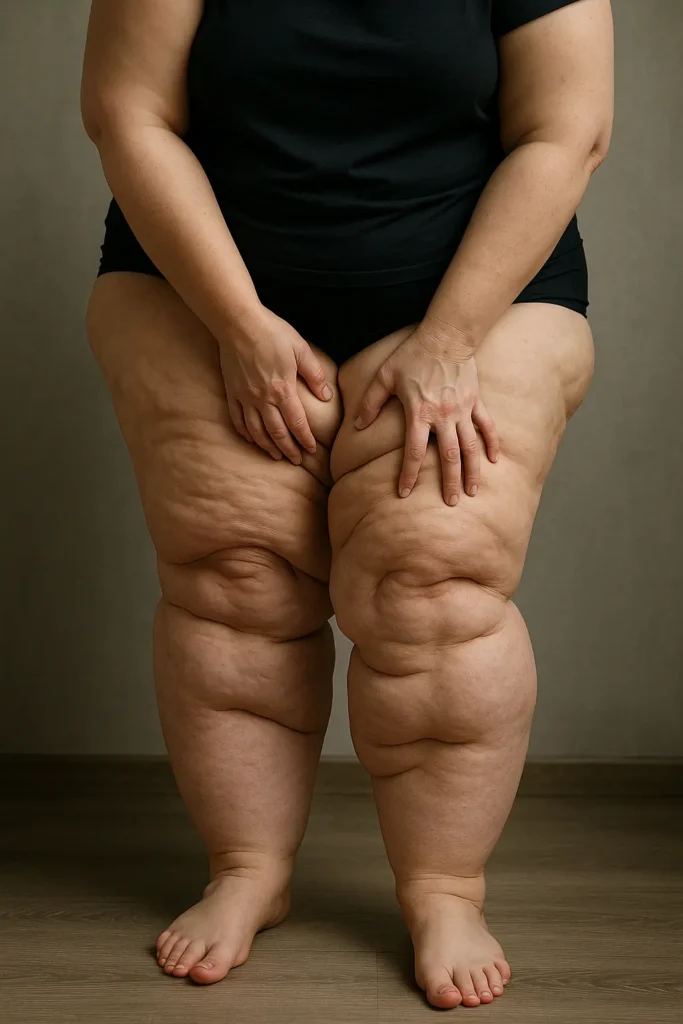
The fat accumulation pattern of lipedema is anomalous, symmetrical, and disproportionate:- Symmetry and Disproportion: Fat accumulates symmetrically in both lower extremities (legs, thighs, and hips), with a notable disproportion relative to the waist and torso. A patient may be thin in the torso and have excessive volume in the legs.
- Depth: Lipedema primarily affects the deeper fat, known as yellow fat or deep fat layer.
- Key Indicator: Fat accumulation spares the feet and hands. The fat stops at the ankles or wrists, creating a visible “cuff effect.”
Why Conventional Dieting is not Enough
This is the most frustrating characteristic for patients, and it is worth explaining precisely because it gets oversimplified:- The Tissue is Different: The adipose tissue of lipedema is anomalous and pathological and does not behave like ordinary fat under a calorie deficit.
- What Dieting Does Change: Where there is associated excess weight or obesity, losing weight does also bring leg volume down. This is why anti-inflammatory nutrition and exercise are baseline therapy in lipedema, not an optional extra.
- What it Does Not Change: The disproportion between limbs and trunk stays, and pain does not improve in proportion to the weight lost. A patient may slim down visibly in the face and abdomen and still have the same disproportion and the same discomfort in her legs.
- Differentiation: It is that persisting disproportion which sets lipedema apart from obesity and from cellulite, which does improve with healthy habits.
Genetic and Hormonal Origin (The real cause)
Lipedema is a condition with an etiology strongly linked to female biology:- Genetic Component: There is a strong genetic and hereditary predisposition. It is estimated that up to 50% of patients have a family history of the disease.
- Hormonal Influence: The disease is practically exclusive to women. Its onset or development usually coincides with periods of significant hormonal changes, such as puberty, pregnancy, or menopause. To learn more about the causes of this condition, we invite you to visit: What causes lipedema?.
Cellulite: What it is and Why it is not the Same as Lipedema
Cellulite is an extremely common skin condition affecting almost 90% of women at some point in their lives.Multifactorial Nature (Lifestyle, Hormones, Diet)
Unlike lipedema, which has an endogenous origin, cellulite is a multifactorial pathology (PEFE):- Lifestyle: Factors such as a sedentary lifestyle, an unhealthy diet (excess fat, sugar, and salt), smoking, and insufficient hydration are important contributing causes to its development.
- Biological Factors: Genetic predisposition and hormonal imbalances (estrogens, insulin, cortisol) also influence its appearance.
Superficial Accumulation and Improvement with Healthy Habits
Cellulite has a more superficial and local pathophysiology that makes it sensitive to habit modification:- Location: The accumulation of fat, fluid, and toxins occurs in the most superficial layers of the skin (areolar stratum).
- Response: Cellulite usually improves with healthy habits, regular physical activity, and overall weight loss.
The “Orange Peel” Appearance (Confusing Similarity)
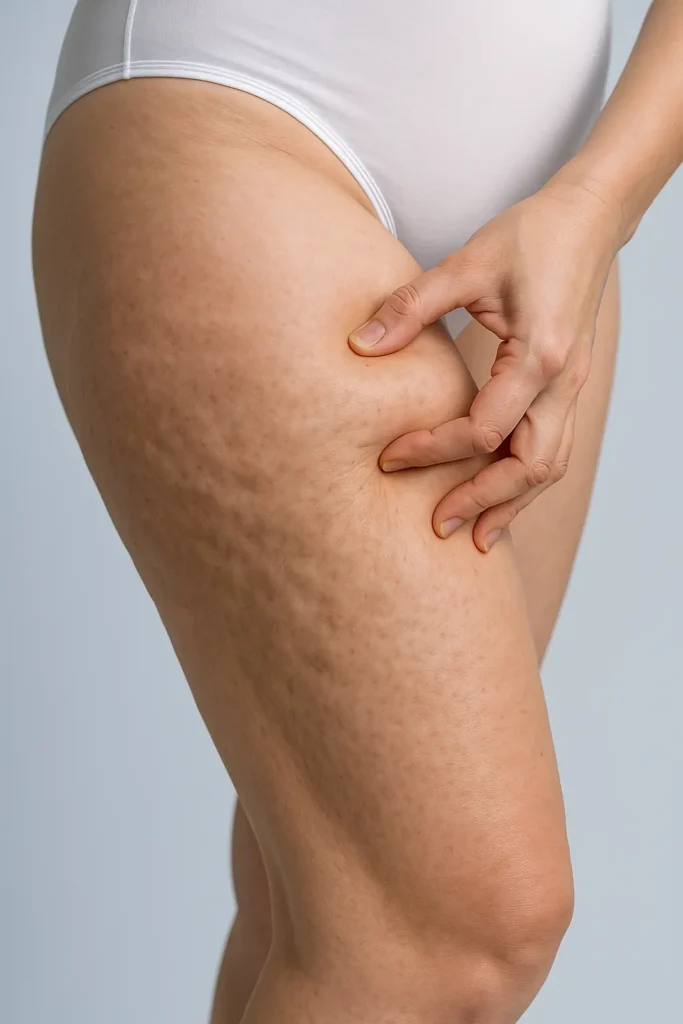
- Visual Manifestation: Cellulite is defined by the “orange peel” or dimpled appearance.
- Similarity: This rough texture can also be present in lipedema in its initial stages, leading to diagnostic confusion.
Lipedema or Obesity: Why They are not the Same
Lipedema is confused with obesity even more often than with cellulite, and the consequences are worse: this is the mix-up that delays diagnosis for years. In obesity, fat is distributed proportionally across the whole body, hands and feet included. In lipedema the accumulation is symmetrical and disproportionate, concentrated between the hips and the ankles (and often in the arms too), and it spares hands and feet. The clearest difference is pain: lipedema fat hurts when pressed, obesity fat does not.| Feature | Lipedema | Obesity |
|---|---|---|
| Fat distribution | Symmetrical and disproportionate, hips to ankles and often the arms | Proportional across the whole body |
| Hands and feet | Spared, with a visible step at the ankle | Also affected |
| Pain on pressure | Yes, characteristic | No |
| Easy bruising | Frequent (accompanying sign, not a diagnostic criterion) | Not characteristic |
| Response to calorie deficit | Reduces volume where there is associated excess weight, but does not correct the disproportion or the pain | Reduces volume across the body |
| Who it affects | Almost exclusively women | Both sexes |
- They can coexist: Lipedema and obesity often occur together. Obesity is an aggravating factor for lipedema, not an alternative explanation. Being overweight does not rule out the diagnosis.
- Dieting is not pointless: Where there is associated excess weight or obesity, losing weight does also reduce leg volume. What diet does not correct is the disproportion, and pain does not improve in proportion to the weight lost.
And the Knees: the Detail Most Often Mistaken
A fat pad on the inner side of the knee is characteristic of lipedema. It creates a step in the contour while the foot stays spared. Cellulite can appear over the knee, but it does not create that disproportion or that abrupt change in contour, and it does not hurt when pressed.Types and Stages of Lipedema: Why “Stages I to V” Is Misleading
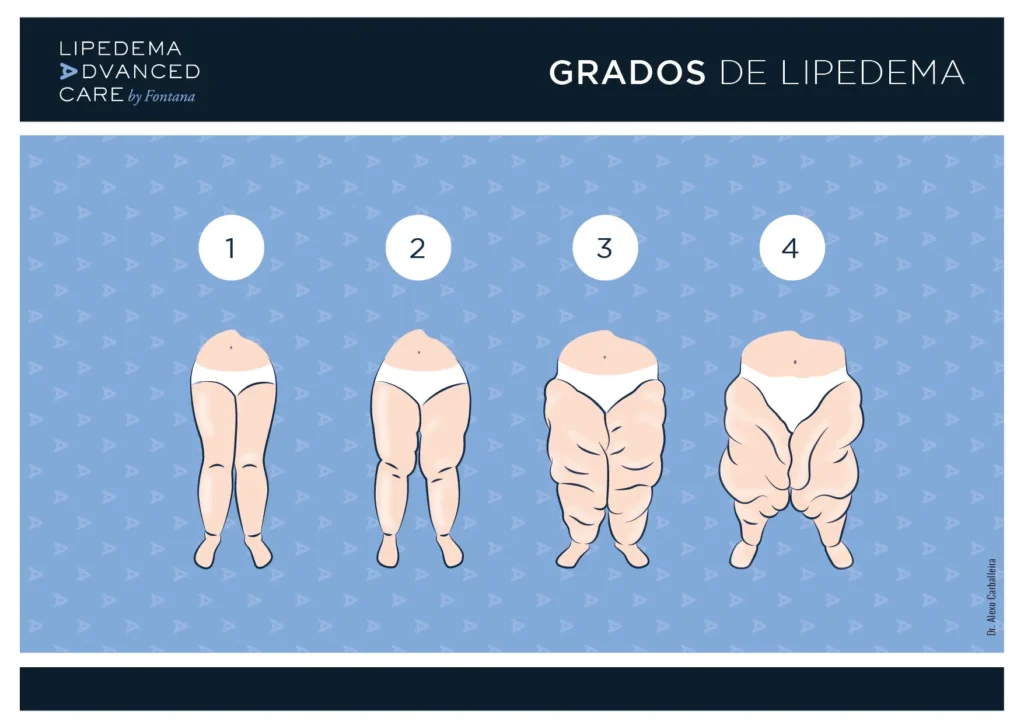
Lipedema is usually a progressive disease. Recent literature questions whether it always progresses, and inevitably: some patients remain stable for years. What does change the outlook is being diagnosed early and having the symptoms treated.The 5 Types of Lipedema by Affected Area
There is a very common confusion to undo here, because these are two separate classifications rather than one. The types (I to V) describe where the fat accumulates, and they are not stages: a patient with type III has not passed through type I first. The stages describe something else, how far the tissue has changed, and those do evolve. You will often see the types called “stages” or “phases”, which is the common informal usage, but they do not describe a progression:- Type I: Increased localized fat in the hips, buttocks and pelvis.
- Type II: Fat extends to the inner side of the knees, sometimes with the formation of “pads.”
- Type III: The affected area extends from the hip to the ankle.
- Type IV: Involvement of the arms occurs.
- Type V: Isolated involvement of the lower leg, from the knee to the ankle, sparing the foot.
Why Early Diagnosis Matters
The accumulation of lipedema fat compresses the lymphatic vessels, reducing their capacity to transport lymph.- This lymphatic dysfunction is the cause of swelling and heaviness that do not improve with nocturnal rest.
- When a lymphatic component is added to lipedema it is called lipo-lymphoedema, which is not one more type: it is a different situation, harder to manage, and unlike the types it can appear over time. It does not happen to every patient, and sustained conservative treatment, above all compression, is what can be offered today to reduce that risk.
Why Aesthetic Treatments Don’t Work for Lipedema?
Lipedema’s resistance to weight loss and conventional treatments is the cause of frustration for patients.- Proven Ineffectiveness: Aesthetic or body medicine treatments for cellulite (such as radiofrequency, mesotherapy, cryotherapy, shock waves, or wood therapy) are ineffective in the case of lipedema.
- Dieting Alone is Not Enough: Restrictive diets and intense exercise do not correct the disproportion or the pain, even where associated excess weight does bring volume down. This shows the cause is not a lack of willpower, but a chronic disease that requires a medical approach.
Specialised Surgical Treatment (WAL/PAL)
Given that lipedema fat is resistant to conventional methods, treatment requires a comprehensive and specialized medical approach.- Conservative Treatments: They are the pillar of symptomatic management. They seek to reduce pain and edema, but do not eliminate accumulated fat. They include compression therapy (stockings/leggings), Manual Lymphatic Drainage (MLD), physiotherapy, pressotherapy, and anti-inflammatory nutrition.
- Surgical Treatment: Specialized liposuction is considered the most effective option and the only one with immediate and long-term results for removing pathological fatty tissue.
- Key Techniques: Surgery must be performed by an expert team using techniques that preserve the lymphatic system. At Lipedema Advanced Care, we specialize in Water-Assisted Liposuction (WAL) and Power-Assisted Liposuction (PAL).
- Objective and Results: The goal is to remove excessive fat to alleviate pain and pressure, and improve functionality and the contour of the extremities.
Medical Content Reviewed
Medical content reviewed. This content was produced by the medical team at Lipedema Advanced Care and reviewed by Dr. Carballeira, plastic surgeon (SECPRE recertified) specialising in the treatment of lipedema, registered with the ICOMV (Official College of Physicians of Valencia). Meet Dr. Carballeira and the rest of the medical team. The information on this page is for general guidance and does not replace a medical consultation or diagnosis. Lipedema is a chronic condition: treatment and surgery aim to improve symptoms, function and body contour, but they are not a cure. Every case requires an individual assessment. Last updated: August 2026.
