
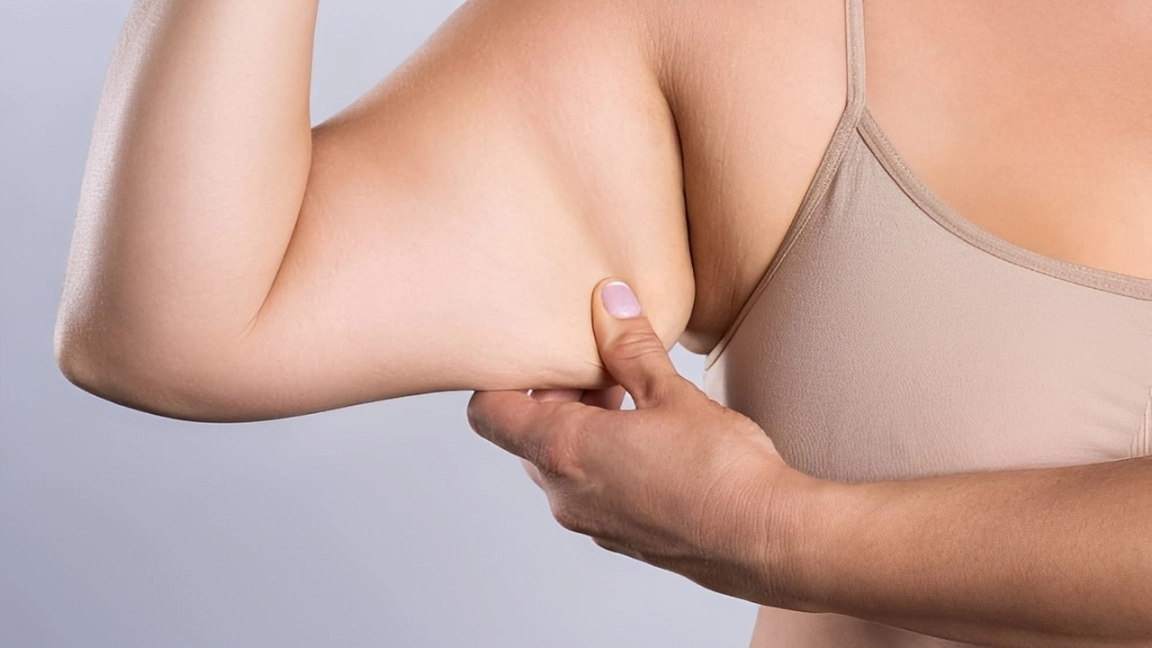
Lipedema in the arms is a disproportionate, symmetrical build-up of fat tissue in the upper limbs, painful to pressure and to touch, which spares the hands and leaves a visible step at the wrist. It appears or worsens during hormonal transitions: puberty, after a pregnancy, and around the menopause.
For too long this build-up has been misread as excess weight or as a supposed lack of discipline, leaving patients trapped in years of dieting, exercise and wrong diagnoses. At Lipedema Advanced Care we know that story. This page explains how lipedema in the arms is recognised today, how it is told apart from other causes, and what treatment options exist.
How lipedema in the arms is recognised
These are the criteria the current clinical guideline supports (S2k 037-012, version 5.0, 2024):
Symmetrical disproportion. Volume increases in both arms equally and is out of proportion with the rest of the body.
Pain on pressure and on touch, spontaneous pain, and a feeling of heaviness or tightness. This is the core criterion: without symptoms, lipedema is not diagnosed.
The hands stay out of it. The affected tissue stops before the hand and leaves a characteristic step at the wrist, the so-called cuff sign.
Onset tied to hormonal change: puberty, after a pregnancy, or around the menopause.
Negative Stemmer sign, which helps separate it from lymphoedema.
And two things that keep being repeated and no longer count as diagnostic criteria:
Nodular fat on palpation. The 2024 guideline expressly withdrew that criterion for lack of validity, with 100% panel consensus, even though it still appears in almost every source you will read.
Bruising easily. It is common and many patients report it, but the current state of the research does not allow it to be used as a decisive diagnostic criterion.
Diagnosing lipedema is a clinical judgement made by a doctor experienced in the condition. This list is there to help you organise what you will tell them in the consultation, not to diagnose yourself at home.
Can you have lipedema only in the arms?
Yes, and the opposite is also common: having it in the legs and the arms joining in later. The guideline records that the disproportion of lipedema always appears symmetrically, in the legs, in the arms or in both, and that it arises exclusively in the limbs: neither the trunk, nor the head, nor the neck are affected. In the classification by Kruppa and colleagues (2020), involvement of the upper arm corresponds to type IV, although the guideline itself warns that no numerical system can be recommended, because each source numbers them differently. If you want to place what you see, we go into it on the stages and types of lipedema.
What is lipedema in the arms?
Lipedema is a chronic disorder of fat tissue distribution that predominantly affects women. It is chronic, but one thing deserves a precision that is almost never made: the 2024 guideline states expressly that lipedema should not be understood as an inherently progressive disease, with 94.1% panel consensus, because whether it worsens depends on factors that differ from one patient to another. What does happen is that it can worsen during hormonal transitions.
When the disease shows in the upper limbs, it presents as an abnormal, typically symmetrical accumulation of fat tissue in the upper arm, particularly the triceps region, and it can extend to the forearm. A defining feature is that this fat stops abruptly: the hands are not affected, and the change of calibre towards the healthy area below is what is described as the cuff sign.
Lipedema in the arms is not a cosmetic problem: it is a medical condition that causes pain, limits mobility and carries a significant emotional weight.
How many women have it, and why the figures in circulation do not hold
You have probably read that lipedema affects 10% or 11% of women. We had that written on this very page and we have taken it down, because it does not hold up.
The guideline devotes a whole chapter to epidemiology and its conclusion is uncomfortable but clear: there are no prevalence studies that stand up to the current diagnostic criteria. The single most quoted figure, that “up to 11%”, comes from a 2003 textbook, was later retracted by its own author and does not appear in the editions published from 2012 onwards. Other figures in circulation come from highly specialised clinics, where patients concentrate by definition, and cannot be extrapolated to the general population.
The most honest data available come from a single centre: in a German family medicine practice, out of 815 women attending for any reason, 5% were diagnosed with lipedema; and among the 126 who came specifically because of leg pain, 32.5%. Those figures are useful to understand that this is not a rarity, and they are not a global prevalence.
Nobody knowing how many women have it changes nothing about your case. It only explains why for years nobody named it.
Why are my arms thick? Causes of lipedema in the arms
The exact cause of lipedema is not fully understood, but there is broad consensus that its origin is multifactorial: a genetic predisposition on which hormonal change acts.
Genetic factors
There is a clear family basis. Among the classic clinical criteria the guideline records is precisely that, in many cases, there are other women in the family with the same pattern of legs or arms. A linkage analysis in a three-generation family ruled out X chromosome markers and concluded that autosomal dominant inheritance is the more likely mode. There is still no validated genetic test to diagnose lipedema.
The role of hormonal change
Hormonal change acts as a trigger or an aggravating factor, and that explains why the disease predominantly affects women. It usually appears or worsens at:
Puberty.
Pregnancy and the postpartum period.
Perimenopause and menopause.
Symptoms of lipedema in the arms
Lipedema is told apart from ordinary fat by a set of symptoms that define its pathological nature. And there is a hierarchy among them that is almost never explained: pain is the criterion, and the rest accompanies it.
Pain and sensitivity to touch: the symptom that decides
Lipedema is a painful disease, and pain is the core diagnostic criterion. Without symptoms, lipedema is not diagnosed, however much volume there is.
Sensitivity to touch: the arms hurt. Pressure, a hug, the friction of clothing or a caress can cause a sharp pain that is hard to explain to anyone who does not have it.
Spontaneous pain and pain at rest: it can be constant or intermittent, and it appears without anyone touching the arm.
A feeling of tightness and heaviness, which many patients describe better than the pain itself.
What does an arm with lipedema look like?
It is the most searched question, and the visual answer is in the outline, not in the skin. The build-up is symmetrical and disproportionate relative to the torso: both arms, equally. The arm loses its natural taper towards the elbow and takes on a more cylindrical shape, described in the clinical literature as a “column-like” appearance, with the increase concentrated in the triceps region. And the clearest signal is where it ends: the fat stops before the hand and leaves a step at the wrist, with a normal-sized hand.
That means thick arms with the hands enlarged as well point to something else, and that the disproportion can occur even in women of normal or low body weight. We cover it alongside the rest of the picture on the lipedema symptoms page.
Persistent swelling in the arms
Many patients notice the arm swelling as the day goes on, with the feeling of tightness increasing in the afternoon, in the heat, or after long periods standing. Unlike swelling from fluid retention, the swelling of lipedema does not improve significantly when the limb is raised, because what lies underneath is mostly tissue, not fluid.
Bruising easily: common, but not a criterion
The tendency to bruise from minimal knocks, or with no apparent cause, is one of the things patients report most. It deserves an honest precision: the guideline states that, with the available research, it cannot be used as a decisive diagnostic criterion, and a 2023 comparative study failed to objectify that greater tendency to bruise against women without lipedema.
Put another way: bruising does not confirm lipedema, and not bruising does not rule it out. It is noted, it is taken into account, and it is not asked to carry the diagnosis.
Skin texture and nodules: what changed in 2024
Lipedema fat can feel denser than abdominal fat and, at times, nodules or lumps can be palpated that are painful to the touch. That is a real description of what many patients and many doctors find on examination.
What changed is its diagnostic value. The 2024 guideline withdrew the “nodular” fat criterion for lack of validity, with the highest possible consensus, 100% of the panel. We say it here because it is the exact opposite of what you will find on most websites, including the ones that rank above this one: nodularity is still published as though it were proof, and it is not.
Diagnosis of lipedema in the arms
Lipedema remains underdiagnosed, and years commonly pass between the first symptoms and the diagnosis. The main difficulty is confusion with other things that look similar.
How do I know if I have lipedema in my arms?
You cannot know at home, and any page telling you otherwise is selling you something. What you can do is arrive at the consultation with the information that matters, which is four things: whether the increase is symmetrical in both arms, whether it hurts on pressure or on contact, whether the hand stays out of it with a step at the wrist, and at what point in your life it started or worsened. With that, plus the examination, a doctor experienced in lipedema can orient the diagnosis in a single visit.
The full process, with what is examined and what is ruled out, is on the lipedema diagnosis page.
Clinical assessment by a specialist
Diagnosing lipedema is clinical. There is no test that confirms it, and what the tests do is rule out what resembles it.
Differential diagnosis: it must be separated from excess weight and obesity, from cellulite and from lymphoedema. With one nuance that matters: excess weight and lipedema coexist very frequently, so the useful question is not “is it one or the other?” but “is there lipedema underneath as well?”.
Physical examination: the specialist assesses the disproportion, pain on pressure, the step at the wrist, the Stemmer sign and the symmetry.
Complementary tests
Although the diagnosis is clinical, the specialist may use a vascular study with duplex ultrasound and other imaging to rule out venous disease, assess whether there is an added lymphatic component, and evaluate the state of the tissues.
Why it is worth not waiting
Naming what is happening changes the management: it allows the pain to be treated with what actually works, avoids years of dieting aimed at tissue that does not respond as expected, and makes it possible to decide, with proper criteria, whether surgery makes sense at some point.
How is lipedema in the arms treated?
There are two blocks and they do not compete with each other: conservative treatment, which is maintained throughout, and surgery, which is considered when conservative treatment fails to control the symptoms.
Conservative treatments
They are the backbone of symptom management and are part of every phase, before and after any procedure.
| Conservative therapy | What it aims for in the arm |
Compression therapy | Reduce pain and the feeling of tightness, and control oedema. That is the aim the guideline sets, with 100% consensus. |
Manual lymphatic drainage | Stimulate drainage to reduce swelling, pain and the feeling of heaviness. |
Adapted physical exercise | Improve mobility, maintain muscle and reduce pain. It is a key element, although it does not reverse the disease. |
Weight management and nutrition | Reduce inflammation and, where there is excess weight or obesity, help keep the picture from worsening. |
Compression therapy
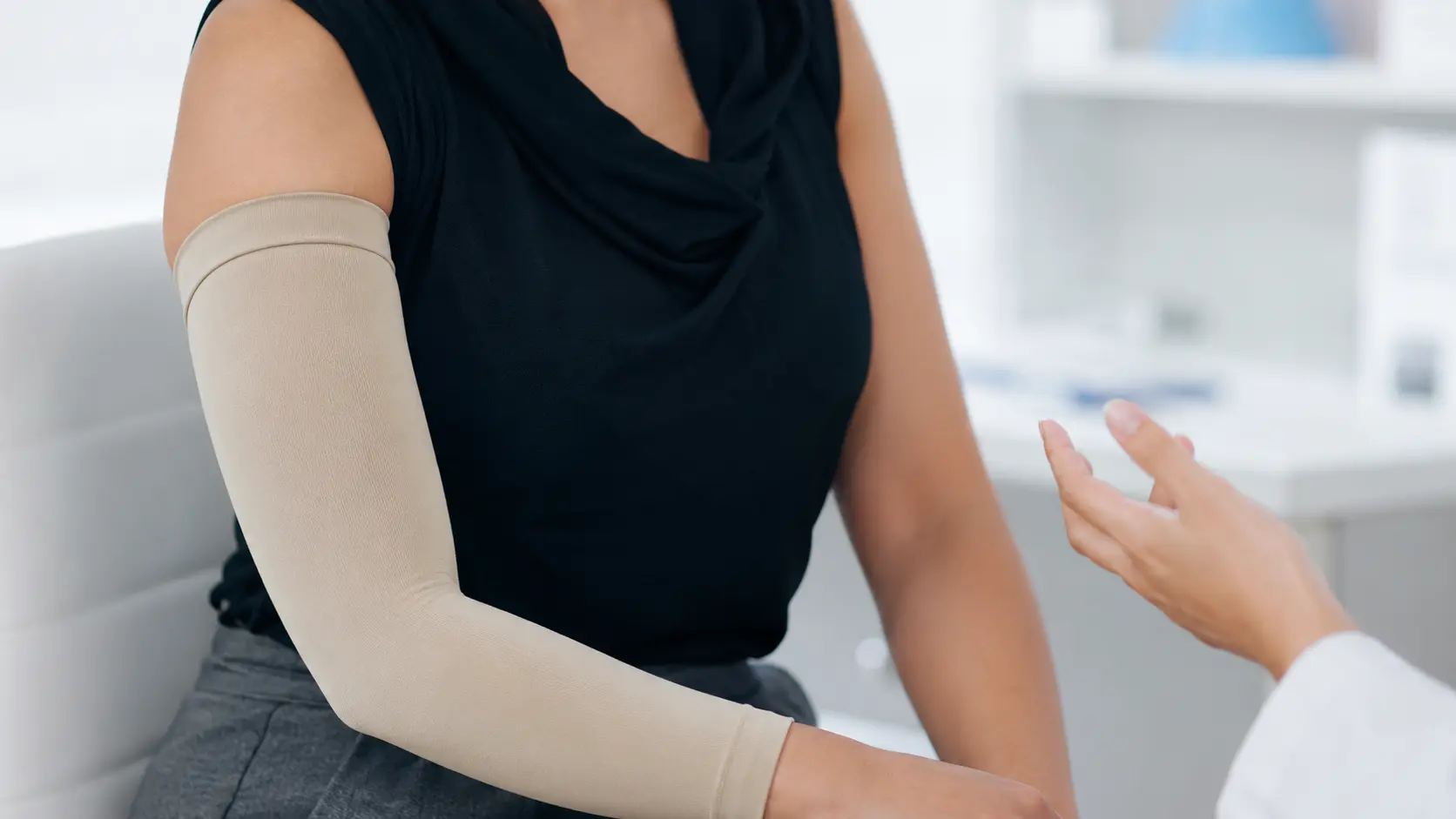
Wearing made-to-measure compression garments, sleeves or arm bands in the case of the arm, is the basis of conservative treatment. And there are three precisions the guideline puts in writing that are rarely read:
The aim is pain, not volume. The recommendation is explicit: in diagnosed lipedema, compression is used to reduce pain in the affected limbs.
There is no “lipedema compression class”. The guideline says expressly that a class must not be rigidly assigned to the diagnosis: it is adjusted to the location, the clinical findings and the intensity of the symptoms.
The lowest class that relieves is always preferred, because a garment you cannot wear is worth nothing. Adherence is part of the treatment.
Manual lymphatic drainage
Manual lymphatic drainage is a gentle massage technique, performed by a physiotherapist with specific training, that stimulates lymphatic circulation and helps reduce swelling, pain and the feeling of heaviness. Done properly it neither hurts nor leaves bruises.
Adapted physical exercise
Low-impact activity such as swimming, yoga or walking is recommended to improve mobility, reduce heaviness and activate the lymphatic system without aggravating the pain. Exercise is one of the elements with the most weight in reducing pain.
Nutrition and weight management
An anti-inflammatory way of eating, with more vegetables, fruit, quality protein and healthy fats, and fewer ultra-processed foods and less sugar, helps reduce inflammation and improves symptoms. And where there is excess weight or obesity, losing weight with an appropriate plan can help reduce volume and contributes to keeping the picture from worsening. What weight loss does not change is the disproportion: the distribution pattern remains that of lipedema.
Pain management
Analgesics and anti-inflammatories may be used for symptomatic pain control. In severe chronic pain, the specialist may consider medication for neuropathic pain. Always on medical indication, and never diuretics: the guideline is explicit that they must not be used to treat lipedema.
Surgery for lipedema in the arms: what it does and what it does not
When conservative measures fail to control the symptoms, liposuction is the indicated surgical option to remove the pathological fat tissue, relieve pain and improve mobility.
Is there a cure for lipedema in the arms?
No. And it needs saying before anything else, because it is the most searched question and the worst answered. The clinical guideline puts it without margin: lipedema is not cured by liposuction. What surgery can achieve is durable pain relief and an improvement in quality of life. That is not a small thing: for many patients it is the difference between living with the arm and organising the day around it. But it is not a cure, and anyone presenting it as one is promising something they cannot support.
After surgery, conservative treatment continues, adjusted to whatever symptoms remain, with attention to mobility, weight stability and stress regulation.
Liposuction techniques used in lipedema
The techniques used in lipedema are specific: unlike cosmetic liposuction, they aim to be less traumatic and to preserve the lymphatic structures.
Tumescent liposuction: a solution is infiltrated that facilitates removal, reduces blood loss and improves postoperative pain control.
Power-assisted liposuction (PAL): uses a vibrating cannula for more even removal, useful in large areas.
The full approach, with indications and what has to be assessed beforehand, is on the lipedema surgery page.
WAL liposuction for lipedema in the arms
Water-assisted liposuction (WAL) is the technique we use preferentially at Lipedema Advanced Care for lipedema of the arms. It uses a gentle jet of fluid to separate and aspirate the pathological fat tissue.
What the technique contributes
| Feature | What it means for the patient |
Less tissue trauma | By separating the tissue with water pressure rather than fragmenting it, the vascular and lymphatic structures of the area are better preserved. |
A more manageable recovery | Less trauma translates into a quicker return to ordinary activity. |
Less bruising and swelling | The gentleness of the method reduces bruising and inflammation in the first weeks. |
Contour control | It allows more even removal, which matters especially in an arm, where any irregularity shows. |
Aftercare: what is not optional
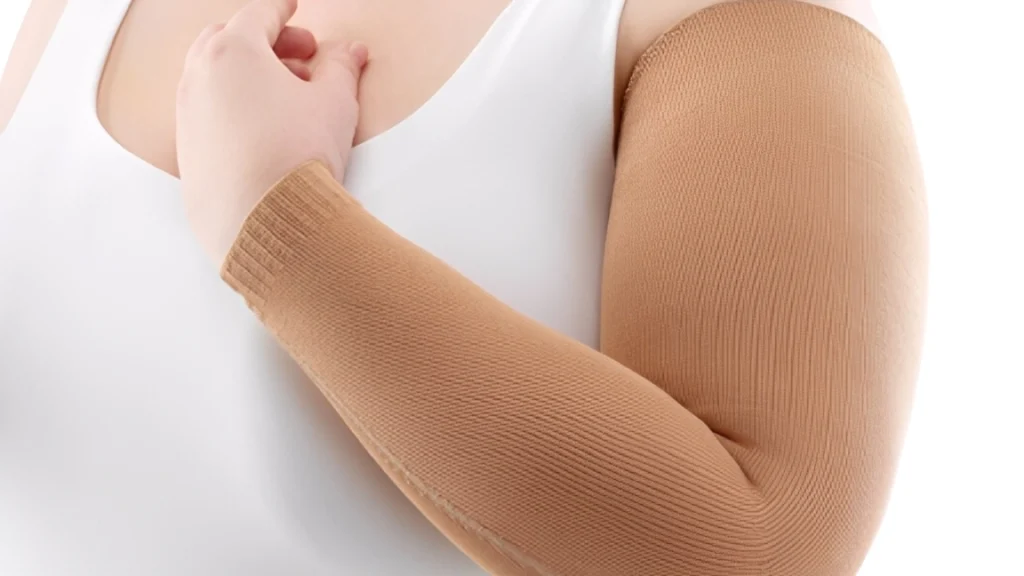
Compression: wearing the garment is mandatory during recovery, to control inflammation and support even healing.
Early mobilisation: gentle walking from the same day is recommended, to support circulation and reduce the risk of thrombosis.
Postoperative lymphatic drainage: the guideline recommends starting decongestive therapy immediately after the procedure, adjusting intensity and duration to each patient’s postoperative course.
Timescales: most patients return to non-demanding work within one or two weeks. Returning to all physical activity usually takes four to six weeks.
Results: what has been measured, and over how many years
Symptom improvement: marked improvements have been documented in spontaneous pain, pain on pressure and the tendency to bruise, as well as mobility. Many patients notice the change within the first weeks.
Durability: a long-term follow-up study measured spontaneous pain and pain on pressure at 4, 8 and 12 years after liposuction, and found a significant reduction sustained at all three points. That is what has been measured: less pain at twelve years, not the disappearance of the disease.
Brachioplasty (optional): in advanced cases where removing the fat leaves excess skin, an arm lift may be considered as a second surgical step. It is recommended sequentially: liposuction first, then the lift.
Long-term management
Lipedema is chronic, so treatment is planned over years rather than as an episode.
A personalised treatment plan
Our medical team, covering plastic surgery, vascular surgery, physiotherapy and nutrition, designs a plan that integrates conservative treatment beforehand, surgery where it is indicated, and aftercare. Consultations are held in Spanish and English.
Emotional support
Lipedema carries a deep emotional burden, and in the arm there is something specific about it: it is an area clothing cannot hide. We offer support to manage that impact, which is part of the picture and not an accessory to treatment.
Follow-up
Continued follow-up makes it possible to adjust compression, exercise and pain management over time, and to notice early if something changes.
Daily care for lipedema in the arms
Keep to the compression prescribed, in the class you can genuinely wear all day.
Sustain low-impact exercise, one of the measures with the greatest effect on pain.
Maintain manual lymphatic drainage as indicated by the physiotherapist.
Look after nutrition and weight, without turning it into a fight against the disproportion, which does not depend on that.
Report changes: a sudden increase, new pain, or swelling that also affects the hand are not “the usual”.
Lipedema or a thick arm from excess weight: how they are told apart
Many women arrive here having been told their arms are simply fat, or living it that way themselves. Clinically, a thick arm caused by excess weight is not the same as an arm with lipedema, and the difference matters because the treatment is different:
| Criterion | Lipedema in the arms | Excess weight or obesity | Cellulite |
Symmetry and distribution | Symmetrical in both arms and disproportionate relative to the torso. | More general accumulation throughout the body, tending to be proportional. | Localised surface change, with dimpling, mainly on hips, thighs and buttocks. |
Pain and tightness | Frequently painful on pressure and on contact, with heaviness. This is the core criterion. | Usually not painful. | Not usually painful. |
Step at the wrist | Yes: it stops before the hand and the hand stays normal. | No: the increase continues gradually towards the hand. | Not applicable. |
What persists after substantial weight loss | The disproportion: the distribution pattern remains that of lipedema. | Volume falls proportionally across the body. | It may improve, and the skin appearance often persists. |
How it started | Tied to hormonal change: puberty, pregnancy, perimenopause. | Gradual, related to energy balance. | Appears over the years, with no defined hormonal trigger. |
Stemmer sign | Negative in pure lipedema. If positive, it points to added lymphoedema. | Negative. | Negative. |
The weight-loss row deserves a nuance, because it gets repeated in absolute terms. Lipedema fat does not respond to a calorie deficit the way ordinary fat does, but where there is also excess weight or obesity, losing weight with appropriate nutrition can help reduce volume, and weight management contributes to keeping the picture from worsening. Exercise, for its part, is a key element in reducing pain, although it does not reverse the disease.
And an important precision: excess weight and lipedema are not mutually exclusive, they are the most frequent combination. In a person with obesity, pain on pressure and the feeling of tightness still point to lipedema possibly being there as well, and they are reason enough to have it looked at.
If your arms have been like this for years and nobody has explained why
It is the most common situation we see, and it is not the patient’s fault. Our assessment includes examination, a vascular study to rule out venous disease and identify any lymphatic component, and a written report with the findings. You leave knowing what you have, and if it is not lipedema, that too.
You can request an assessment with our team in Valencia.
Sources and references
Guideline S2k Lipoedema, AWMF 037-012, version 5.0 (2024). For the current diagnostic criteria, recommendation 2.5 on nodular fat, 2.10 on the disease not being inherently progressive, recommendations 4.1, 4.9 and 4.10 on the aims of compression, chapter 3 on epidemiology, and the statement that lipedema is not cured by liposuction.
Kruppa P, Georgiou I, Biermann N, Prantl L, Klein-Weigel P, Ghods M. Lipedema: Pathogenesis, Diagnosis, and Treatment Options. Deutsches Ärzteblatt International, 2020. For typing by location.
Baumgartner A, Hueppe M, Meier-Vollrath I, Schmeller W. Improvements in patients with lipedema 4, 8 and 12 years after liposuction. For the long-term follow-up of pain.
Carballeira Braña A, Poveda Castillo J. The Advanced Care Study: Current Status of Lipedema in Spain. Int J Environ Res Public Health, 2023;20(17):6647. View on PubMed
World Health Organization. ICD-11, code EF02.2 Lipoedema.
Reviewed by Dr Carballeira, specialist in Plastic, Aesthetic and Reconstructive Surgery and medical director of Lipedema Advanced Care.
Published on 17 October 2025 · Reviewed on 3 September 2026.
This page is for information purposes and does not replace a medical consultation. Diagnosing lipedema is a clinical judgement and must be made by a professional experienced in the condition.

