WAL liposuction for lipedema
WAL liposuction (Water-Assisted Liposuction) is one of the reference techniques in lipedema surgery because of its lymph-preserving nature. A fine pressurised saline jet releases the fat cells while respecting the blood vessels and lymphatic channels. Here we explain how it works, when it is indicated, how it differs from other techniques and what recovery is like.
What WAL liposuction is
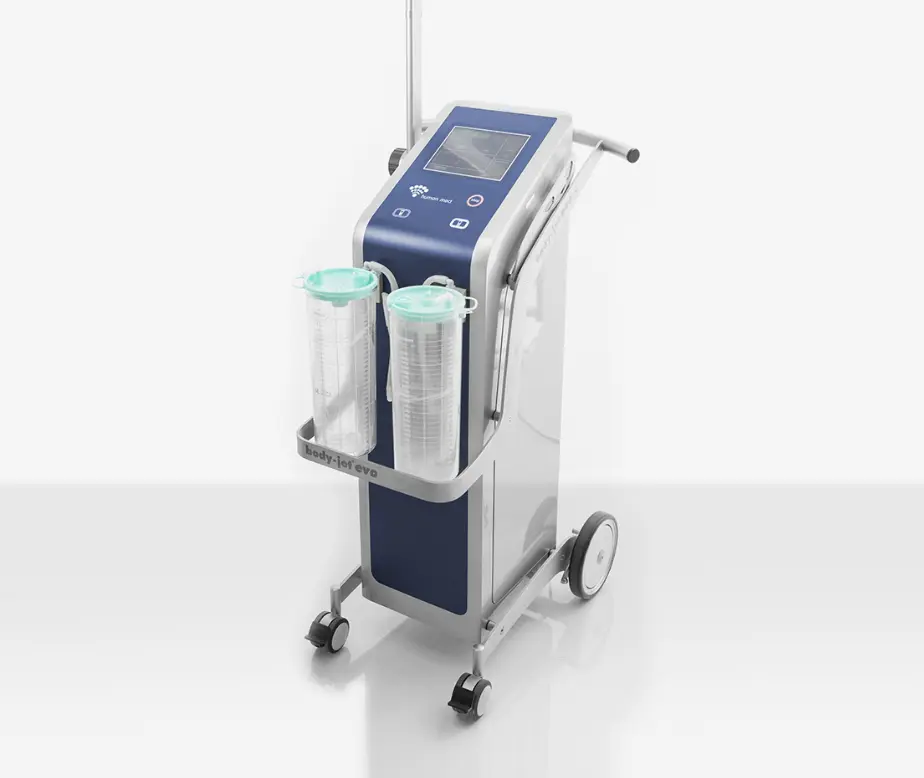
WAL stands for Water-Assisted Liposuction (also known as body-jet). Instead of releasing the fat by mechanical force, it uses a fan-shaped pressurised saline jet that gently separates the fat cells from the tissue before they are aspirated.
That way of working makes the technique especially respectful of the structures that must be preserved in lipedema: blood vessels and lymphatic channels. It is one of the core techniques of our lipedema surgery, within the Advanced Care Method.
Why WAL is a reference technique in lipedema
Lipedema is not ordinary fat: it is diseased adipose tissue, often painful and prone to bruising. The goal of surgery is not cosmetic but therapeutic: to reduce the volume of diseased tissue and ease symptoms while preserving lymphatic function.
Lymphatic preservation
WAL allows a gentle approach that reduces trauma to the lymphatics, a critical point because advanced lipedema can be associated with a lymphatic component (lipo-lymphoedema).
Is WAL always the best option?
Some clinics question WAL against other technologies. The clinical reality is that there is no single best technique for everything: in lipedema we prioritise lymphatic preservation and safety, and we often combine WAL with PAL depending on the tissue and the area. The decision is medical and individualised.
WAL versus traditional cosmetic liposuction
Although they share the name "liposuction", lipedema surgery and cosmetic liposuction differ in goal, starting point and follow-up.
| Aspect | Cosmetic liposuction | WAL liposuction in lipedema |
|---|---|---|
| Goal | Reshape body contour | Therapeutic: reduce diseased tissue and ease symptoms |
| Starting point | No underlying disease | Prior medical and vascular diagnosis |
| Tissue treated | Healthy fat | Lipedema fat, often fibrous and painful |
| Lymphatic preservation | Not the focus | Central goal of the technique |
| Follow-up | Cosmetic | Structured medical after-care |
Lipedema is a chronic condition; surgery reduces the diseased tissue and improves symptoms, but does not cure it.
WAL, PAL, VASER or tumescent liposuction: which and when
These are the liposuction techniques that come up in lipedema. The column that is almost never compared -and which is decisive for us- is preservation of the lymphatic system.
| Technique | How it works | Best for | Lymphatic preservation | Typical recovery |
|---|---|---|---|---|
| WAL (water) | Pressurised saline jet that releases the fat | Large volumes with a gentle approach | High: respects vessels and lymphatics | Usually associated with less bruising |
| PAL (vibration) | Vibrating cannula, power-assisted | Fibrous tissue and large areas | High with a specialised team | Even, moderate |
| VASER / UAL (ultrasound) | Ultrasound that liquefies fat before aspiration | Dense fibrosis and definition | Variable: heat requires careful technique | Moderate |
| Tumescent / traditional | Infiltration and manual aspiration with a cannula | Small volumes, cosmetic use | Less specific control over lymphatics | Variable |
The choice and combination of techniques is always a medical, individualised decision.
When it is indicated and in which areas
Surgery is considered when lipedema is diagnosed and its symptoms (pain, heaviness, disproportion, limited mobility) affect quality of life, always alongside conservative care. The typical areas are the legs and arms.
Indication also depends on the lipedema stage. See the staging classification and the approach criteria in the Advanced Care Method.
WAL within the Advanced Care Method
The technique is one part of the result; the protocol is the rest. In the Advanced Care Method, WAL is part of a sequence coordinated by the same team:
Recovery, step by step
Recovery is gradual and is part of the result: compression, lymphatic drainage and medical follow-up until the tissues adapt over several months. We break it down by phases, with its care and timings, in lipedema surgery recovery.
Questions about WAL liposuction
What is WAL liposuction?
It is water-assisted liposuction: a pressurised saline jet releases the fat before it is aspirated, in a way that is gentler on vessels and lymphatics.
Why is it used in lipedema?
Because it respects the lymphatic system during extraction, which is key in a disease that can involve a lymphatic component.
Can all the lipedema be treated in a single operation?
It depends on the volume and areas. It is often planned in several stages for safety; the decision is medical and individualised.
Can I have surgery if I had failed cosmetic liposuctions before?
It is usually possible, but it requires a specific assessment of the tissue and previous surgeries. Request an assessment to review it.
Can any surgeon operate on lipedema?
It is not advisable: lipedema requires specific experience and lymphatic preservation, unlike cosmetic liposuction. Meet the medical team.
What about skin laxity after removing the fat?
If laxity appears or there is a risk, Renuvion® can be added to support skin retraction.
WAL or PAL?
They are complementary and often combined. The choice depends on the tissue, the area and the goal. See PAL liposuction.
How long is recovery?
Light activity usually resumes within a few weeks and the result settles over several months. See recovery.
Does surgery cure lipedema?
No. Lipedema is chronic and has no cure; surgery reduces the diseased tissue and improves symptoms, but management continues.