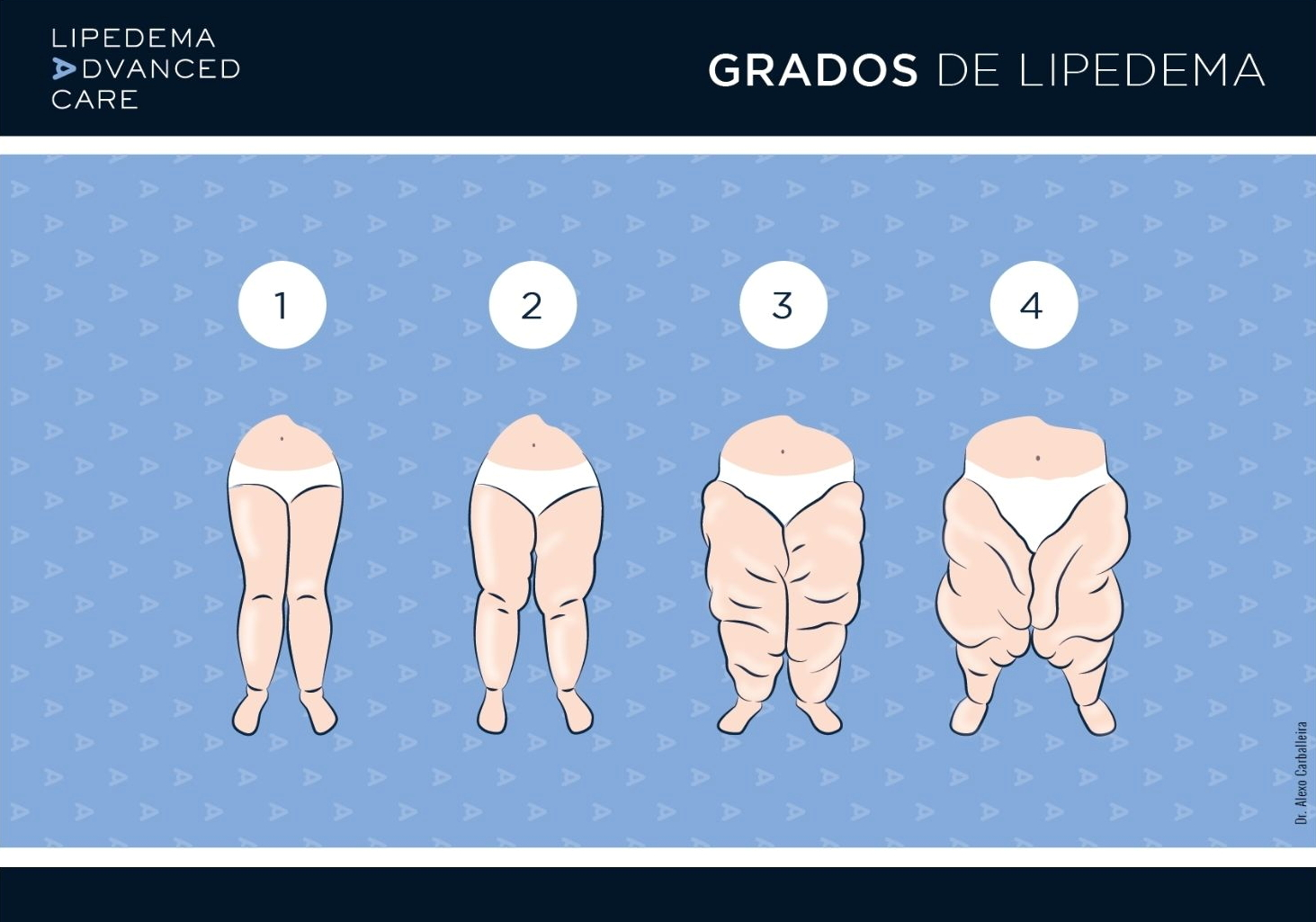
Lipedema is classified in two different ways that are often confused: by stages (1 to 4, according to how the skin and tissue evolve) and by types (I to V, according to where the fat accumulates). Here we explain both with our own illustrations, so you can place your case and understand what each stage involves.
When a patient searches for "stages of lipedema" she is usually trying to answer one very specific question: where am I?. And that is where the first confusion appears, because lipedema has two classifications that do not mean the same thing and are often mixed up.
The stages from 1 to 4, which you will also see as grades or phases, describe the state of the tissue and the skin: whether the surface is smooth, whether there are nodules, whether there are lobules of fat that hang. The types (I to V) describe where the fat accumulates: hips, thighs, down to the ankle, arms or only the calves. When the build-up reaches the upper limbs, we look at it in lipedema in the arms.
In other words: the stage tells you how far it has advanced, the type tells you which areas it affects. Every patient always has both: for example, a type III lipedema at stage 2.
This is the table that settles the most repeated question in consultation. Both classifications are complementary and are used together.
| Stages (1 to 4) | Types (I to V) | |
|---|---|---|
| What it describes | The state of the skin and the fat tissue | The anatomical distribution of the fat |
| Question it answers | How far has it advanced? | Which areas does it affect? |
| Can change over time | It can, but it is not the rule | Usually stays the same, although it can extend |
| Example | Stage 2: skin with waviness and nodules | Type III: from hips to ankles |
Indicative classification for educational use. Your stage and type are determined by an experienced professional through clinical examination.
Each stage describes a state of the tissue, not a sentence: lipedema does not evolve the same way in every patient, and the stage alone does not decide the treatment.
It is worth knowing that there is no single official classification. The classic morphological description (Meier-Vollrath and Schmeller, 2004) sets out three stages, and many centres add a fourth when lymphoedema is added to the lipedema (lipo-lymphoedema). We use the four-stage nomenclature because it is the most widespread and the one patients search for, but with an important caveat: the German S2k guideline on lipedema (AWMF 037-012, 2024) recommends understanding these stages as a description of the appearance of the tissue and not as a measure of the severity of the condition, because volume and skin appearance do not correspond to the intensity of the pain or the impact on daily life. The lymphatic component, moreover, can be present at any stage and not only at the fourth.
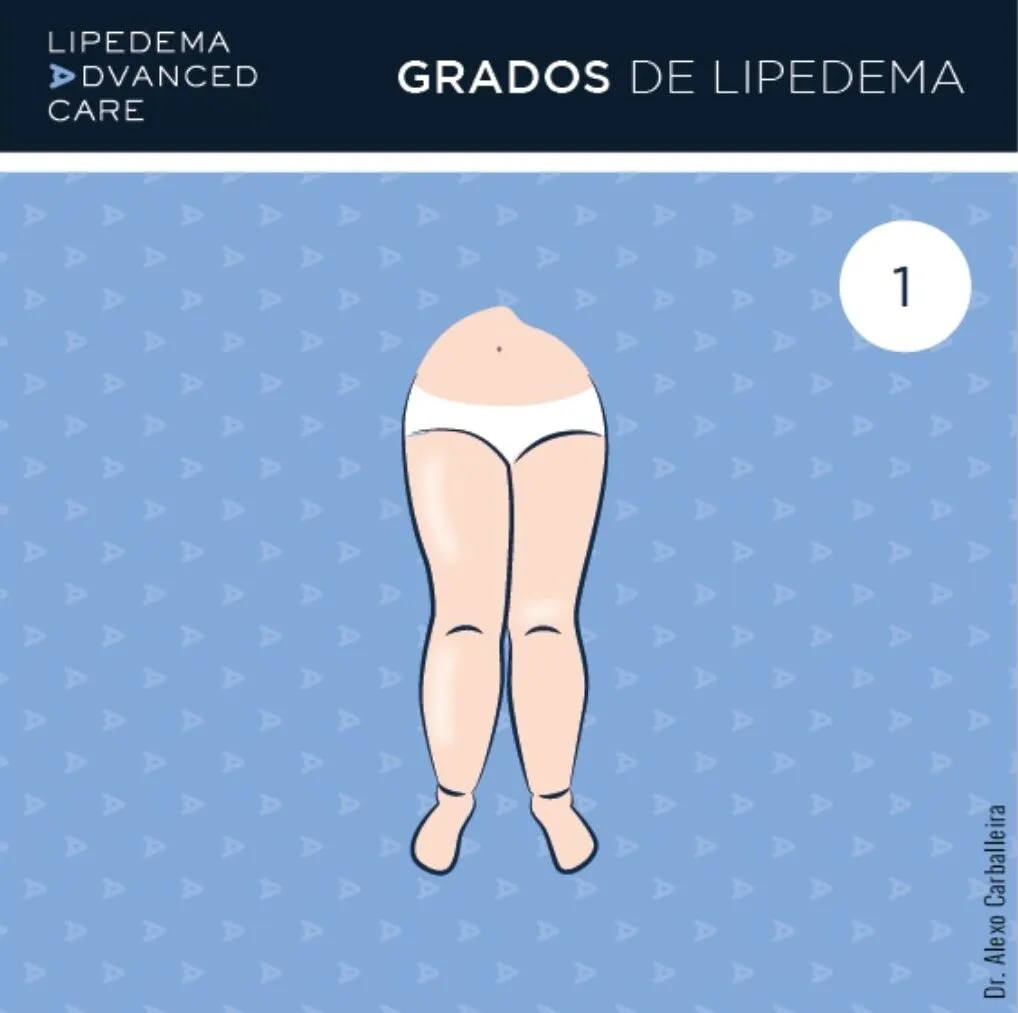
Stage 1 lipedema is the earliest phase: to the eye the skin looks smooth and even. The change is underneath. On palpation you can feel small nodules, like grains of rice or peas, and the tissue is denser than normal. It is what many patients know as "mild lipedema".
It is the stage that takes longest to diagnose, precisely because "there is nothing to see". Many women spend years here being told it is a matter of diet, or that it is cellulite. The difference lies in three details that cellulite does not have: it hurts on pressure, bruises appear easily and the disproportion is symmetrical in both legs or both arms. We compare them in lipedema or cellulite.
Is it worth seeking advice at stage 1? Yes. It is the point at which conservative management (compression, drainage, habits) has the most room to control symptoms, and at which a correct diagnosis saves years of the wrong approach. It does not mean you need surgery: it means knowing what you have.
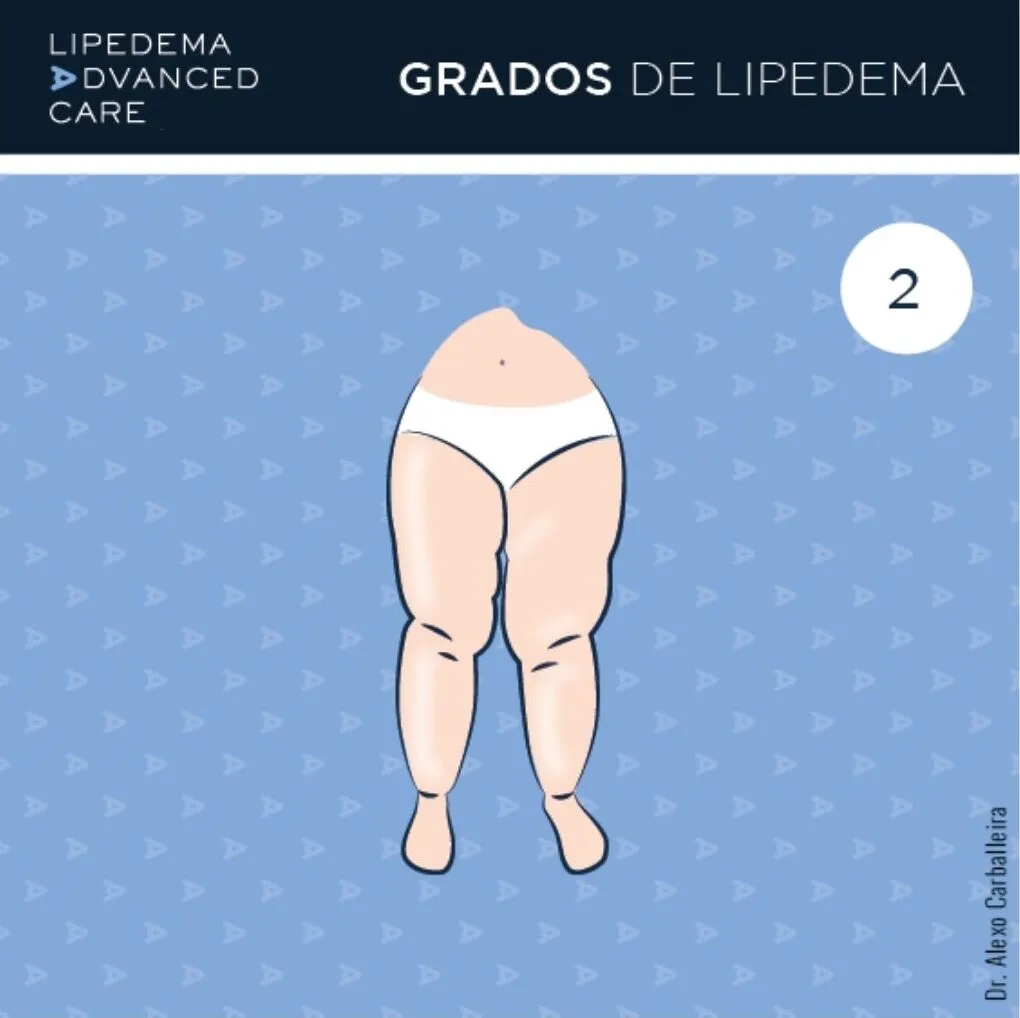
The skin is no longer smooth: visible waviness and irregularities appear, and the nodules are larger and easier to locate by touch. The feeling of heaviness usually increases.
Here the disproportion between legs or arms and the trunk is normally obvious, and it is often mistaken for cellulite. We look at it in detail in lipedema or cellulite.
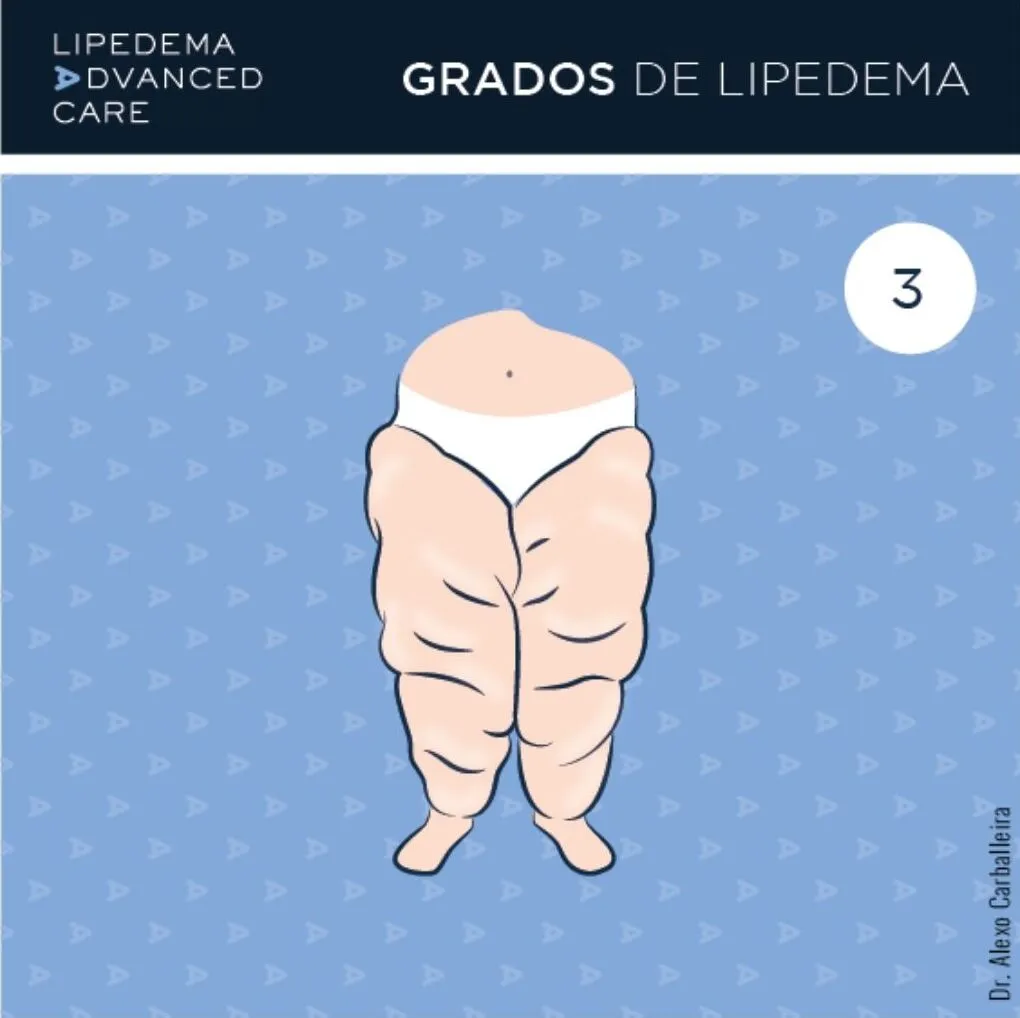
The tissue forms lobules of fat that deform the contour, especially on the inner thighs and knees. The skin is harder and the volume can make walking difficult or cause rubbing between the legs.
At this point the impact is no longer only aesthetic or only painful: it is functional, and it is usually when lipedema surgery is most clearly considered.
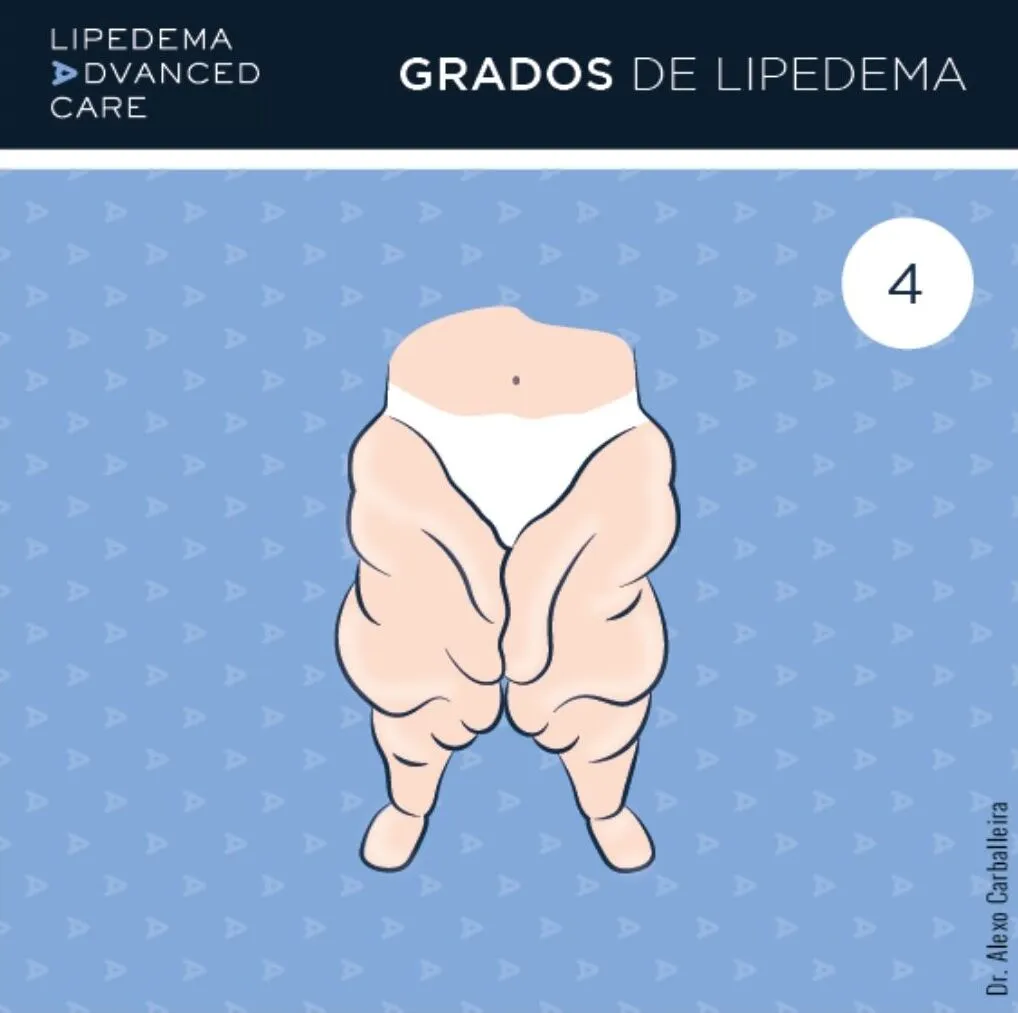
A lymphoedema is added to the lipedema: the lymphatic system stops draining properly and persistent swelling appears which, unlike pure lipedema, can affect the feet.
This is the scenario that benefits most from an approach that protects the lymphatic system, both in conservative management with manual lymphatic drainage and in surgery.
| Stage | Appearance of the skin | Tissue | Usual impact |
|---|---|---|---|
| Stage 1 | Smooth | Small palpable nodules | Pain on pressure, easy bruising |
| Stage 2 | Wavy and uneven | Larger nodules | Heaviness and clear disproportion |
| Stage 3 | Deformed, with lobules | Fibrous and hardened | Limited mobility |
| Stage 4 | Added swelling, fibrosis | Lipedema + lymphoedema | Functional deterioration; can affect the feet |
The stage guides the approach, but does not decide it on its own: how much lipedema affects your quality of life weighs just as much.
While the stage looks at the tissue, the type looks at the map of the body. It is a descriptive classification: it helps plan which areas need treating, not measure severity. In the legs, types I to III describe how far up the fat reaches; type IV is the arm type and type V the one confined to the lower leg.
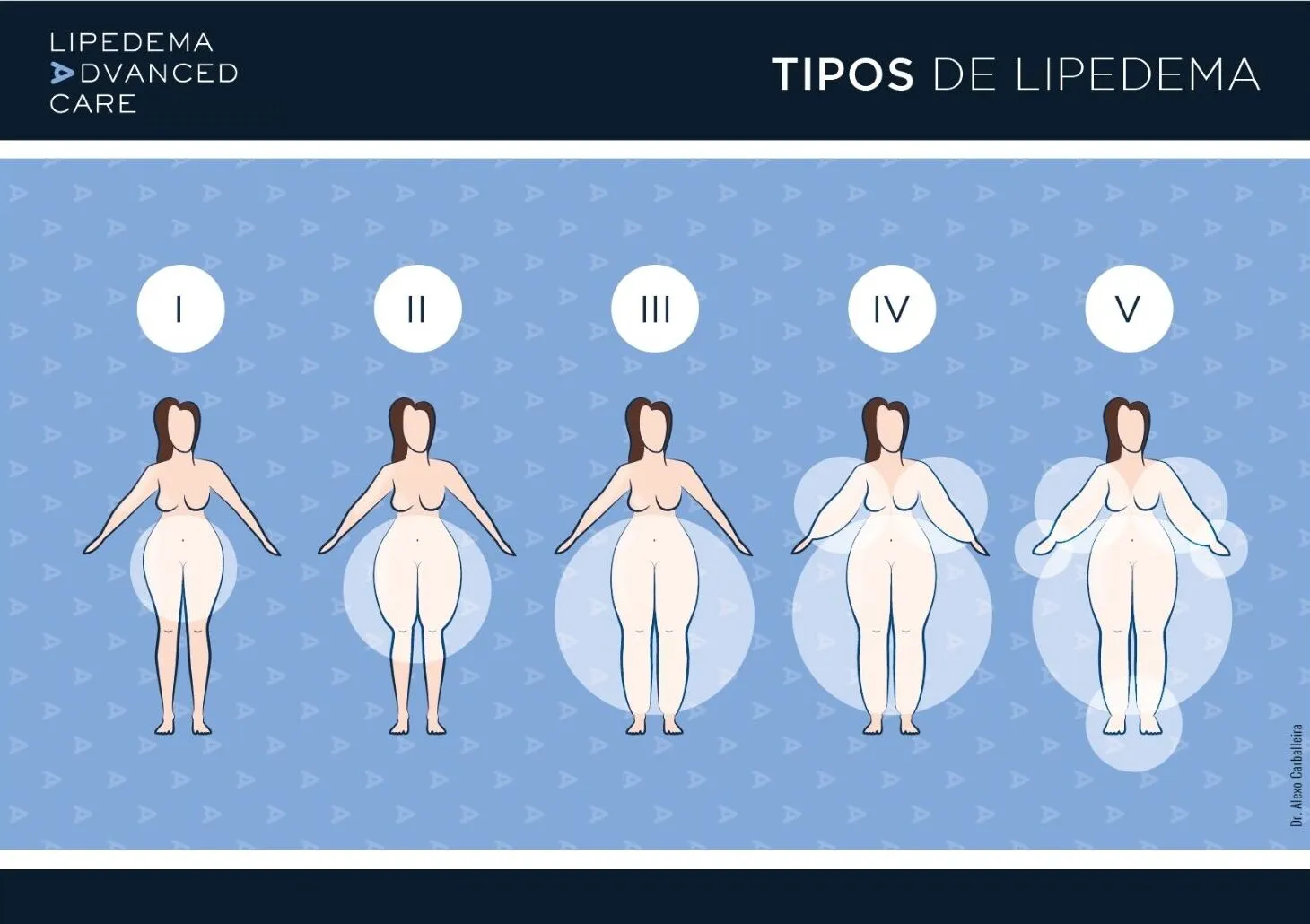
| Type | Affected area | Characteristic feature |
|---|---|---|
| Type I | Hips, buttocks and pelvis | Volume concentrated in the pelvic area |
| Type II | From hips to knees | Build-up in the thighs, with knees affected |
| Type III | From hips to ankles | The most reported in The Advanced Care Study (41.7%, Schingale classification); spares the feet |
| Type IV | Arms | Can appear alone or alongside other types |
| Type V | Calves | Isolated involvement of the lower leg |
Types can combine: it is common, for example, to see a type III with arm involvement (type IV). The frequency data comes from The Advanced Care Study (IJERPH, 2023), a survey answered by 1,069 people in Spain (969 analysed): according to the Schingale classification (types I to IV), the type most reported by participants was the one affecting the hips, thighs and calves (41.7%), followed by the one that adds arm involvement (36.8%). Proportions vary across other series.
One feature repeats across every type: lipedema spares the hands and the feet, which is why a clear step is often visible at the ankle or the wrist. When the foot is affected, a lymphatic component or lipo-lymphoedema should be considered, which can appear at any stage.
Not necessarily. Lipedema is a chronic condition and it can progress, but not every patient goes through all four stages or does so at the same pace. Some women stay at the same stage for years.
A prospective Spanish study of 100 patients with a mean follow-up of 4.6 years (Forner-Cordero and Muñoz-Langa, Vascular Medicine, 2025) found that lipedema remained stable in 62% of the women, progressed in 28% and improved in 10%. Progression was not linked to age, but to an increase in abdominal fat. This is why the German S2k guideline (2024) recommends not regarding lipedema as a necessarily progressive condition.
What we do know is that certain hormonal moments (puberty, pregnancy, menopause) tend to coincide with changes, and that conservative management and follow-up help control the symptoms. No classification replaces a medical assessment: two people at the same stage may need different plans.
Knowing your stage is useful above all to guide the plan. This is the general logic we follow in the Advanced Care Method, always adjusted to each case.
| Stage | Usual approach | Goal |
|---|---|---|
| Stage 1 | Conservative: compression, drainage, habits | Control symptoms and limit the impact |
| Stage 2 | Conservative + surgical assessment | Assess whether surgery brings functional improvement |
| Stage 3 | Surgery + conservative management | Reduce diseased tissue and restore mobility |
| Stage 4 | Lymph-preserving approach and lymphoedema control | Protect the lymphatic system and ease the swelling |
Indicative. The indication for surgery is not decided by the stage: current guidelines (S2k, 2024) recommend basing it on symptoms, functional impact and vascular status, because the appearance of the tissue does not correspond to the intensity of the pain. The stage helps to plan, not to decide.
When surgery is indicated, the technique is also chosen according to the tissue: WAL liposuction as the lymph-preserving base, PAL liposuction for the more fibrous tissue of advanced stages and, if laxity remains after removing volume, Renuvion®.
The stage and the type are determined clinically: through the patient's history and a physical examination by an experienced professional, assessing the texture of the tissue, the distribution of volume and pain on palpation. There is no single test that gives it, although the vascular study and the 3D scan help document it and measure progress.
Four. From stage 1 (smooth skin with palpable nodules) to stage 4 (lipo-lymphoedema, with an associated lymphatic component). They describe the state of the tissue and the skin.
It is the earliest phase of lipedema: the skin looks smooth, but on palpation you can feel small nodules and the tissue is denser. Pain on pressure and easy bruising may already be present. It is the stage that takes longest to diagnose because there is nothing to see, and it is often mistaken for cellulite.
Stages (1 to 4) indicate how far the condition has advanced in the tissue; types (I to V) indicate which areas of the body it affects. Every patient has a stage and a type at the same time.
It is determined by an experienced professional through clinical examination, assessing the texture of the tissue and the distribution of volume. You can get an initial idea with the lipedema test.
Not necessarily. A prospective Spanish study of 100 patients (Forner-Cordero and Muñoz-Langa, 2025) found that lipedema remained stable in 62% of the women, progressed in 28% and improved in 10%. Hormonal changes tend to be sensitive moments.
It is lipedema with an added lymphoedema: there is persistent swelling and, unlike pure lipedema, it can also affect the feet.
Lipedema is chronic and has no cure, so you do not move back down a stage as such. Symptoms can be improved and the diseased fat tissue reduced when surgery is indicated.
Type III, which affects from the hips down to the ankles while sparing the feet. In The Advanced Care Study (a survey answered by 1,069 people in Spain, 969 analysed), the type most reported by participants was the one affecting the hips, thighs and calves (41.7%), according to the Schingale classification, followed by the one that adds arm involvement (36.8%). The two often combine.
It is one criterion, but not the only one. Functional impact, pain and vascular status weigh just as much. The decision is medical and individualised.
It is the everyday name for stage 1: the skin looks smooth and the change is in the tissue, which on palpation has small nodules and feels denser. Be careful with the word mild, because it describes the appearance and not what it feels like: at stage 1 there can already be tenderness on pressure, heaviness and easy bruising. It is not a separate medical category, so if you have been told you have mild lipedema, that means stage 1.
The three that come up most: discomfort or pain when the area is pressed, heaviness at the end of the day and bruises that appear from a knock. Alongside those, a still discreet disproportion between trunk and legs, and the cut-off at the ankle that spares the foot. The skin can look normal while the lipedema is already there, which is why stage 1 is the one that takes longest to diagnose.