Lipedema is diagnosed clinically: from the patient's history and a physical examination by an experienced professional. There is no blood test or imaging study capable of confirming it: technology serves to rule out other causes, not to give the diagnosis. Here we explain who diagnoses it, what happens in the consultation, what each test is really for and how to prepare.
This is the greatest source of confusion and it is worth clearing up straight away: the diagnosis of lipedema is clinical. It is reached by listening to the patient's history and examining the tissue by hand, not with a blood test or an MRI scan.
Imaging studies are used, but they serve a different purpose: to rule out other causes (above all venous or lymphatic problems) and to assess the state of the circulatory system before considering any surgery. None of them confirms lipedema.
This has an important practical consequence: what determines a good diagnosis is not the technology, it is the experience of whoever examines you. That is why so many women spend years without a diagnosis even after having tests done.
There is no single "lipedema specialty", and that is disorienting. Several can diagnose it, provided they have specific experience with this condition, which is what really matters.
| Specialty | What it contributes in lipedema |
|---|---|
| Angiology and vascular surgery | Assesses the venous and lymphatic system and rules out other causes of swelling. Key to distinguishing it from lymphoedema or venous insufficiency. |
| Plastic surgery | Diagnoses and, above all, assesses whether surgery is indicated and plans the approach if appropriate. |
| Internal medicine, dermatology, endocrinology | Can identify it and refer; their role depends greatly on each professional's specific training. |
| Physical medicine and rehabilitation / lymphology | The reference in public lymphoedema units; assesses the lymphatic component and directs decongestive treatment. |
| General practice | Usually the first point of contact. It does not always identify it, but it is the gateway to referral to a unit with experience. |
| Specialist physiotherapy | Does not diagnose, but is often the first to suspect it and the one who manages conservative treatment. |
What matters is not the specialty label but real experience with lipedema. The same presentation can go unnoticed by an unfamiliar professional and be obvious to another who sees these cases daily.
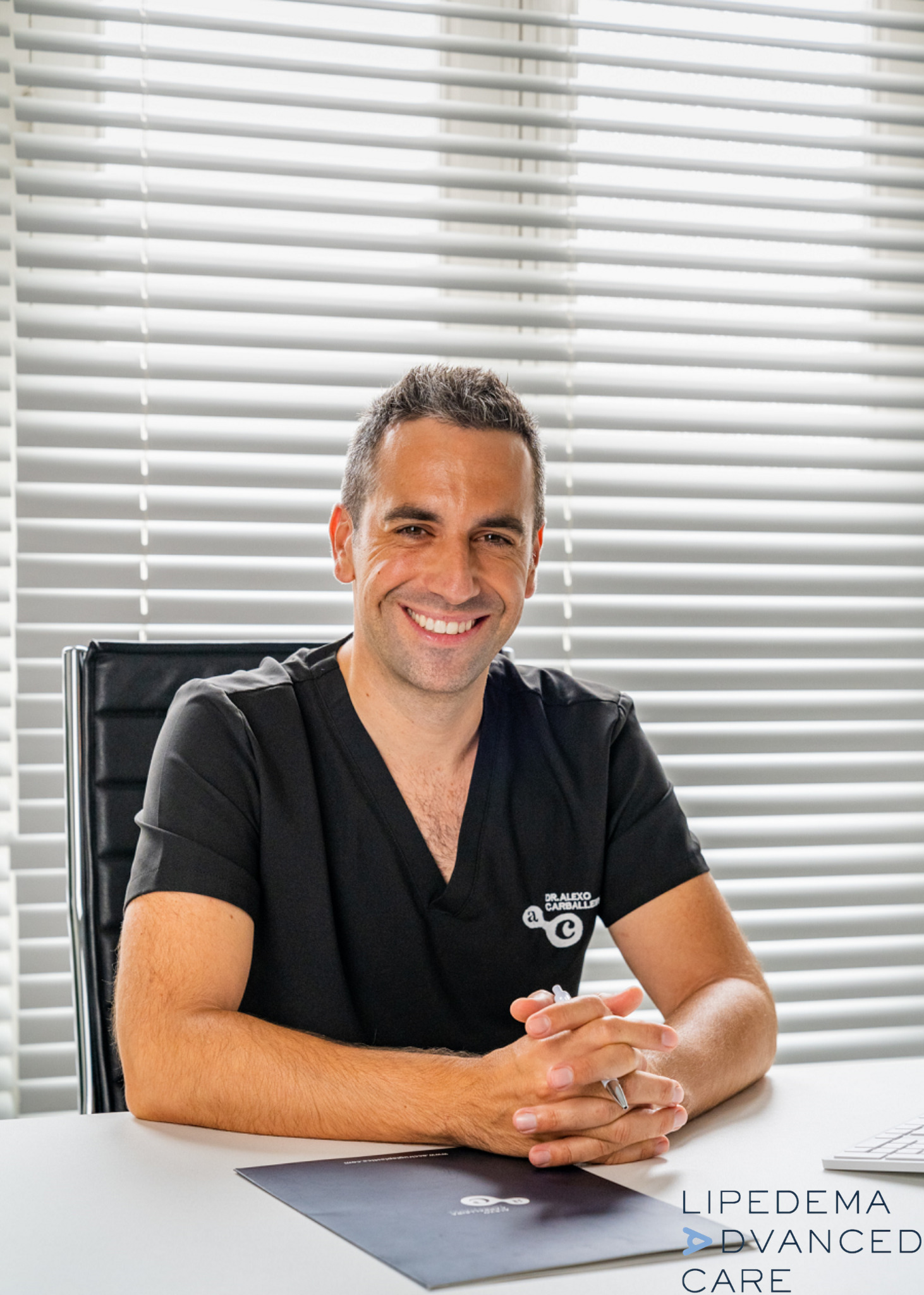
In our case the diagnosis is made by two specialties at once: Dr Carballeira (plastic surgery) and Dr Marta Zaplana (angiology and vascular surgery). This way the clinical and vascular assessments happen within the same process, not in two separate circuits.
So you know exactly what to expect and do not arrive in the dark.
This is the part that carries the most weight and the one most underestimated. You will be asked when it started, whether it coincided with puberty, a pregnancy or the menopause, whether there is a family history of the same leg pattern, how your body responds to diet and exercise, and above all about pain: when it appears, what it feels like, what makes it worse.
That sequence of years, told well, is more informative than any image.
The distribution of volume and its symmetry are observed, whether the foot and hand are spared is checked, and the tissue is palpated to assess its consistency and tenderness to pressure. This examination checks the classic signs: the Stemmer sign (negative in pure lipedema), the cuff sign at the ankle and the absence of pitting on pressure, usual in pure lipedema.
We describe them in the symptoms of lipedema, along with what you can observe yourself before coming in.
This is where technology comes in, and it is worth understanding its real role: it does not come to confirm lipedema, but to rule out other conditions and to prepare the ground in case surgery is considered later on.
| Test | What it is for | Does it confirm lipedema? |
|---|---|---|
| Vascular duplex ultrasound | Assess the venous system and rule out venous insufficiency or thrombosis. Essential in our protocol before considering any surgery. | No, but it is key for ruling out |
| Soft tissue ultrasound | Rule out fluid accumulation and other causes of swelling. It cannot distinguish lipedema tissue from that of lipohypertrophy or obesity, nor determine the origin of an oedema. | No, it is supportive |
| 3D body scanning | Map the contour precisely and objectively measure change over time. | No, it is for documenting and planning |
| Magnetic resonance imaging | Study the tissue when there are doubts about other conditions. Research techniques (sodium MRI, fat/water ratio) are not validated for clinical use. | No, it is not requested routinely |
| Lymphography or lymphoscintigraphy | Study the lymphatic system when a lymphoedema component is suspected. | No, it is reserved for specific cases |
| Blood tests | Rule out hormonal, renal, hepatic or thyroid causes of swelling. | There is no blood marker for lipedema |
If you have had tests done and "they came back fine", that does not rule out lipedema: it is simply not what these tests measure.
There is no laboratory test, but there is a set of recognised clinical features. These are the ones that, if several are present, justify seeking an assessment with someone who knows the condition. None is sufficient on its own.
One point that causes a great deal of frustration is worth clarifying: if there is associated overweight or obesity, losing weight does also reduce leg volume, which is why nutrition and exercise remain the basis of treatment. What diet alone does not correct is the disproportion or the characteristic pain.
Each of these signs, with detail on how it feels and how to distinguish it, is developed in the symptoms of lipedema. Here they matter only as a threshold: recognising several does not amount to a diagnosis, but it is reason enough to seek advice.
Before the consultation: our lipedema test gathers these same criteria into a few questions and gives you an orientation in a minute. It is not a diagnosis and does not replace one, but it helps you organise what you are noticing and arrive at the consultation with clear information.
A good part of the diagnostic work consists of distinguishing lipedema from other causes of increased leg volume, which can also coexist with it.
| Condition | What distinguishes it from lipedema |
|---|---|
| Lymphoedema | Usually asymmetrical and affects the foot; the Stemmer sign tends to be positive and pitting on pressure is common. |
| Obesity | Fat is distributed generally, including the trunk, and responds to a calorie deficit. It is not painful on pressure. |
| Chronic venous insufficiency | Swelling that improves with elevation, skin changes and varicose veins; identified with duplex ultrasound. |
| Lipohypertrophy | Symmetrical, disproportionate increase in leg fat without pain or discomfort in the area. It is the most similar and the most confused: the decisive difference is pain, not volume. |
| Oedema of another cause | Cardiac, renal, hepatic or drug-related origin; usually leaves pitting and is investigated with blood tests. |
Coexistence is common: you can have lipedema and, in addition, obesity or venous insufficiency. Distinguishing which part corresponds to what is precisely what allows effective treatment.
It is one of the most repeated complaints and there is an explanation. Lipedema is confused with being overweight because it looks similar, it does not show up in any blood test, so "everything comes back fine", and it remains little known outside specialist clinics. And there is a fourth reason, harder to say but real: for years, many women have been asked for more willpower when what they had was an undiagnosed condition.
This is not an impression: in our own study of 969 women in Spain, more than half needed to consult three or more different specialists before obtaining a diagnosis, and one in three had to see more than five.
If you have spent years being told it is a matter of diet, the problem was never yours. And arriving late invalidates nothing: the diagnosis still changes the approach at any age and at any stage.
Because the diagnosis rests above all on your history, what you bring prepared makes the difference. This is the list we recommend.
If you are still unsure whether your case fits, the lipedema test gives you an orientation in a minute and serves as a starting point for the consultation.
Our diagnostic protocol combines the clinical assessment with two tools that allow us to document and plan precisely:
That vascular study is not an extra: it is what allows an eventual surgery to be indicated and planned safely. Preservation of the lymphatic system then depends on the surgical technique used. You can see the full protocol in the Advanced Care Method.
What comes out of the consultation: knowing whether you have lipedema, at what stage and type, the state of your vascular system and what options you have, from conservative management to surgery if indicated. With a concrete plan, not a "we will see".
Clinically: through the patient's history and a physical examination by an experienced professional, ruling out other causes. Imaging supports and rules out, but does not confirm the diagnosis.
An angiologist and vascular surgeon, a plastic surgeon or other specialties can do it, provided they have specific experience with lipedema. That experience matters more than the particular specialty.
No. No blood test or imaging study can confirm lipedema. Duplex ultrasound, soft tissue ultrasound or 3D scanning serve to rule out other causes, assess the vascular system and plan, not to give the diagnosis.
Not routinely. Blood tests are used to rule out other causes of swelling and imaging is requested case by case. Everything "coming back fine" does not rule out lipedema.
By symmetry, whether the foot is spared, the Stemmer sign and the presence or absence of pitting on pressure. When there is doubt, the vascular study helps clarify it.
It is a symmetrical increase in leg fat that does not hurt or cause discomfort. It closely resembles lipedema in shape, and what distinguishes them is pain: if there is no pain or discomfort in the area, it is not considered lipedema.
Yes, it is a common confusion because they look similar. If there is pain, easy bruising, symmetry and spared feet, it warrants an assessment by someone experienced in lipedema.
Your history (when it started and what it coincided with), family history, what your pain is like, what you have tried, photographs from previous years, previous reports and tests, and your current medication.
Yes. Lipedema is chronic and has no cure, but the diagnosis makes it possible to start managing the symptoms, avoid approaches that do not work and make informed decisions about the available options.