
If you have lipedema and your legs tingle, you have probably read that tingling is a lipedema symptom. Most lipedema websites say so. The clinical guideline does not, and we think you deserve the accurate version, because tingling usually points somewhere else, and that somewhere else is often treatable.
First, the red flags: when tingling cannot wait
Most tingling is harmless. A small amount is not. Seek same day care, or call 112 in Spain, if it appears like this.
- Suddenly and on one side of the body: with a drooping face, an arm that drifts down when you raise it, or trouble speaking. That is the stroke pattern and time matters.
- With bladder or bowel changes: numbness in the genital or saddle area, new difficulty passing urine or incontinence, with weakness in both legs. That is the cauda equina pattern and it is a neurosurgical emergency.
- With one leg swollen, red, hot and painful: deep vein thrombosis has to be ruled out. With breathlessness or chest pain, do not wait.
- With weakness that is getting worse: the foot drops or you catch your toes when you walk.
- Straight after a blow to the head, neck or back.
Outside those, tingling that comes and goes with position is almost never an emergency. But if it has been there for weeks, it deserves a consultation and blood tests.
When should tingling in the legs be treated as an emergency?
When it is sudden and one sided, when there is trouble speaking or loss of strength, when bladder or bowel control changes, and when one leg is swollen, red and painful. Also straight after an injury. Otherwise the route is your GP, not the emergency department.
What tingling is, and what it is not
The medical word is paraesthesia: an abnormal skin sensation with nothing outside causing it. It is not the same as hypoaesthesia, where you feel less and the area is numb, or dysaesthesia, where an ordinary touch feels unpleasant or burns. Those two point more towards nerve damage.
Positional tingling, the leg that goes to sleep when you sit on the floor, resolves on its own and does not need investigating. What needs investigating is tingling that persists, tingling with no position to explain it, and tingling with loss of sensation or strength.
Tingling is not on the guideline list of lipedema symptoms
The reference guideline in Europe is the S2k Lipoedem guideline (AWMF 037-012, version 5.0, 2024). Its Recommendation 2.1, agreed with strong consensus of 100%, lists the symptoms of lipedema: pressure pain, touch pain, spontaneous pain and a feeling of heaviness. Paraesthesia is not there. Not in that recommendation, not in the symptoms chapter, not in the chapter on pain.
There is more. The guideline concludes that lipedema pain fits a dynamic mechanical allodynia rather than direct nerve damage, and it carries Dinnendahl (2023): standardised quantitative sensory testing in 20 non obese lipedema patients came back normal except for two measures, a strongly reduced pressure pain threshold and a strongly raised vibration detection threshold in the affected thigh. The authors describe that pain as somatic rather than neuropathic.
And the strongest point comes from the very paper the other side cites. Chakraborty (2022) asked 27 lipedema patients about tingling and about numbness and found no significant difference between stages (p = 0,89 and p = 0,77), while pain and touch sensitivity did vary. The tingling some patients report is real as an experience, but it does not behave like a feature of the disease.
Does lipedema cause nerve pain or tingling?
No, not as a symptom of the disease. Tingling and numbness are not on the S2k list, which is pressure pain, touch pain, spontaneous pain and heaviness, and the guideline analyses lipedema pain as somatic rather than neuropathic. If you have lipedema and tingling, give the tingling its own explanation. You can read separately about the symptoms that do define lipedema.
So why do many women with lipedema notice tingling?
Because two different things coincide in the same person, and some of those coincidences are well documented.
- Thyroid: hypothyroidism runs at 30% to 40% in lipedema patients against 2% in the general population (Bauer 2019 and Földi 2009, in the guideline). Hypothyroidism can cause paraesthesia. This is the soundest bridge between the two, and a blood test settles it.
- Leg axis and gait: the guideline records that in very marked disproportion the knee axis can change and gait can be altered. That changes how you load the lumbar spine, and lumbar overload does cause tingling. The link is indirect and we will say so: the guideline does not describe nerve compression caused by lipedema.
- Associated lymphoedema: it adds volume and tissue tension. There the Kaposi-Stemmer sign, negative in pure lipedema, can turn positive.
- The compression garment: badly measured or wrinkled, it can compress a nerve.
None of these says “lipedema causes tingling”. They say something more useful: if you have lipedema and tingling, there are specific things worth checking.
When the tingling comes from your back
This is the commonest mechanical cause of tingling running down one leg: a nerve root is compressed in the lumbar spine and the symptom is felt far from the problem.
- Lumbar radiculopathy: runs down the buttock and the back or outer thigh, on one side only. It changes with position, coughing or bending.
- Lumbar canal stenosis: comes on when walking or standing and eases when you sit or lean forward.
- Meralgia paraesthetica: tingling and burning over the outer thigh from entrapment of the lateral femoral cutaneous nerve. Linked to tight clothing, belts, weight and pregnancy. It does not cause weakness.
- Peroneal nerve at the knee: tingling over the top of the foot and difficulty lifting the toes. Linked to sustained pressure on the outer knee, including crossing your legs, and to prolonged constriction of the lower leg.
When the problem is the nerve itself: peripheral neuropathy
This is the pattern worth recognising: both legs, starting at the toes and feet, creeping upwards, stocking shaped. Diabetes is the commonest cause; in prediabetes the association has been described with more limited evidence. Alongside it, what is always looked for.
- Vitamin B12 deficiency: common and treatable. Watch for it if you take metformin, if you have had bariatric surgery, if you are strictly vegan without supplementing, or if you have atrophic gastritis.
- Alcohol: sustained intake damages the nerve, directly and through vitamin deficiency.
- Medicines: some chemotherapy agents and some antibiotics. If the tingling started weeks after a new treatment, say so in the consultation.
- Too much vitamin B6: counterintuitive. Pyridoxine above 500 milligrams a day, and especially above 1.000, causes a sensory neuropathy with numbness in the legs and feet. Check the multivitamins you take on your own.
- Hypothyroidism: as above, and the reason TSH is in the basic panel.
Which vitamin deficiency causes tingling in the legs?
The first one checked is vitamin B12: deficiency is common, it causes tingling and it is correctable. B1 and B6 deficiency can also be involved. And B6 causes neuropathy by excess too, so supplementing blind is not harmless: do not self medicate before you have the blood test.
Restless legs: the diagnosis most often confused with tingling
Restless legs syndrome is often described as “night time tingling”, and it is not the same thing. Its defining feature is not the sensation, it is the irresistible urge to move the legs. It worsens on lying down or sitting for long periods, it is worse in the evening and at night, and it eases while you move. That relief is the giveaway. It is associated with iron deficiency, chronic kidney disease, diabetes, pregnancy and neuropathy itself, which is why ferritin is measured.
Is it tingling or restless legs syndrome?
Ask yourself three questions. Do you feel an urge to move your legs, not just an odd sensation? Is it worse at night and at rest? Does it ease as soon as you get up and walk? If all three are yes, it points to restless legs and deserves its own consultation with iron studies. If it does not change when you move, it points elsewhere.
“Poor circulation”: the most repeated explanation and the weakest
Chronic venous insufficiency explains heaviness, end of day swelling, cramps and itching very well. It explains pure tingling much less well. If tingling is your main symptom and all you have been told is poor circulation, do not close the file: ask about the nerve, glucose, B12 and thyroid. If swelling is really your problem, the read is the causes of swollen ankles. And if pain dominates, it is why your legs hurt.
Posture, footwear and compression that presses in the wrong place
Crossing your legs for long periods, sleeping in an awkward position or resting the outer knee against something hard compresses the peroneal nerve and causes tingling on top of the foot. It is harmless if it clears in minutes.
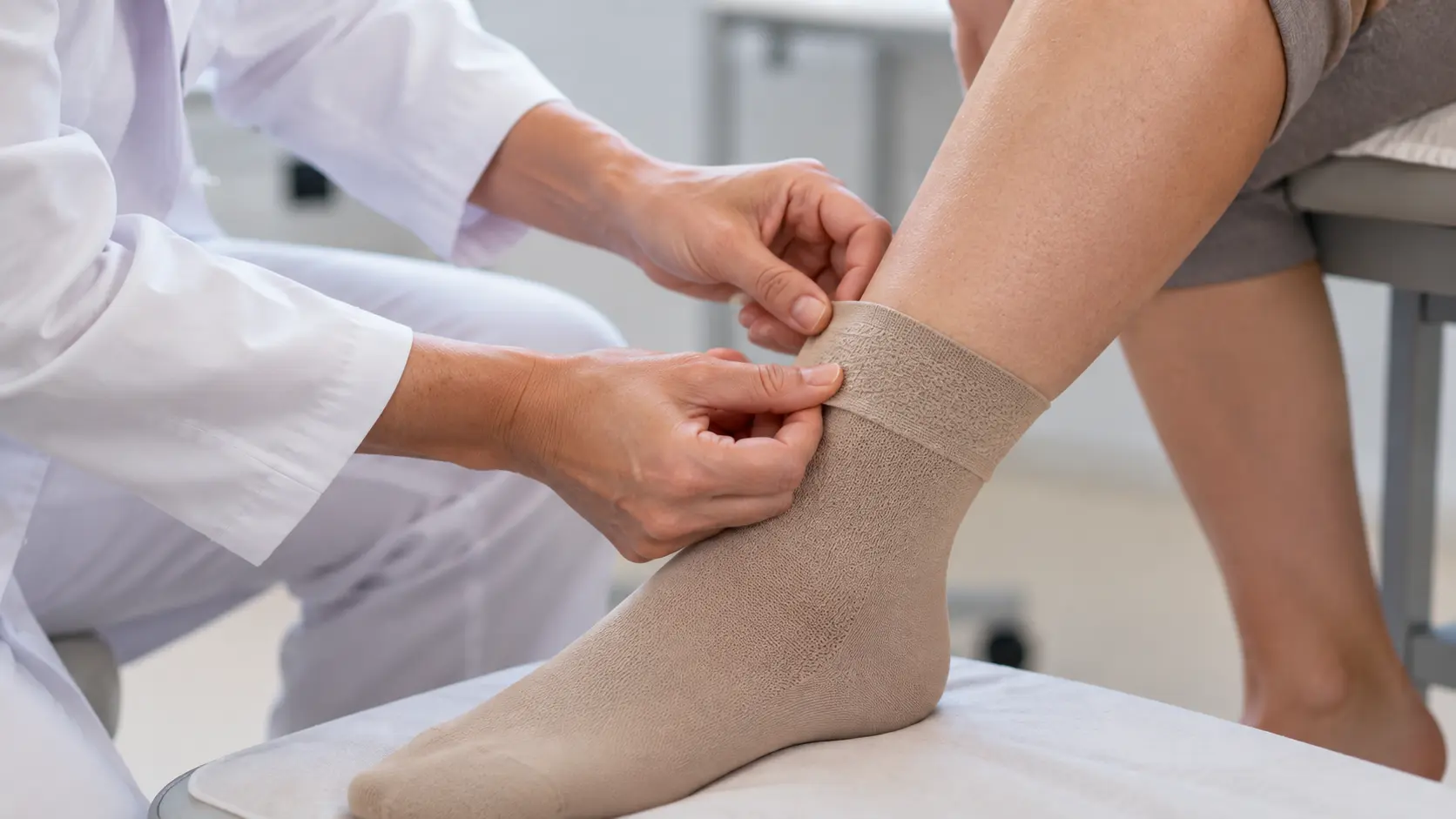
Then there is the compression garment, and this is a real consultation for us. Correctly prescribed, compression is used in lipedema to reduce pain, at the lowest class that helps so you can actually wear it daily. Worn badly it does the opposite. The S2k guideline describes the mechanism: circular knit has lower bending stiffness, slides into deep tissue folds and can produce constriction, while flat knit bridges them better. And it sets a rule that should come with every fitting: a garment that hurts is not tolerated, it is corrected. If yours leaves deep marks, rolls at the knee or numbs the area, review the measurements and the prescription with whoever fitted it, and read how compression garments work in lipedema.

Anxiety and hyperventilation: real, but not the first drawer
Hyperventilation produces respiratory alkalosis, and that alkalosis lowers the calcium available in the blood. The result is paraesthesia, typically around the mouth and in the hands, sometimes with stiff fingers and occasionally in the legs. The mechanism is real and well described.
That said, anxiety is used far too often as a catch all for symptoms in women nobody has investigated. The order is the reverse: rule out the physical first, then assess the anxiety component, which can add to it and deserves attention. If your tingling is in one leg only or comes with loss of sensation, anxiety does not explain it.
What points to what: an orientation table
This table diagnoses nothing. It helps you arrive at the consultation able to describe your tingling, which is half the work.
| What your tingling is like | What it points to | What is usually checked |
| Sudden, one side, speech or strength affected | Stroke. | Emergency services now. |
| Saddle area numb, bladder or bowel changed | Cauda equina. | Neurosurgical emergency. |
| One leg, tracking down from the buttock | Lumbar nerve root. | Neurological exam, lumbar imaging. |
| On walking, eases sitting or leaning forward | Lumbar canal stenosis. | Spine assessment. |
| Both legs, stocking shaped, from the toes up | Polyneuropathy. | Glucose, HbA1c, B12, TSH. |
| Outer thigh patch, no weakness | Meralgia paraesthetica. | Clothing, belts, weight. |
| Urge to move, worse at night, eases on walking | Restless legs. | Ferritin and iron studies. |
| Only with the garment on, or with a deep mark | Badly fitted compression. | Measurements, class and knit. |
| Around the mouth and in the hands, when panicky | Hyperventilation. | Rule out the physical first. |
What is usually checked in the consultation
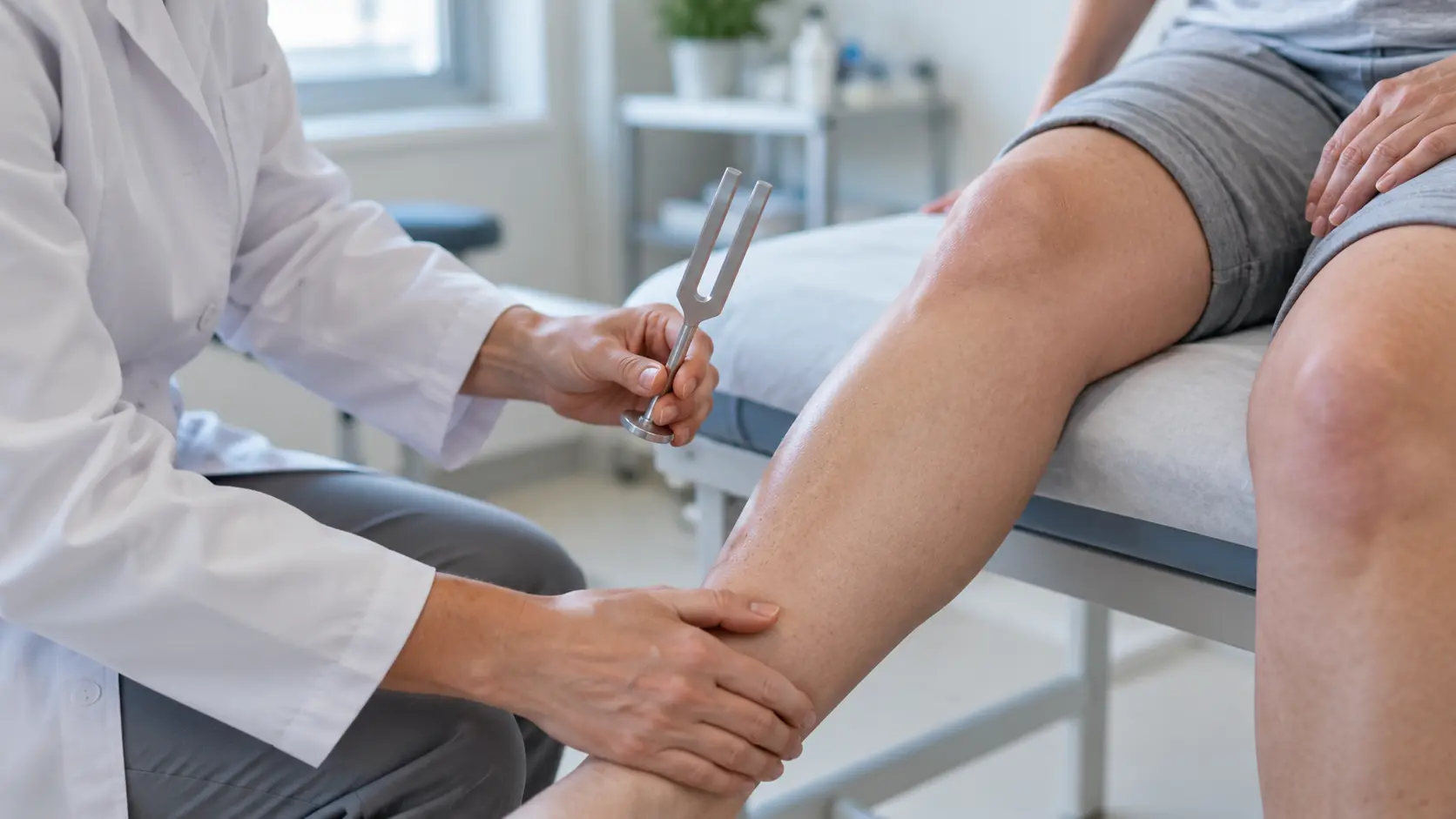
The usual approach is a neurological examination with reflexes, strength and vibration sense using a tuning fork, plus targeted blood tests. This is not a menu to request: it is so you do not leave the appointment empty handed.
What tests are done for persistent tingling in the legs?
Fasting glucose or HbA1c, vitamin B12, TSH, full blood count, kidney function and ferritin. TSH, FT3 and FT4 are the same parameters the S2k guideline names for investigating oedema, along with creatinine, glomerular filtration rate, urine protein and NT-proBNP. Depending on the results and the pattern, nerve conduction studies with electromyography or lumbar imaging are added. The choice follows the examination, not the symptom alone.
If your legs are also disproportionate and hurt when touched
That is a different conversation, and it is ours. Lipedema is a disproportionate, symmetrical increase in the fat tissue of the limbs that hurts on pressure and on touch, spares the feet and hands and is not explained by weight. It is chronic and it has no cure, and it can worsen during phases of hormonal change. If that sounds like you, start with what lipedema is and note that lipedema diagnosis is clinical.
Our clinic is in Valencia, Spain, and everything described here refers to Spanish clinical practice. Consultations are held in Spanish and in English, both for English speaking residents of the Valencia and Alicante area and for international patients travelling for assessment. If you have both things, disproportionate painful legs and tingling, the right answer is not to blame the lipedema for everything: it is to investigate each one. That is what a first assessment does, and you can request one here.
Sources and references
- Guideline S2k Lipoedema, AWMF 037-012, version 5.0 (2024). Recommendation 2.1, the pain analysis, Dinnendahl 2023, hypothyroidism prevalence, the oedema laboratory panel, axis and gait, Kaposi-Stemmer and flat versus circular knit.
- Chakraborty A et al. Int J Mol Sci, 2022. Tingling and numbness with no significant difference across lipedema stages.
- MedlinePlus. Numbness and tingling. Emergency criteria.
- MedlinePlus. Peripheral neuropathy. Diabetes as commonest cause, plus vitamin, toxic and drug causes.
- MedlinePlus. Common peroneal nerve dysfunction. Compression from posture and prolonged constriction.
- MedlinePlus. Restless legs syndrome. Defining features and iron deficiency.
- MSD Manuals. Vitamin B6 toxicity. Sensory neuropathy from excess pyridoxine.
Reviewed by Dr Carballeira, specialist in Plastic, Aesthetic and Reconstructive Surgery and medical director of Lipedema Advanced Care.
Published on 10 September 2026.
This page is for information purposes and does not replace a medical consultation. Lipedema is diagnosed clinically and must be assessed by a professional experienced in the condition. Seek same day care, or call 112 in Spain, if tingling comes on suddenly on one side of the body with trouble speaking or moving an arm or a leg, if bladder or bowel control changes or the saddle area goes numb, or if one leg is swollen, red, hot and painful.

