

If you searched for edematous cellulite, start with the word itself, because two different things are hiding behind it. Cellulite, with an E, is the dimpled orange-peel skin that most women have. Cellulitis, with an S, is a bacterial infection of the skin and the tissue underneath, and that one is a medical emergency. One letter apart, and nothing else in common.
The label “edematous cellulite” also gets used for three other things: fluid retention, lymphoedema and lipedema, which is a chronic disease that many women carry for years labelled as a beauty problem. This article separates all five. It starts with what cannot wait, because that is the only part that is urgent.
Start here: when this is not a cosmetic problem
Before you read anything about types of cellulite, rule out the urgent causes. If you recognise any of the following, a cream or a pressotherapy session is not the answer.
Skin that is red, hot, painful and spreading, with fever or feeling generally unwell: that is cellulitis, the infection. See a doctor the same day. The US National Library of Medicine describes a red area that appears suddenly and grows within 24 hours, with tight shiny skin and fever with chills, and advises seeking care immediately if drowsiness, blisters over the area or spreading red streaks appear.
Swelling in ONE leg only, with calf pain, warmth and a visible increase in size: deep vein thrombosis has to be ruled out. That is urgent. If you also have shortness of breath or chest pain, go to A and E.
Swelling in both legs together with breathlessness when you lie down, new tiredness, or swelling that is creeping upwards: oedema can be the sign of a heart, kidney or thyroid problem. That is not treated with aesthetics.
A cut, an insect bite or a crack between your toes that has turned red and hot: that is the usual entry point for the infection.
If none of that describes you, and what you have is swelling that comes and goes, is worse at the end of the day and in hot weather, with dimpled skin, read on.
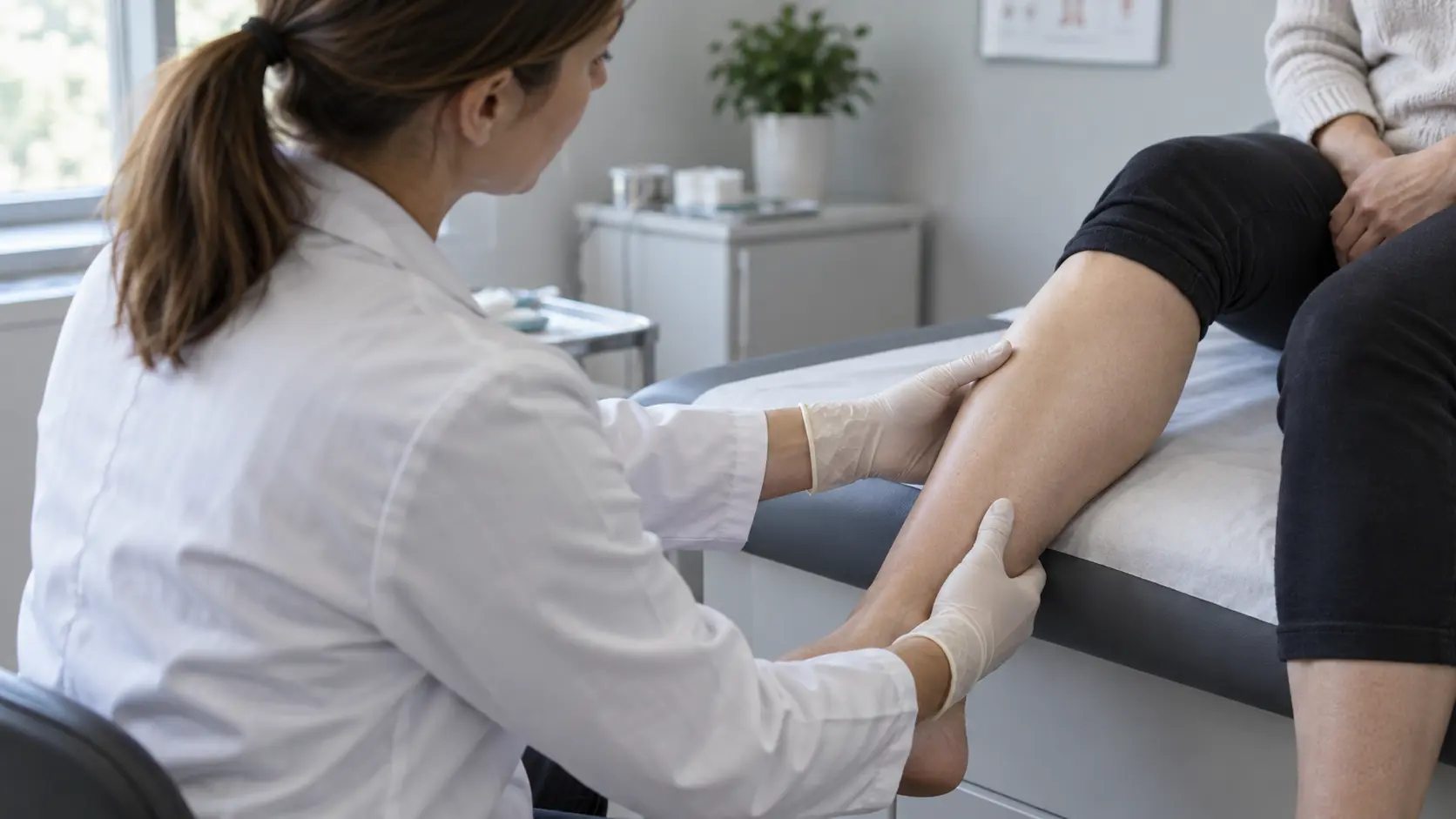
Cellulite and cellulitis are not the same word
This is not a spelling footnote. It appears in the medical literature on lipedema as a diagnostic criterion.
Cellulitis, with an S
A bacterial infection affecting the dermis and the tissue beneath it. In Spain it is often used interchangeably with erysipelas, and it is treated with antibiotics. It has nothing to do with skin texture: what you get is inflammation, heat, pain and fever.
The original description of lipedema, by Allen and Hines in 1940, which the S2k guideline of 2024 reproduces in its historical chapter, includes this criterion word for word: in lipedema there are no recurrent episodes of acute cellulitis (erysipelas), and there never have been. In other words: if a patient has repeated leg infections, that points somewhere else, typically to lymphoedema. The absence of those episodes is one of the findings used to support a diagnosis of lipedema.
Cellulite, with an E
The orange-peel skin. Its technical name is oedematofibrosclerotic panniculopathy, and it affects most women after puberty: the 2023 review by Gabriel and colleagues puts it at 80% to 90% of postpubertal women. It is not a disease and it does not compromise how your body works.
Why do two such different things share a name?
Because of how the words arrived. “Cellulite” was coined in France in the early twentieth century to describe the dimpling, while medicine was already using “cellulitis”, with the suffix for inflammation, for infections of the subcutaneous tissue. English kept the two words apart. Spanish did not, and uses “celulitis” for both, which is why Spanish-language pages on this topic are often confusing. When you read about this, check which of the two the page is actually about.
What “edematous cellulite” is supposed to mean
In the classification used by aesthetic clinics, edematous cellulite, or oedematous cellulite in British spelling, is the variant dominated by fluid retention. It is described like this: legs that are swollen, heavy and tight and that increase in volume through the day; skin that looks padded or spongy; discomfort or pain when pressed; and pitting, meaning that pressing with a finger leaves a dent for a few seconds. It is mostly reported in the legs, ankles, knees and thighs.
As a picture of symptoms, that is reasonably accurate. The problem is what gets done with it next.
Are there really four types of cellulite?
Not as validated clinical categories, and it is worth knowing that before you pay for a treatment aimed at “your type”. The reference review on cellulite, published in 2023 in Aesthetic Surgery Journal Open Forum, describes two scales: the Nurnberger-Muller scale, grades 0 to 3, which the authors themselves call an unvalidated, purely qualitative scale; and the Cellulite Severity Scale, which is validated and scores five items. Neither of them includes an “edematous” type as a category. The split into hard, soft, edematous and mixed cellulite is commercial usage in the aesthetics sector, not a clinical classification with evidence behind it.
Put plainly: “edematous cellulite” describes a set of symptoms quite well, but it is not a diagnosis. And the symptoms it describes are exactly the ones produced by three real diseases. The name matters little. What matters is what is underneath it.
Five things confused under one term
| What it is | How it behaves | The sign that tells it apart | Who should see it |
Cellulite (orange-peel skin) | Dimpling, with or without a feeling of heaviness. Usually painless. | It is on the surface, and there is no disproportion between the legs and the trunk. | Aesthetic medicine. It is not a disease. |
Cellulitis (erysipelas) | Sudden onset. A red, hot, painful area that spreads, with fever. | Fever and local heat. It gets worse over hours, not months. | A doctor the same day. Antibiotics. |
Fluid retention | Swelling that comes and goes, worse at the end of the day, in the heat and after standing. | Marked pitting, and it improves when you raise your legs or sleep. | Medical work-up of the oedema to find the cause. |
Lymphoedema | Swelling that usually starts asymmetrical and involves the top of the foot and the toes. | Positive Kaposi-Stemmer sign. Repeated infections. | A lymphology unit. Decongestive therapy. |
Lipedema | Symmetrical increase in volume in both legs, or in the arms, that does not respond to dieting. | Pain on pressure and a step in calibre at the ankle, with the feet spared. | A team experienced in lipedema. The diagnosis is clinical. |
Edematous cellulite or lipedema: the criteria that actually separate them
This is the part almost nobody gets right. If your legs are out of proportion with your trunk, they hurt when touched and they do not respond to dieting, the question is not which type of cellulite you have. These are the criteria used in the S2k guideline of 2024.
Symmetry, and the areas it spares
Lipedema is always symmetrical and arises exclusively in the limbs: it does not affect the trunk, the head or the neck. And it spares the feet and the hands. That is the most visible sign: the volume stops abruptly at the ankle or the wrist and creates a step in calibre, described in the guideline as a cuff phenomenon. If you have noticed that boots close at the ankle but not around the calf, that step is what you are seeing, and it is worth reading the symptoms of lipedema in detail.
Pain on pressure, which is the core criterion
Cellulite is generally painless. In lipedema, pain on pressure is the cardinal symptom, and it can be triggered by a light touch, by the elastic of a sock, or appear with no touch at all. If what brought you here is that your legs hurt, skin texture is not where the answer lies.
The Kaposi-Stemmer sign
It consists of trying to pinch the skin at the base of the second toe. If you can pinch it, the sign is negative. In pure lipedema it is negative, and it can turn positive if lymphoedema is added on top, something that becomes more frequent with advancing stage. It is a clinical manoeuvre rather than something to test in front of a mirror, and it is part of the diagnosis of lipedema.
Nodules are no longer a criterion, and that undoes most of the internet
Almost every page comparing cellulite and lipedema leans on the same line: “in lipedema you will feel nodules or little beads when you palpate”. That no longer holds. Recommendation 2.5 of the S2k guideline removed nodularity as a diagnostic criterion for lack of validity, with strong consensus of 100%. If you have been told you do not have lipedema because no nodules can be felt, that argument is not valid. And if you have been told you do have it on that basis alone, it is not valid either.
Can I have cellulite and lipedema at the same time?
Yes, and that is the most common situation. Cellulite affects the great majority of women, so most patients with lipedema have it too. The right question is therefore not one or the other: it is whether, on top of the dimpling, there is disproportion, pain on pressure and sparing of the feet and hands. If there is, the cosmetic part is the secondary issue. The full comparison is on our page about the difference between lipedema and cellulite, and there is an orientation questionnaire in our lipedema test.
Edematous cellulite or fluid retention: what has to be ruled out
When swelling is the dominant feature, the first step is to look for a medical cause rather than treat the appearance. The guideline names the parameters for the work-up of oedema: TSH, FT3 and FT4 for thyroid function; creatinine and glomerular filtration rate for the kidney; urine protein; and NT-proBNP for cardiac function. It is an ordinary blood and urine panel that a doctor can request.
That work-up is not a formality. In patients with lipedema, the prevalence of hypothyroidism runs at 30% to 40%, against around 2% in the general population, according to the Bauer 2019 and Foldi 2009 data cited in the guideline.
Do diuretics help swollen legs?
For lipedema, no. Recommendation 6.1 of the S2k guideline, with 94.4% consensus, states that diuretics should not be used to treat lipedema. It is a different matter if a doctor prescribes them for a separate internal medicine reason, cardiac or renal. If swelling is your main symptom, compare your case against the differences between lipedema and fluid retention and the causes of swollen ankles.
What treatment can and cannot do
If what you have is cellulite
The evidence is modest, and you should know that before you commit. The 2023 review by Gabriel and colleagues notes that none of the topical formulations available for cellulite is approved by the FDA; that mechanical suction massage of the Endermologie type, in a prospective randomised trial, was only partially better than a topical aminophylline cream; and that radiofrequency results are short lived and need multiple sessions. That does not mean nothing works. It means the improvement is partial and temporary, and that nothing is being cured, because there is nothing to cure.
If there is lipedema underneath
Then the whole approach changes. Lipedema is chronic and has no cure, and it can worsen during phases of hormonal change. Conservative management is the mainstay: compression garments are used to reduce pain, and the guideline is explicit that no fixed class is assigned to the diagnosis, but rather the lowest class that relieves symptoms, so that the patient can actually wear it. Alongside that sit manual lymphatic drainage, movement and weight management.
Does liposuction get rid of edematous cellulite?
That is not what it is for, and it is worth being blunt. In lipedema, the guideline puts it literally: lipedema is not curable by liposuction; through liposuction, pain can be relieved in a lasting way and quality of life can improve. Baumgartner and colleagues measured, in 2020, a significant reduction in spontaneous pain and in pain on pressure at 4, 8 and 12 years. That is what was measured: less pain. Nor is it free of risk: among the complications the guideline records is erysipelas, at 0.28% in the Cornely 2022 series of 1,400 operated patients and at around 4% in the Kruppa and colleagues review of 2020. One more reason not to confuse the two words.
Can edematous cellulite be removed completely?
No. Orange-peel skin affects the vast majority of women and no treatment makes it disappear permanently. Any page promising to eliminate it is selling you something. What can be resolved is the underlying question: whether that swelling and that pain come from a disease with a name and a management plan of its own.
When to ask for an assessment, and where
Ask for a medical assessment rather than an aesthetic one if you recognise three things together: disproportion between your legs or arms and the rest of your body, pain on pressure or on light touch, and no response to sustained dieting and exercise. Add one more reason if other women in your family have the same leg pattern, because a family history is common.
The diagnosis of lipedema is clinical: it is made from the history and the physical examination, not from a machine. Our clinic is in Valencia, Spain, and consultations are held in Spanish and English, which matters if you live on the Valencia or Alicante coast and would rather be seen in your own language. If you are considering travelling for an assessment, the practical details are on our page for international patients, and you can put your case to the team through our contact page. Please note that everything in this article refers to clinical criteria and to care in Spain; it says nothing about NHS pathways or about insurance cover in any country.
Sources and references
Guideline S2k Lipoedema, AWMF 037-012, version 5.0 (2024). For the Allen and Hines 1940 criteria on the absence of recurrent episodes of acute cellulitis or erysipelas, symmetry and the sparing of feet and hands, the cuff phenomenon, the Kaposi-Stemmer sign, Recommendation 2.5 removing nodularity as a diagnostic criterion, Recommendation 6.1 on diuretics, the parameters for the work-up of oedema, the prevalence of hypothyroidism, and the liposuction complication figures from Cornely 2022 and Kruppa 2020.
Gabriel A, Chan V, Caldarella M, Wayne T, O’Rorke E. Cellulite: Current Understanding and Treatment. Aesthetic Surgery Journal Open Forum, 2023. For the prevalence of cellulite, the Nurnberger-Muller and Cellulite Severity Scale grading systems, the absence of an “edematous” type as a clinical category, and the level of evidence for topical treatments, mechanical suction massage and radiofrequency.
MedlinePlus, US National Library of Medicine. Cellulitis. For the definition of cellulitis as a bacterial infection and the signs that require immediate care.
Carballeira Brana A, Poveda Castillo J. The Advanced Care Study: Current Status of Lipedema in Spain. Int J Environ Res Public Health, 2023. Our own team’s study on the situation of lipedema in Spain.
World Health Organization, ICD-11, code EF02.2 Lipoedema. For the classification of lipedema as an entity in its own right.
Reviewed by Dr Alexo Carballeira Brana, specialist in Plastic, Aesthetic and Reconstructive Surgery and medical director of Lipedema Advanced Care.
Published on 10 September 2026.
This page is for information purposes and does not replace a medical consultation. The diagnosis of lipedema is clinical and must be made by a professional experienced in this disease. Seek medical care the same day if you have an area of skin that is red, hot, painful and spreading, with fever or a general feeling of illness, because that is the picture of cellulitis, the infection. Go to an emergency department if swelling appears suddenly in one leg with calf pain, or if you have shortness of breath or chest pain.

