

If you live in Spain and you have just been diagnosed with lipedema, this is probably your first practical question. And the honest answer has two halves: the Spanish public system does fund part of the conservative treatment, but it does not fund it under the name lipedema, and everything else follows from that.
What follows is what the regulation says, not what circulates in forums. Every figure here comes from the public catalogue of the Spanish National Health System.
The fact that explains everything: the word lipedema does not appear
The catalogue that decides which compression garments the public system funds is Annex VI of Royal Decree 1030/2006, updated by Order SND/44/2022 of 27 January. It lists, product by product, what can be prescribed at public expense.
We searched it for two words. «Lymphoedema» appears 63 times. «Lipedema», zero.
That is not sloppy drafting. The funding group is called, literally, «Products for the therapy of lymphoedema», and the indication it demands is written with surgical precision: compression garments «for lymphoedema of the upper limbs, severe lymphoedema of the lower limbs and lymphoedema of the trunk».
Translated: a woman with lipedema and no lymphatic component does not fit the indication the catalogue asks for. A woman with lipo-lymphoedema, the most advanced situation, where a drainage failure has been added to the lipedema, can fit under «severe lymphoedema of the lower limbs».
That sentence, which reads like paperwork, is what decides whether you get the prescription or not. And it explains why two patients with the same diagnosis walk out of the hospital with different answers.
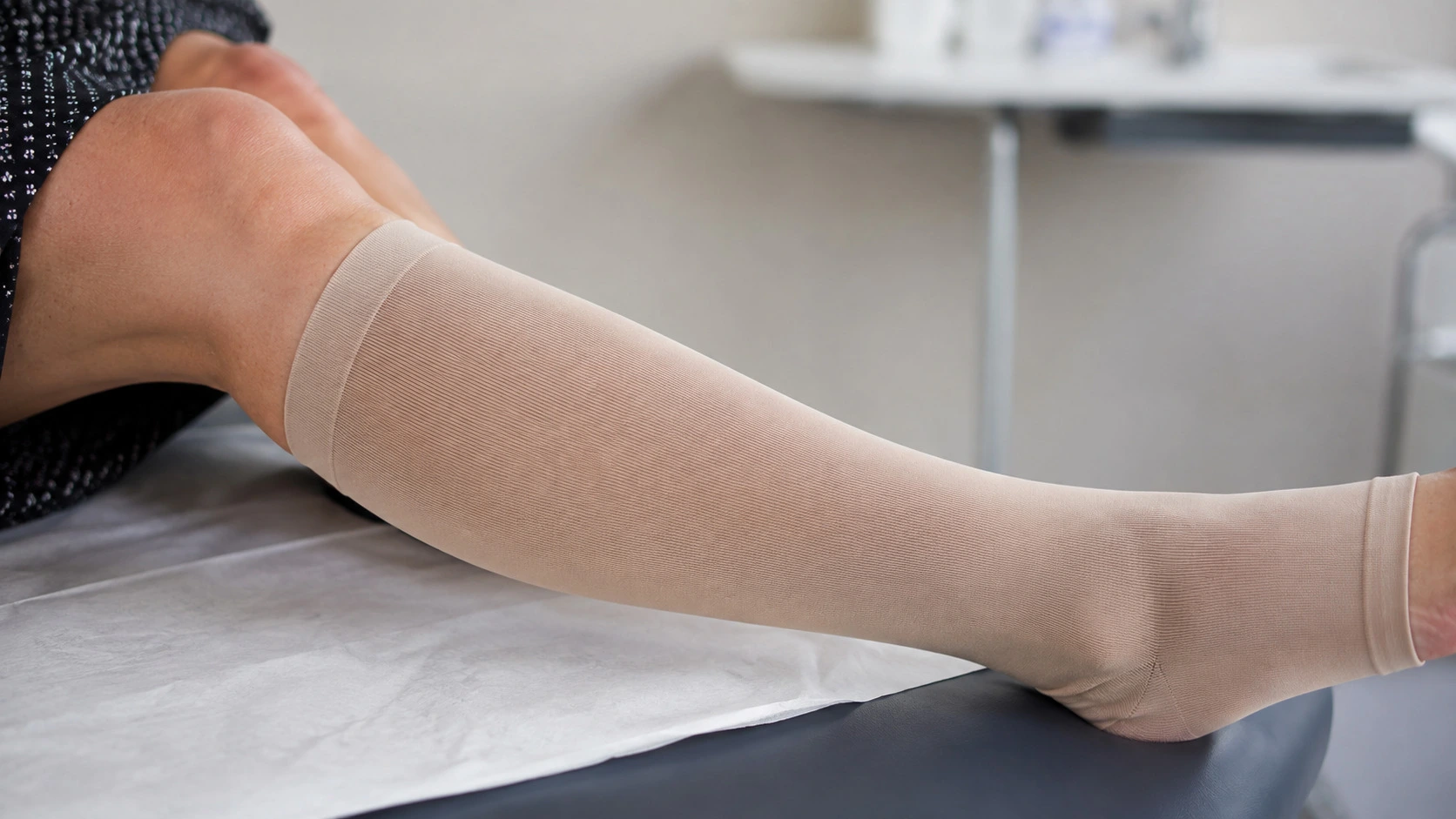
What the system does fund, with the numbers in front of you
When the indication fits, this is what the catalogue puts on the table. These are maximum funding amounts for made-to-measure garments, and the patient pays a 30 euro contribution per product.
| Garment | Code | Maximum funded amount |
Below-knee stocking, made to measure | EPL 070A | 106.82 euros |
Full-leg stocking, made to measure | EPL 070C | 165.44 euros |
Full-leg stocking with waist attachment | EPL 070E | 173.03 euros |
Single-leg tights | EPL 080A | 282.15 euros |
Two-leg tights | EPL 080C | 353.67 euros |
Short-leg trousers | EPL 090A | 251.82 euros |
Full trousers | EPL 090B | 309.79 euros |
Three details almost nobody mentions, and they change the final sum:
Two units per prescription: the catalogue allows two units of each product per prescription. That matters, because a compression garment has to be washed and you need the second one while the first dries.
A six-month service life: renewal is not a favour, it is written into the catalogue.
15% more for flat-knit: the amounts in the table are for circular-knit garments. The catalogue states, verbatim, that if flat-knit is prescribed the maximum funding amount increases by 15%.
The flat-knit trap
This deserves a pause, because it is where half of the patients are lost.
In lipedema, the garment that tends to work is flat-knit: it is cut and sewn to a pattern, it does not stretch like a conventional stocking, and it contains an irregular, nodular tissue better. We go through it in our guide to compression garments for lipedema, because choosing the wrong fabric is the most frequent reason a patient abandons compression within two weeks.
The good news is that the catalogue recognises flat-knit and pays 15% more for it. The bad news is that it still does so under the lymphoedema heading. So what decides the outcome is not the fabric, it is how the indication is written in your report.
Why surgery is not included, and what is actually being argued
Here the answer is blunter: volume-reduction surgery for lipedema is not in the common services portfolio of the Spanish National Health System.
The reason sits in Article 5.4 of the same Royal Decree 1030/2006, which excludes techniques whose purpose is «mere leisure, rest, comfort, sport or aesthetic or cosmetic improvement». As long as an operation is classified as aesthetic improvement, it stays outside. And lipedema carries half a century of being read as a cosmetic problem.
What is argued, case by case and with no homogeneous national criterion, is whether an operation with a functional purpose can stop being considered aesthetic: pain that does not respond to conservative treatment, restricted mobility, friction causing repeated skin lesions, an altered gait. We are not aware of any Spanish region that has a protocol for this in lipedema, and telling you otherwise would be dishonest. If anyone promises to get you the operation through the public system, be sceptical.
When surgery is considered privately, what you can demand is that the indication, the limits and the risks are explained before you decide. That is what we set out on the lipedema surgery page, including the cases in which we do not operate.
Manual lymphatic drainage and physiotherapy
Here the answer depends on where you live, and there is no honest way to give you a single rule: the services portfolio is applied by each autonomous region, and the real availability of physiotherapists trained in lymphatic drainage varies a great deal between hospitals.
What is seen in practice: where a lymphoedema is documented, access to manual lymphatic drainage in the public system is more likely. Where the diagnosis is lipedema alone, it usually falls outside and is referred to the private sector. It is worth asking at your health centre before assuming it is lost, because the answer changes from one province to the next.
If you end up paying for it yourself, the criteria for not wasting your money are on our manual lymphatic drainage page: done properly it does not hurt and does not leave bruises, and it is not a reducing massage.

Disability and sick leave: a different route and a different scale
These are worth keeping apart, because they are different things and patients often conflate them.
Treatment coverage depends on the common services portfolio.
Recognition of disability depends on the state assessment scale, governed since 2023 by Royal Decree 888/2022.
Work incapacity is a third procedure, run by the Social Security system, with its own criteria.
The point that matters: all three assess documented functional limitation, not the diagnostic label. A report saying «stage 3 lipedema» without describing what you cannot do is worth little. A report describing the pain, how far you can walk, the falls, the friction lesions, how long you tolerate standing and the treatment you have already tried without success is worth a great deal more.
We cannot tell you how your case will be resolved, not least because it does not depend on us. What we can tell you is that the quality of the clinical report is the part within your reach.
Five practical things you can do
Get the diagnosis inside the public system, even if you already have it privately. The garment prescription has to come from a specialist within the system, and without that step the rest does not stand.
Ask for the lymphatic component to be documented if it exists. Not to force anything: so the report reflects reality. If there is pitting, if the foot is involved, if the Stemmer sign is positive, it has to be on paper. That is where the catalogue indication is won or lost, and how all of it is examined is on our lipedema diagnosis page.
Ask for the prescription with the catalogue code and the fabric. «Compression stockings» is not the same as «EPL 070C, made-to-measure full-leg stocking, flat-knit». The second one gets processed; the first sits in a drawer.
Ask about the two units and the six-month renewal. They are in the catalogue, they are not concessions.
Keep every report, dated. For the orthopaedic supplier, for an appeal, for a disability assessment and for the next renewal.
What nobody will fund, and it is better to know beforehand
Home pneumatic compression is not in Spain’s orthoprosthetic catalogue, even though the clinical guidelines include it and even endorse it as home therapy. If it is sold to you as funded, it is not. We cover it, along with its contraindications, on the pneumatic compression page.
Supplements, paid diets and aesthetic devices are not funded either. Nor is surgery, outside the functional scenario described above.
There is a reason for saying this plainly. In a disease that is diagnosed late and badly, misinformation about what the system covers makes many patients give up before trying, or spend on the wrong things. Knowing exactly where the line runs is what lets you fight for what can actually be won.
If what you need is the diagnosis done properly
Most of what we have described rests on one thing: a clinical report that states precisely what you have and what you cannot do. That is not paperwork, it is medicine.
At our clinic in Valencia the assessment includes examination, a vascular study with duplex ultrasound to rule out venous disease and identify any lymphatic component, and a written report with the stage, the type and the findings. If you are going to fight for a prescription or an assessment, that document is your tool. You can see who carries out the assessment on our medical team page. Consultations are held in Spanish and English.
Sources and references
Royal Decree 1030/2006, of 15 September, establishing the common services portfolio of the Spanish National Health System. Article 5.4.
Order SND/44/2022, of 27 January, updating Annex VI of Royal Decree 1030/2006 regarding the common orthoprosthetic catalogue, including products for the therapy of lymphoedema. Catalogue published by the Ministry of Health.
Royal Decree 888/2022, of 18 October, on the procedure for recognising and grading disability.
S2k guideline Lipoedema, AWMF 037-012, v5.0 (2024), for compression and conservative treatment.
Medically reviewed content. Produced by the medical team at Lipedema Advanced Care and reviewed by Dr Carballeira, plastic surgeon (SECPRE recertified) specialising in the treatment of lipedema and registered with the ICOMV. This information is for general guidance and does not replace a medical consultation or legal advice. The amounts and codes come from the official catalogue in force in August 2026 and may be updated by ministerial order. Last updated: August 2026.

