
Pneumatic compression for lipedema:what it does and what it does not
Compression boots, lymphatic pumps, pressotherapy: all the same therapy. The guidelines include it for pain, accompanying oedema and bruising, and state plainly that it complements rather than replaces. Here is what they say, with the recommendations quoted, the studies with their numbers, and also the study that found no benefit.
What it actually does to a leg with lipedema
Pneumatic compression, sold as compression boots, lymphatic pumps or pressotherapy, is a sleeve with air chambers that inflate and deflate in a cycle. When the chambers fill sequentially, from the ankle upwards, the effect is a continuous push in the direction the fluid needs to travel.
And fluid is what it acts on. This is the point almost no page explains clearly, because a leg with lipedema has two things stacked on top of each other. First, the adipose tissue of the disease itself, which is what creates the disproportionate volume and what hurts when pressed. Second, a fluid component that builds through the day and explains why the leg is different at night from how it was in the morning.
Pneumatic compression works on the second. It reduces swelling, the sense of heaviness and, according to the guidelines, pain and the ease of bruising. It does not move fat. So a patient can feel her leg lighter and less tight after a session and still see no change in size: those are two different things and both are true.
The sentence that sums up this page: pneumatic compression is useful and it is in the guidelines, but as support. The German pneumatic compression guideline puts it literally: it is "supportive, but not a replacement for manual lymphatic drainage and compression". If it is being sold to you as a treatment for lipedema, you are being oversold.
What the guidelines say, literally
Two documents deal with this: the German lipedema guideline, which is the international reference, and the guideline specific to intermittent pneumatic compression. Both include lipedema among their indications, with caveats worth reading in full:
| Guideline | What it recommends for lipedema | How strongly |
|---|---|---|
| S2k Lipoedema AWMF 037-012 v5.0 (2024) Recommendation 5.1 |
Use intermittent pneumatic compression for pain relief and to reduce accompanying oedema of other origin, also as home therapy. | "Should" be used (intermediate strength). 94.4% panel consensus. |
| S1 Intermittent Pneumatic Compression AWMF 037-007 (2018) Recommendation 12 |
Use it for oedema reduction, pain relief and reduction of the tendency to bruise, also as home therapy. And explicitly: supportive, not a replacement for manual lymphatic drainage and compression. | "Can" be used (open recommendation). |
The verbs matter: in these guidelines "should" and "can" are not synonyms, they encode the strength of the recommendation. And the lipedema guideline warns in the same chapter that the available data are very limited. Recommended is not the same as well proven.
The two details almost nobody quotes
First: both guidelines explicitly include home use. It is not a grudging concession, it is part of the recommendation. That does not remove the prior step: there are contraindications to rule out and parameters to prescribe.
Second: the specific guideline adds a benefit that rarely gets mentioned, reducing the tendency to bruise. For many patients with lipedema, who bruise from a knock against a table, that matters more day to day than a centimetre of circumference.
What the studies actually found
Research on pneumatic compression in lipedema is scarce and small: we are talking about studies of between 14 and 31 patients. These are the ones the guidelines cite, with their results as published:
| Study | What it compared | Result |
|---|---|---|
| Atan and Bahar-Ozdemir, 2021 (randomised, 31 patients) | Complete decongestive therapy plus exercise, versus pneumatic compression plus exercise, versus exercise alone. | Complete therapy won, on pain (p = 0.045) and volume (p = 0.017 right leg, p < 0.001 left). Pneumatic compression alone came behind. |
| Volkan-Yazici and Esmer, 2022 (14 patients, arms) | Complete therapy plus pneumatic compression: 45 minutes of manual drainage and 30 of the device, five days a week. | Significant reduction in circumference at 3 of 4 measurement points and in volume (p = 0.023 and p = 0.041). |
| Volkan-Yazici et al., 2021 (23 patients, legs) | The same scheme over five to six weeks, measured by perometer. | Significant reduction in leg volume (p < 0.05). |
| Szolnoky et al., 2008 (24 patients, randomised) | Complete therapy alone versus complete therapy plus pneumatic compression. | Adding pneumatic compression gave no significant advantage in volume. It did allow the manual drainage time to be shortened, with the saving that implies. |
That last study is the most inconvenient one and we publish it anyway, because it explains why the guidelines say "can" rather than "must". The same group did document an improvement in capillary fragility, which is the basis for the bruising claim.
What all of this comes down to
That pneumatic compression works inside a treatment, not instead of one. In every study showing a clear benefit it was accompanied by manual drainage, compression and movement. In the study where it was compared alone against complete therapy, it lost. And when it was added to a treatment that was already being done properly, volume did not improve further, although time and comfort did.
What it does not do
This part matters more than the previous one, because it is where the disappointment comes from and where device marketing exaggerates most:
- It does not burn or remove fat. Lipedema fat does not respond to pressure, just as it does not respond to dieting.
- It does not cure lipedema. Nothing does: it is a chronic disease. What gets treated are the symptoms.
- It does not slim the leg. What comes down after a session is fluid, and it returns without underlying treatment.
- It does not replace compression garments or manual drainage. The guideline says so in those words.
- It does not avoid surgery where surgery is indicated, nor make it unnecessary.
- It is not harmless just because it is a machine. It has absolute contraindications, and some of them are serious.
A warning sign when buying: any device advertised to "eliminate lipedema", "burn localised fat" or "drop a dress size" is promising something its technology cannot do. Pneumatic compression moves fluid. That is useful enough without inventing anything.
At home or at the clinic?
Both guidelines allow home use, so the honest answer is that both work, for different purposes.
At the clinic makes sense when the aim is intensive decongestion, in blocks of several weeks combined with manual drainage and bandaging, which is exactly the scheme that produced the published results. Also when parameters need adjusting and someone needs to watch how the tissue responds.
At home makes sense for maintenance: short, regular sessions over months or years, which no clinic diary can sustain. The real advantage is not the cost, it is the consistency. In a chronic disease, half an hour three times a week for two years counts for more than six perfect weeks followed by nothing.
What does not change between the two: someone has to have ruled out the contraindications and prescribed pressure, duration and frequency.
How to choose a device without being sold a story
Prices run from under a hundred euros to several thousand, and the difference is not the styling. These are the parameters that do change the result, with what the technical guideline says about each:
| What to look at | What to look for | Why |
|---|---|---|
| Inflation pattern | Sequential, multi-chamber, distal to proximal | The guideline explicitly recommends multi-stage devices over single-chamber ones. A single compartment squeezes; it does not accompany. |
| Number of chambers | More chambers, more gradual | More chambers make the wave more continuous. Overlapping chambers avoid unpressurised gaps between one and the next. |
| Adjustable pressure | Adjustable, with the figure visible in mmHg | Devices work between 12 and 200 mmHg. Without setting the figure you cannot follow a prescription, and in lipedema the tissue is tender. |
| Sleeve length | As far up as your lipedema goes | With thigh and saddlebag involvement, a knee-high sleeve leaves most of the problem outside it. |
| CE marking | CE with the four-digit notified body number | The generator is a class IIa medical device: the CE mark alone is not enough, it must carry the number of the body that supervises it. |
| Programmes and timings | Configurable inflation, plateau and pause cycles | That is what lets the session be adapted rather than repeating the same generic programme. |
On pressure: the 30 to 40 mmHg figure circulating in forums and shops comes from studies in chronic venous insufficiency, not lipedema. There is no established pressure for lipedema, so it is set individually. And more is not better: in tissue that hurts to touch, it is the fastest way to more pain and more bruising.
When it should not be used
The pneumatic compression guideline separates absolute contraindications, where it is not applied, from relative ones, where it can be applied under close monitoring and with precautions. This is its list, nothing added or removed:
Absolute: not used
- Decompensated heart failure
- Extensive thrombophlebitis, thrombosis or suspected thrombosis
- Acute erysipelas
- Acute phlegmon
- Compartment syndrome
- Severe uncontrolled hypertension
- Occlusive processes in the lymphatic drainage pathway where pneumatic compression has caused pooling in the groin or genital area
Relative: only under close medical supervision
- Extensive soft-tissue trauma of the limb, all the more so if the wound is open
- Marked neuropathy of the limbs
- Blistering dermatoses, for example IgA dermatitis or pemphigoid
Source: guideline S1 037-007 on intermittent pneumatic compression, recommendations 3 and 4. The guideline adds that these situations must be clarified before starting and monitored during treatment, and that with careful indication and correct use the technique is safe.
In practical terms: two of those, thrombosis and infection of the leg, can appear while you are already in treatment. If one leg becomes hot, red, painful or noticeably more swollen than the other, the session stops and you seek advice that same day. That is not a theoretical precaution.
How we use it
Pneumatic compression is not the centre of our treatment and we do not present it as such. It has two specific places:
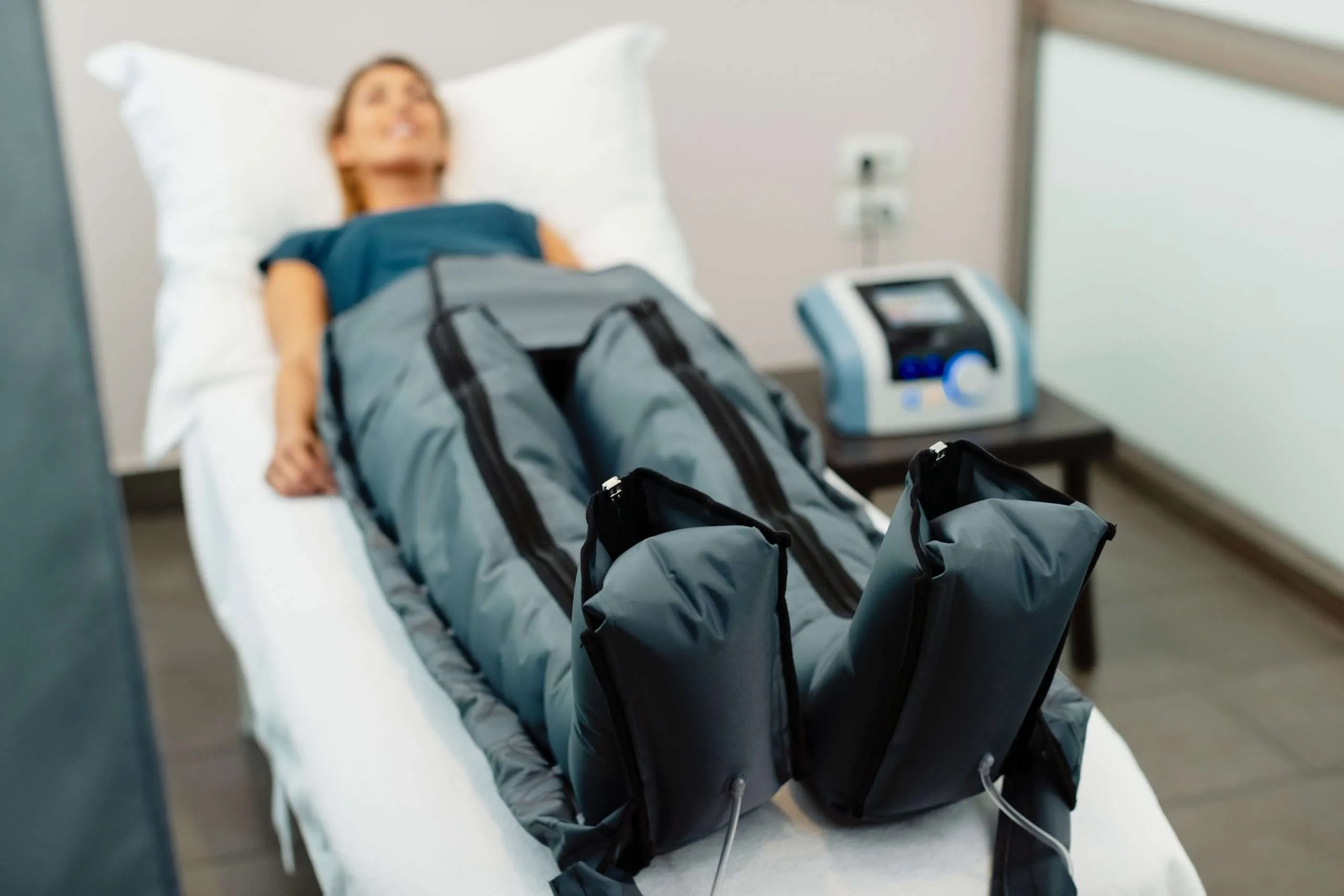
In conservative treatment, supporting manual lymphatic drainage and compression, which are the foundation. The order matters: the right garment and the drainage first, the device after, not the other way round.
In recovery after surgery, where we combine it with cold in the first days for pain and swelling. Here it pays to be precise about what is claimed: the lipedema guideline does not mention cold anywhere, and the evidence for cold plus compression comes from orthopaedic surgery. We use it as a clinic protocol with a reasonable basis, not as a guideline recommendation, and we explain that difference to the patient. Detail in recovery after surgery.
And there is a third use that is almost never mentioned: as a differential diagnosis tool in the conversation. If a patient has had months of pneumatic compression and her leg has not changed at all, that does not mean the device is useless: it means what she has is fat volume rather than fluid, and the plan needs rethinking. That is the point at which many patients arrive at the clinic.
Questions about pneumatic compression in lipedema
Do compression boots help with lipedema?
Yes, for part of the problem. Both reference guidelines include it for pain relief, reducing accompanying oedema and reducing the tendency to bruise, and they state explicitly that it is supportive, not a replacement for manual lymphatic drainage and compression garments. It does nothing to the lipedema fat itself.
Does pneumatic compression remove lipedema fat?
No. It moves fluid, not fat. Lipedema adipose tissue does not shrink under pneumatic pressure, just as it does not shrink with dieting. If your leg feels slimmer after a session, what came down is the fluid component, and it comes back unless the underlying treatment holds.
Can I use it at home?
Yes, and both guidelines say so explicitly: they include it as home therapy. What does not change is that there are contraindications a doctor has to rule out first, and that pressure and duration should be prescribed rather than guessed. Buying the device is the easy part.
How often, and how long per session?
In the published lipedema studies the schedule used was 30 minutes per session, five days a week for five to six weeks, combined with manual drainage and bandaging. For long-term maintenance at home there is no established protocol, so it is decided case by case.
What pressure should I set?
Whatever your doctor prescribes. Devices reach between 12 and 200 mmHg, and the figure usually quoted, 30 to 40 mmHg, comes from studies in chronic venous insufficiency, not in lipedema. Turning it up on your own because "then it does more" is the fastest route to more pain and more bruising.
Should it hurt?
No. In lipedema the tissue is tender and high pressures can be genuinely painful: if it hurts, the pressure is too high or the programme is wrong. It should not leave new bruises either. That is a signal to lower the settings and review, not to push through.
Knee-high boots or full trousers?
It depends on where your lipedema is. If it involves the thigh and the saddlebag area, a sleeve that stops at the knee leaves most of the problem outside it. The pneumatic compression guideline explicitly recommends sequential multi-chamber devices, which push from distal to proximal, over single-chamber ones.
Can I use it during my period or in pregnancy?
The guidelines do not list menstruation as a contraindication: it is a comfort question. Pregnancy does need to be assessed individually with your doctor before use, alongside the rest of the contraindications listed on this page.
Does it replace compression garments?
No. The guideline says it in those words: it is supportive, not a replacement for manual drainage or compression. Garments work all day; the device works for half an hour. If you had to choose one thing only, the compression garment is what holds the result.
Is it covered by insurance?
In Germany these devices sit in the official catalogue of prescribable medical aids, which is why you often read that they "are prescribed". Coverage elsewhere depends entirely on your country and your policy, and it is not usual for lipedema. Ask before buying, and be sceptical of anyone selling it to you as funded.
What about combining it with cold?
Combining pneumatic compression with cold is something we use in the recovery period for pain and swelling in the first days. The evidence for that combination comes from orthopaedic surgery, not from lipedema studies, and that is how we present it: a clinic protocol with a reasonable basis, not a guideline recommendation.
Sources and references
- S2k guideline Lipoedema, AWMF 037-012, v5.0 (22 January 2024). Chapter 5 "Lipödem und IPK", recommendation 5.1, consensus 94.4%. View guideline
- Schwahn-Schreiber C, Breu FX, Rabe E, et al. S1-Leitlinie Intermittierende Pneumatische Kompression (IPK, AIK), AWMF 037-007 (2018). Recommendations 3, 4 and 12. Also published in Hautarzt 2018;69:662-673. View guideline
- Atan T, Bahar-Ozdemir Y. The effects of complete decongestive therapy or intermittent pneumatic compression therapy or exercise only in the treatment of severe lipedema: a randomized controlled trial. Lymphat Res Biol, 2021. View on PubMed
- Volkan-Yazici M, Esmer M, et al. Studies of decongestive therapy combined with intermittent pneumatic compression in upper-limb (2022) and lower-limb (2021) lipedema, cited in the S2k guideline.
- Szolnoky G, et al. Complex decongestive physiotherapy decreases capillary fragility in lipedema, and the 2008 randomised study of decongestive therapy with and without pneumatic compression, cited in the S2k guideline.
- Carballeira Braña A, Poveda Castillo J. The Advanced Care Study. Int J Environ Res Public Health, 2023;20(17):6647. View on PubMed