
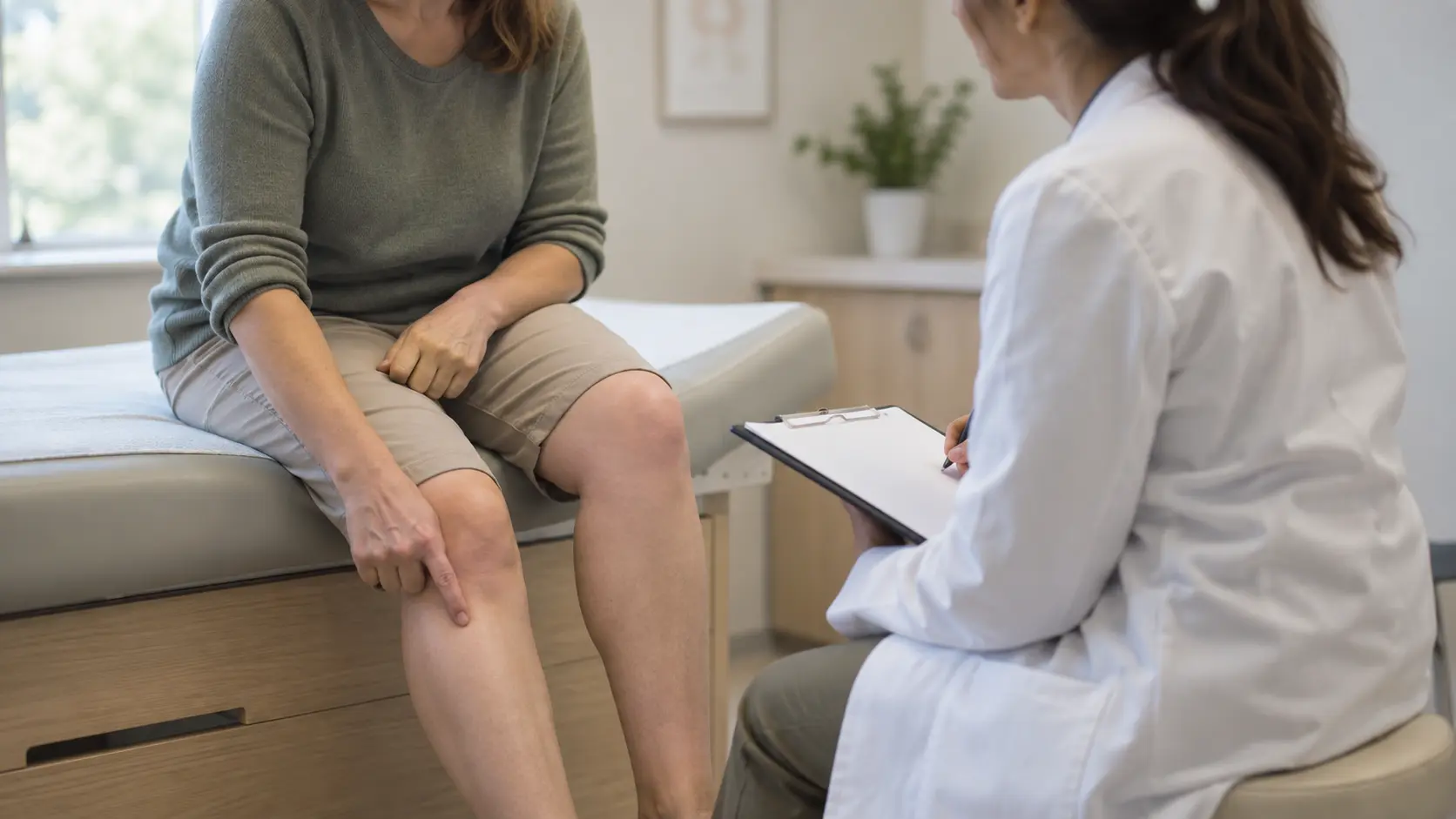
You look at your leg, you see a bruise and you have no idea what you hit. And it is not the first one. The first thing worth knowing is that most bruises are nothing: legs collide with the corner of the bed every single day and most of those knocks never register.
The second is that some bruises with no remembered injury do need a consultation, and a few cannot wait. And the third is the part almost nobody tells you: if you bruise easily, that does not confirm lipoedema, and it does not rule it out either. Lipoedema, also spelled lipedema, is what we treat, which is exactly why we are writing this.
Scope: this article describes clinical practice in Spain. It does not describe what any health system covers.
When a bruise with no injury cannot wait
Two clarifications before the table, because they are the ones most often confused. Petechiae are pinprick red or purple dots, and what distinguishes them is that they do not blanch when you press them: press the side of a clear glass firmly against the skin and ordinary redness fades while those dots stay put. And symmetry: lipoedema is always symmetrical, so a one-sided picture is never "my lipoedema".
| What you notice | What needs ruling out | How urgent |
One leg swollen and painful, skin red, blue or darkened, the other leg normal | Deep vein thrombosis. | Same day. |
The same with breathlessness or chest pain | Pulmonary embolism. | 112. |
Petechiae with fever, severe headache or feeling very unwell | Serious infection. | 112. |
A large, very painful bruise with the area tight and hard | Compartment syndrome. | Same day. |
Skin that is red, hot, painful and spreading, with fever | Erysipelas or cellulitis. | Same day. |
Petechiae without fever, many sudden bruises, or bleeding from gums, nose, urine or stools | Low platelets, a clotting disorder. | Within days. |
Fever, pallor, night sweats or marked fatigue getting worse over weeks | Bone marrow or blood disease. | Within days. |
Disproportionate bleeding after surgery, childbirth or dental work, or a family history of it | Inherited bleeding disorder. | Book an appointment. |
Bruises on the chest, abdomen, back or face with no injury | Atypical site: it gets investigated. | Book an appointment. |
Easy bruising, stable for as long as you can remember, nothing else | Medication, fragile skin. | Routine appointment. |
112 is the emergency number in Spain and across the European Union.
Why a bruise appears when there was no injury
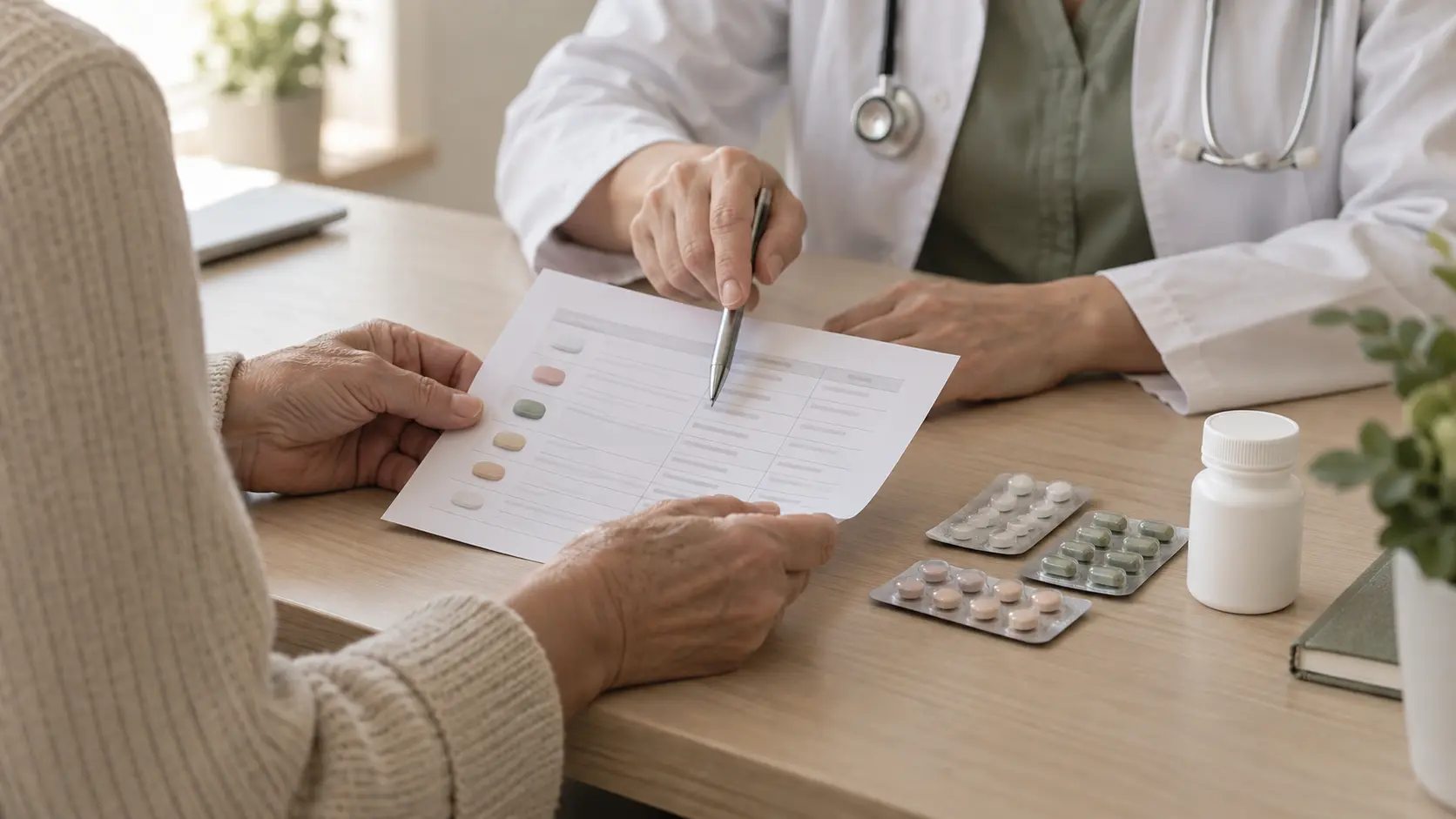
A bruise is blood outside the vessel. When you cannot recall the knock, one of three things is usually happening: the knock did happen and was too small to register, the vessels are more fragile than they should be, or the blood takes too long to seal the leak. The causes below act on one of those three, ordered from most to least common.
Medication, the most common cause and the least suspected
This is the first thing to review and the thing almost nobody checks. Plenty of women arrive at our clinic convinced their bruises come from their legs, when they come from the blister pack.
Anticoagulants: acenocoumarol, warfarin, heparin and the direct oral anticoagulants (apixaban, rivaroxaban, edoxaban, dabigatran).
Antiplatelets: aspirin, including the low cardiovascular-protection doses, plus clopidogrel, prasugrel and ticagrelor.
Anti-inflammatories: ibuprofen and naproxen also interfere with platelet function, more briefly than aspirin but enough if taken often.
Corticosteroids: these work through a different route. Prolonged oral use, and potent topical steroids used for months, thin the skin and make the dermis more fragile.
Ginkgo biloba and garlic supplements (not the garlic you cook with): both can increase bleeding risk, particularly alongside an anticoagulant.
And a correction, because this is one of the most repeated claims and it does not hold up: fish oil and omega 3 appear in almost every article on this subject and the evidence does not support them. They do reduce platelet aggregation in the laboratory, but in pooled randomised trials covering more than 120,000 patients there were no more bleeding events than in the control groups. One caveat from that analysis: high-dose purified EPA, the prescription form, did show a small increase in risk, so there the dosing is a matter for whoever prescribes it. The warning about high-dose vitamin E is also real, but it concerns brain haemorrhage, not bruises on your legs.
Can a medicine make me bruise without an injury?
Yes, and it is the most common cause of all. If the bruising started soon after a change of medication, that is the first thread to pull. And something important: do not stop it on your own, because an anticoagulant is there to prevent something a good deal more serious than a bruise. Take the full list of what you take to whoever prescribed it. Significant bleeding is a different matter: black stools or vomiting blood need immediate medical attention.
Age, sun and skin that has become thin
Over the years, and with accumulated sun, the collagen in the dermis degrades and the tissue that supports the small vessels stops supporting them. A minimal knock is enough. This is actinic purpura, also called senile purpura or Bateman's purpura.
It is common: around 12% of people over 50 and 30% of people over 75. And it has a characteristic distribution: it predominates on the backs of the hands and the extensor forearms, the most sun-exposed areas. It appears on the legs too, but that is not where it predominates. The patches are painless, clear on their own in one to three weeks, and tend to recur. It is a change in the skin, not in the blood, which is why blood tests come back normal.
When the problem is in the blood
Von Willebrand disease
It is the most common inherited bleeding disorder there is, and both figures are worth giving because they get confused constantly: population studies detect it in around 1% of people, but the clinically significant form affects roughly 1 in 1,000. It causes bruising with very little or no trauma.
It is clearly underdiagnosed, and particularly in women: the median delay to diagnosis can exceed 14 years. Although it affects both sexes equally, women get more symptoms, and up to 90% have heavy menstrual bleeding. That is the sign most often missed, because for years it gets normalised as "heavy periods, it runs in the family". So that "heavy" means something, the CDC defines it as soaking through a pad or tampon every one to two hours on your heaviest days, bleeding for more than 7 days, or passing clots larger than a grape.
Low platelets
When platelets fall below 150,000 per microlitre (the normal range runs from 150,000 to 450,000) you get easy bruising, petechiae, purpura and bleeding from the gums or nose. It can be caused by medication, infection, alcohol, autoimmune disease or a bone marrow problem. A full blood count finds it.
Does bruising easily mean I have a clotting problem?
Almost never: most people who bruise easily have a normal clotting screen. What points to a clotting problem is not the isolated bruise but the accompanied bruise: bleeding from the gums or nose, very heavy periods, disproportionate bleeding after a dental extraction or an operation, or a clear family history. If any of those apply to you, ask for it to be investigated.
Three causes that get forgotten
Vitamin deficiencies, in proportion: scurvy (severe vitamin C deficiency) does cause easy bruising and bleeding gums, but it is rare where a normal diet covers vitamin C comfortably. Overt vitamin K deficiency is also uncommon in a healthy adult and rarely causes significant bleeding. If you eat a varied diet, the answer is not here, and the oral collagen recommended in almost every article on this topic has no evidence of reducing bruising.
Liver disease: in cirrhosis, bleeding and bruising easily are common, and the mechanism people repeat is out of date. The diseased liver produces fewer of the factors that promote clotting, but also fewer of the ones that restrain it. You are not simply "bleeding more": it is a new and fragile balance that can tip towards bleeding or towards thrombosis.
Chronic kidney disease: the toxins that build up impair how platelets work even when the count is normal. Mild ecchymoses and purpura are the usual result.
Golfer's purpura, or when your training is to blame
This one is described in the literature and almost nobody mentions it. It is called exercise-induced purpura and the pattern is very recognisable: petechiae or purple patches appearing within 24 hours of prolonged physical activity, especially in heat, characteristically on the legs, and sparing the areas your clothing covered. It is most common in women over 50, the blood tests are normal and it settles on its own in one to two weeks. It matters because it is often mistaken for more serious vasculitis, and that confusion generates tests and worry that were never needed.
Lipoedema and bruising: what you will read elsewhere and what the guideline says
Search for lipoedema and bruising and you will find, on almost every clinic website and on several institutional pages, that easy bruising is a characteristic sign of lipoedema caused by the fragility of the blood vessels in the affected tissue. The current clinical guideline, the S2k Lipoedema guideline AWMF 037-012, version 5.0, January 2024, says something considerably more careful.
It is frequently reported. The guideline records that bruising tendency is a symptom patients report often, citing Forner-Cordero and colleagues in 2021. Isabel Forner-Cordero heads the Lymphoedema Unit at Hospital Universitari i Politecnic La Fe, here in Valencia.
It is not a diagnostic criterion. The same guideline states, in as many words, that given the state of the studies it cannot be used as a decisive diagnostic criterion, and cites four references to support that (Herpertz 1995, Sucker 2021, Szolnoky 2017 and 2008).
And there is more. A comparative study by Erbacher and colleagues in 2023, titled precisely "subjective perception versus objective examination", failed to objectify that greater bruising tendency against women without lipoedema.
And a finding that changes what a clinician does: the guideline records that there is no relationship between the bleeding tendency of lipoedema patients and a coagulation defect (Sucker 2021). Which means that if a clotting problem shows up in a woman with lipoedema, lipoedema does not explain it and it has to be investigated separately.
And we are not alone in saying so: the international Delphi consensus published by the Lipedema World Alliance records that patients frequently report easy bruising in affected areas and adds, with equal emphasis, that it is not pathognomonic for lipoedema and can have various aetiologies.
Both things are true at once. A symptom failing as diagnostic proof does not mean the woman reporting it is imagining it: a great many patients with lipoedema report bruising, and we believe them. What we will not do is sell you the idea that the bruise proves something, because using it as proof has a cost. The case gets closed with a convenient label and nobody looks at the medication, the heavy periods or the liver.
Does easy bruising confirm that I have lipoedema?
No, and it does not rule it out either. What points to lipoedema is different: pain on touch or pressure, symmetrical disproportion between the limbs and the trunk, and hands and feet spared, with a visible cuff at the ankle. The full picture is on our page about lipoedema symptoms.
If you have lipoedema and you bruise, this is what has evidence behind it
There is one measure with evidence and it is not a supplement. The guideline records a 6-week randomised trial (Czerwinska and colleagues, 2023) in which adding flat-knit class 2 compression to an exercise programme produced a significant reduction in palpation pain and in bruising tendency, compared with the same exercise without compression. Compression is used to reduce symptoms, above all pain, and always in the lowest class that gives relief, so that you can actually wear it. We go into this in compression garments for lipoedema.
What to look at, by pattern
| The pattern you describe | First cause to consider | What gets examined |
Started after a change of medication | Medication. | Full treatment review, supplements included. |
Backs of the hands and forearms, thin skin, older age | Actinic purpura. | Skin examination; blood tests usually normal. |
With very heavy periods since adolescence | Von Willebrand disease. | Clotting screen and von Willebrand factor. |
With petechiae, gums or nosebleeds | Low platelets. | Full blood count with platelets. |
On the legs, within 24 hours of a long effort in the heat | Exercise-induced purpura. Not a vasculitis. | Nothing, if it settles in one to two weeks. |
Symmetrical, with pain on touch and disproportion | Lipoedema, on the whole picture and not on the bruise. | Pain on pressure, symmetry, feet spared, Stemmer sign. |
One leg only, swollen and painful | Deep vein thrombosis. Never lipoedema. | Urgent Doppler ultrasound. |
Bruising after lipoedema surgery
If you have had surgery, this section is for you. After liposuction, bruising is to be expected: the technique works with a cannula inside the subcutaneous tissue and discolouration of the treated area is part of normal recovery. It is not a complication. And there is a paradox worth knowing, because it is in the guideline: liposuction, as well as reducing spontaneous pain and pressure pain, markedly improves the bruising tendency of lipoedema itself.
Is bruising normal after lipoedema surgery?
Yes, and it changes colour as it reabsorbs. Timings vary a great deal, so any figure is orientation only: American Society of Plastic Surgeons material places the disappearance of bruising at around the fourth or fifth week. It depends on the volume treated, the area and the individual patient, and anyone who gives you a fixed number is making it up.
Call the clinic without waiting for your review appointment if a haematoma grows quickly, if pain increases instead of easing, if the area feels very tight or hard, if fever, spreading redness or discharge appear, or if you notice swelling and pain in one leg, breathlessness or chest pain. In a review of 1,400 patients operated on in Germany (Cornely, 2022) complications were uncommon: inflammation 1.79%, seroma 0.79%, erysipelas 0.28%, necrosis 0.14% and thrombosis 0.07%. The way to keep those numbers low is to tell us early. The full protocol is in recovery after lipoedema surgery.
What to bring to your appointment
The full list of medicines and supplements, with doses and start dates, including anything bought over the counter.
Photographs of the bruises with something next to them for scale. They reabsorb before the appointment.
How long it has been happening. A new pattern carries far more weight than one that has been stable for years.
Family history of bleeding and what your periods are like, honestly. These are the details most often left out and among the most informative.
What tests are done for bruising with no injury?
Not always any. When there is a reason, the usual starting point is a full blood count with platelets and a basic clotting screen, extending from there according to the suspicion: von Willebrand factor if there is heavy menstrual bleeding, or liver and kidney function. If there is also swelling in one leg, the test is a Doppler ultrasound and it is urgent.
Where we can look at this for you
We are a clinic dedicated to lipoedema, not a haematology service, and it is worth saying plainly: if your bruising comes from your medication, your clotting or your liver, the person who needs to see you is your GP or a haematologist, and this article was written so that you arrive with the right questions. What we do in depth is lipoedema diagnosis, which is clinical and rests on examination, not on a bruise.
If what actually worries you is your legs rather than the bruises, which is the most common story in our clinic, start with what lipoedema is, then the lipoedema test, and if pain is what limits you most, why your legs hurt.
We are based in Valencia, Spain, and consultations are held in Spanish and in English, which matters if you live on this coast and do not read Spanish comfortably. If you are travelling from abroad, the practicalities are set out on our page for international patients. You can see who would be seeing you on the medical team page, and write to us through contact us.
Sources and references
Guideline S2k Lipoedema, AWMF 037-012, version 5.0 (2024). For the diagnostic value of bruising tendency (chapter 2.2.2), the absence of any relationship with a coagulation defect, the compression plus exercise trial, the improvement after liposuction and the complication rates.
Lipedema World Alliance, international Delphi consensus. For easy bruising not being pathognomonic for lipoedema.
CDC, von Willebrand Disease and review of its underdiagnosis.
StatPearls, Actinic Purpura, NHLBI, Thrombocytopenia and MedlinePlus, Bleeding into the skin.
Omega 3 and bleeding events, Exercise-induced vasculitis and Cirrhotic coagulopathy.
Carballeira Brana A, Poveda Castillo J. The Advanced Care Study: Current Status of Lipedema in Spain. Int J Environ Res Public Health. 2023;20(17):6647. Our own team's study.
Reviewed by Dr Alexo Carballeira Braña, specialist in Plastic, Aesthetic and Reconstructive Surgery and medical director of Lipedema Advanced Care.
Published on 10 September 2026.
This page is for information purposes and does not replace a medical consultation. Lipoedema is diagnosed clinically and must be diagnosed by a professional experienced in the condition. Seek same-day care if one leg is swollen and painful, if petechiae appear that do not blanch on pressure, if a haematoma is large and very painful with the area tight and hard, if bruising comes with bleeding from the gums or nose, blood in the urine or stools, fever or marked fatigue, or if you notice an area of red, hot, painful skin that is spreading. Call 112, the emergency number in Spain and across the European Union, if there is breathlessness or chest pain, or if petechiae come with fever, severe headache or feeling very unwell.

