
Which doctor diagnoses lipedema? There is no single specialty “for lipedema”. The diagnosis is clinical and can be made by a doctor who knows the condition and examines you carefully. What matters most is not the label of the specialty, but that whoever sees you has seen lipedema before, asks you about pain and examines your legs, your feet and, where relevant, your arms.
When should you book an appointment? When you notice a symmetrical increase in volume in your legs (or arms) that does not affect your trunk, and also it hurts when you press or touch it, or you feel heaviness. If you have spent years feeling that “something does not add up” and you have only been told about weight, a second look is also worthwhile.
In this article we look at who to see and what to expect from the appointment. How the diagnosis is reached, step by step, is in the guide to the diagnosis of lipedema.
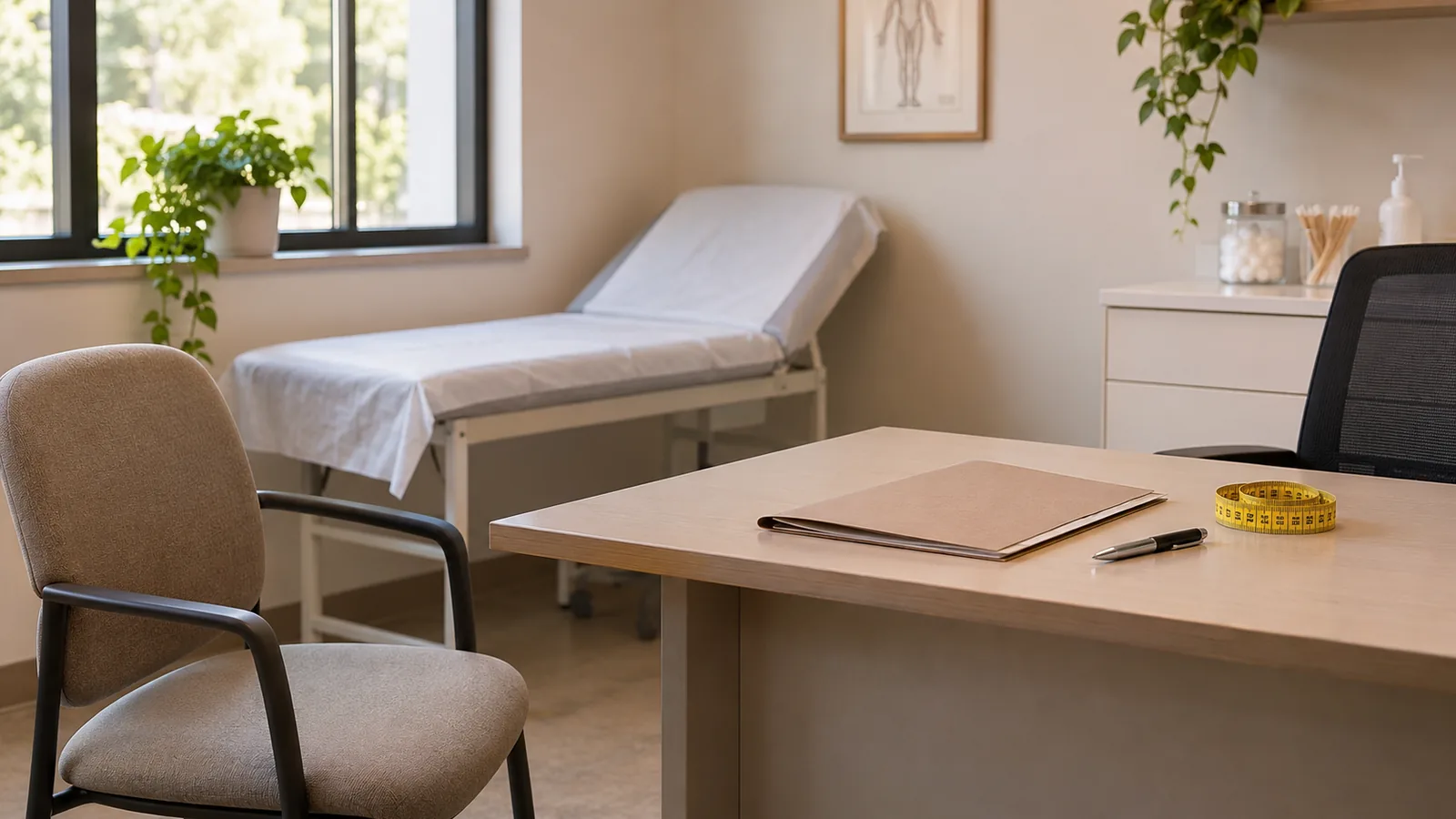
Who to see: what the clinical guideline says and what it does not say
The S2k clinical guideline (2024) establishes that the diagnosis of lipedema must be made clinically: from the history and the physical exam, because there is no imaging or laboratory test that demonstrates it. And in its recommendations on diagnosis it does not reserve it for any specific specialty.
What the guideline does say is who wrote it: scientific societies of phlebology and lymphology, dermatology, internal medicine, angiology, vascular surgery, general surgery and plastic surgery, together with representatives of lymphology, physiotherapy and patient associations. It is a condition that crosses several disciplines, which is why there is no “lipedema doctor” with a single label.
Put another way: there are several ways in and none of them is the only correct one. What you should ask of whoever sees you is this:
That they ask you about pain. The S2k guideline considers pain on pressure and touch, spontaneous pain and a feeling of heaviness to be symptoms of lipedema.
That they examine you. That they look at how the volume is distributed, whether it is symmetrical, whether the trunk is left out and whether the feet and hands are spared.
That they explain what they are ruling out. Many tests serve to rule out other causes of swelling, not to confirm lipedema.
If the appointment was settled by looking at your weight or with a normal blood test, lipedema has been neither confirmed nor ruled out: the guideline points out that blood tests can help rule out other diseases, but not demonstrate lipedema.
When to book an appointment
You do not need all of these signs, and none of them confirms anything on its own. If several coincide, it is a good time for an assessment:
Symmetrical disproportion: more volume in the hips, thighs and legs than in the waist and trunk, the same on both sides. The S2k guideline states that lipedema appears only in the extremities, and that the feet and hands are not affected.
Pain on pressure or touch, spontaneous pain or heaviness in that area. According to the S2k guideline, a disproportionate increase in volume without discomfort is not diagnosed as lipedema.
An onset tied to a hormonal stage: the S2k guideline notes that the onset or worsening of symptoms almost always occurs in phases of hormonal change, such as puberty, after a pregnancy or at menopause.
Years of explanations that do not fit: “it is overweight,” “get some blood tests,” “it is fluid retention,” without anyone having examined your pain or the symmetry.
You can organize what you notice with the symptoms of lipedema and get your bearings with the lipedema test, which is not a diagnosis, only a starting point for the appointment. If you want to compare with how it is described at a glance, see what lipedema looks like.
Where to start: three reasonable paths
There is no single path. These three are the usual ones and they can be combined:
Your family doctor. It can be a first step: tell them about the pain, the symmetry and how long it has been going on. If after examining you they are not sure, you can ask them to refer you or look for a consultation with experience in lipedema.
A consultation with experience in lipedema, whatever the professional’s specialty. Ask naturally how many patients with lipedema they see and how they do the exam. A clear answer is a good sign.
A second opinion, if the first answer was “it is overweight” or “it is cellulite” without an exam, or if your symptoms do not match what you have been told.
What is not advisable is to settle for an answer that did not include an exam. And there is no need to go from specialist to specialist either: what helps is reaching someone who examines you, not someone with the right title.
What to expect at the first appointment
Every appointment is different, but these are the usual steps of a well-done assessment:
Your history. When it started, whether it coincided with puberty, a pregnancy or menopause, whether relatives have the same leg pattern and what your pain is like. What you tell them weighs as much as what can be seen.
The physical exam. They observe the distribution of volume and the symmetry, check whether the foot and hand are spared and palpate the tissue to assess sensitivity to pressure.
Questions about how you live with the pain and your day-to-day life. The S2k guideline recommends including psychosocial factors in the assessment of the pain associated with lipedema, because they can influence symptoms and quality of life. It is not a doubt about your mind: it is part of understanding your whole case.
Tests, only if needed. A blood test can rule out other causes of swelling (the guideline cites hypothyroidism, a kidney problem or heart failure as examples). A duplex ultrasound can detect associated vascular problems, such as varicose veins or other venous abnormalities. None of these tests confirms lipedema.
An explanation at the end. If you meet the clinical criteria, what other causes were considered and what the next step is. If it is not lipedema, they should also tell you clearly.
Two points from the guideline avoid misunderstandings at the appointment. The first: the appearance of the tissue and the “grades” do not measure severity; they are descriptive, and there is no severity scale for symptoms. The second: the criterion of “nodular fat,” widely used in the past, should not be used on its own to diagnose. Whoever examines you should rely on pain, symmetry and the exam, not on a single feature. If you want to know more about the stages, we explain them in the stages of lipedema.
What whoever examines you will have to distinguish
Having voluminous legs has several causes, and part of the work of the appointment is telling them apart. This table sums up what the professional looks at:
| Condition | What sets it apart | What is looked at in the appointment |
Lipedema | Symmetrical, disproportionate increase in the extremities, with pain on pressure or touch | Pain, symmetry, trunk without that increase, feet and hands spared |
Obesity | Proportionate increase in volume across the whole body. It can coexist with lipedema | Distribution of volume, trunk included, and whether or not there is pain on pressure |
Lymphedema | Swelling from fluid buildup | Whether it affects the foot, Kaposi-Stemmer sign, and whether there is pitting edema on pressure |
Cellulite | Superficial “orange peel” appearance, with no disproportion between trunk and legs | Appearance of the skin, absence of intense pain and of a step at the ankle |
Lipohypertrophy | Symmetrical disproportion like that of lipedema, but it does not hurt | Whether there is pain or not: without discomfort it falls outside the S2k guideline’s definition of lipedema |
There is one special case: lipedema and obesity can occur at the same time. The S2k guideline states that overweight and obesity are the conditions that most often accompany lipedema, although only a minority of patients have a normal weight. That is why being overweight does not rule out lipedema. We go into this in lipedema or lymphedema and in the difference between lipedema and cellulite.
If you have been told it is overweight
It is one of the phrases most often repeated by women who come to a consultation after years of explanations that did not fit, and it has some truth in it: overweight is common in lipedema. But “it is overweight” is not a complete diagnosis if nobody has examined the pain, the symmetry or the feet.
It is not a problem of your willpower. If after reading this you recognize your story, you can ask for a second assessment with these questions, without confronting anyone: “Did you examine the pain on pressure?”, “What have you ruled out and how?”, “Could someone with experience in lipedema see me?”
Warning signs: when not to wait to book an appointment
There are situations that are not typical of lipedema and require prompt medical attention. Go to the emergency room if a leg becomes red, hot and painful with a fever, or if a single leg swells suddenly. They can occur in addition to lipedema, which is why it is advisable not to put them down to it.
Book an appointment soon, without waiting weeks, if the swelling is new, grows quickly, affects the feet or only one side, or if the pain increases and limits your day-to-day life. There is no need to wait until you are “sure” it is lipedema: whoever examines you will decide what needs to be looked at.
What to bring and what to ask
Arriving with your history in order shortens the appointment and makes it more useful. What helps to bring:
A short timeline: when it started, which hormonal stages coincided and what has changed over the years.
What your pain is like: whether it appears on pressure or spontaneously and when it gets worse.
Previous reports and tests, even if they “came back fine,” and a list of what you take.
Family history with a similar leg pattern.
And these are useful questions to ask the professional, written down so they are not forgotten:
Do my symptoms fit lipedema, something else or a combination?
What have you already ruled out and what is left to rule out?
Do I need any test and, if so, what is it for: to rule out or to confirm?
What experience do you have with lipedema?
What is the next step and when do we see each other again?
The complete list of what to prepare is in the guide to the diagnosis of lipedema.
What the assessment is like at Lipedema Advanced Care
At our lipedema clinic in Valencia, Spain, the assessment is carried out by a plastic surgeon and a specialist in angiology and vascular surgery, in the same process. You can get to know them on the medical team page. We review your history, examine you and explain what we have seen. If it is not lipedema, we tell you, because ruling it out is also part of the work.
If you would like us to review your case, you can write to us through the clinic’s contact form. If it is confirmed, what comes next is in lipedema treatment.
Frequently asked questions about which doctor diagnoses lipedema
Which doctor diagnoses lipedema?
There is no single specialty. The S2k guideline states that the diagnosis is clinical and does not reserve it for any specific specialty. What matters is that it is made by an experienced professional who asks you about pain and examines you. If you are unsure where to start, your family doctor or a consultation with experience in lipedema are reasonable starting points.
Which specialist treats lipedema?
It depends on what you need at each moment. The S2k guideline includes, for example, compression to reduce pain in the affected extremities, and the guideline itself was drawn up by several specialties. What decides each case is the team that assesses you; we cover it in lipedema treatment.
Can my family doctor diagnose it?
It can be a first step, because the guideline does not reserve the diagnosis for any specialty. If they examine you, ask you about pain and it fits what the guideline describes, that is fine. If they are not sure, you can ask them to refer you or ask for a second opinion with experience in lipedema.
Is an MRI, an ultrasound or a blood test needed to diagnose it?
No. The S2k guideline recommends diagnosing it clinically, and points out that blood tests and imaging tests cannot demonstrate lipedema. They can be requested to rule out other causes, such as a thyroid, kidney or vein problem.
What if I am told it is overweight or cellulite?
There may be overweight, because it is common alongside lipedema, but on its own it does not explain pain on pressure or a symmetrical disproportion. If nobody has examined those features, it is reasonable to ask for a second assessment. The difference between lipedema and cellulite is explained in detail.
When should I go to the emergency room instead of booking an appointment?
If a leg becomes red, hot and painful with a fever, or if a single leg swells suddenly. These are not typical of lipedema and can occur in addition to it. For the other signs, book an appointment calmly, but without delaying it.
Sources and references
Guideline S2k Lipoedema, AWMF 037-012, version 5.0 (2024). Recommendations 2.1, 2.2, 2.3, 2.4, 2.5, 2.12, 2.14, 2.16, 4.1, 8.1 and 8.2; list of participating societies; sections 2.2.2 (symptoms) and 2.1.1 (weight), and the section on hormones.
Content prepared by the medical team at Lipedema Advanced Care based on the S2k lipedema guideline (AWMF 037-012, 2024 version) and the sources cited.
Published in November 2026.
This page is for information purposes and does not replace a medical consultation. The diagnosis of lipedema is clinical and must be made by an experienced professional. The images are for reference and do not depict any real patient.

