

Knee fat, especially the kind that gathers on the inner side of the knee, is almost always normal fatty tissue that follows the way your body stores fat. But when it appears equally on both knees, hurts when you press it and forms a clear step against the rest of the leg, it may be one of the typical sites of lipedema. Here we explain how to tell one from the other, and from a third thing that is not fat at all: a knee swollen by a problem in the joint.
Many patients come to their first appointment with the same sentence: “my knees are fat even though I am slim”. It is not a minor cosmetic complaint, and it is not something you are meant to fix with squats. It is a clinical question, and it has an answer.
The urgent part first: when it is not fat and cannot wait
Fat does not appear overnight and it does not turn hot. If your knee changes suddenly, what needs ruling out is a problem in the joint or in the veins. Seek medical attention today if you recognize any of these:
A hot, red, swollen knee, with fever or severe pain when you move it: septic arthritis, an infection of the joint, has to be ruled out. The knee is one of the joints it most commonly affects, and the symptoms come on quickly. If treatment is delayed, it can leave lasting damage to the joint.
Swelling after a knock, a twist or a fall, especially if you cannot put weight on the leg, or the knee locks, gives way or looks deformed.
A single swollen, painful leg, with a tense, warm or bluish calf: a deep vein thrombosis has to be ruled out. We explain this in our guide to the hard swollen leg.
None of the above is lipedema. Lipedema always affects both legs symmetrically, does not cause a fever and does not appear suddenly.
Three different things people call “fat knees”
Behind the same search there are three different situations, and it is worth separating them before thinking about any treatment.
What causes fat around the knees?
Three things that look alike from the outside. The first is general weight gain: fat is distributed proportionally and also increases around the trunk and waist. The second is a disproportionate distribution that does not hurt, with more volume in the legs than in the trunk but no discomfort; the reference clinical guideline calls this lipohypertrophy and is clear that it is not lipedema. The third is lipedema: a disproportionate, symmetrical and painful increase in the fatty tissue of the limbs.
What separates the three is symptoms. The German S2k guideline of 2024 explains, in the text that develops its definition (Recommendation 1.1), that lipedema is always painful. And in Recommendation 2.2 (100% consensus) it states that a disproportionate increase in fat without symptoms (no pain on pressure, no spontaneous pain, no heaviness) should not be diagnosed as lipedema.
What is the fat on the knee called?
The fat you can see and pinch on the inner side is subcutaneous fat, the layer just under the skin. In lipedema, the guideline describes those symmetrical, painful deposits above or below the knees with a German word, “Wammen”, roughly pads or folds of fat. There is another fat with a name of its own, Hoffa’s fat pad, but it sits inside the knee capsule and has nothing to do with the volume you can see.
That puzzling line between thigh and knee
It is the detail many patients describe without knowing it has a name. The leg thickens up to a point and, just below, the width drops abruptly: a step, a “cut-off”, sometimes a roll of fat that falls over the knee or rests against its inner side. The S2k guideline calls it a step change in caliber toward the unaffected area and considers it typical of lipedema, with the image of a cuff or collar around the leg.
That line can appear at three levels:
Above the knee: the thigh is full and the leg narrows from the knee down. This matches the pattern the classifications describe as lipedema “down to the knees”, type II.
At the knee itself: the pad on the inner side stands out and shapes the contour.
At the ankle: when lipedema continues down the calf, the step appears just above the foot. In The Advanced Care Study, our team’s survey, in which 1,069 people in Spain answered and 969 were analyzed, the most frequent type was type III, which involves the hips, thighs and calves.
Put another way: what gives lipedema away is not how much fat there is on the knee, but that the fat stops abruptly, is the same on both sides and leaves the feet free. The guideline stresses that the feet and hands are not affected. If you want to see how these patterns are described, they are set out in the stages and types of lipedema; remember that a stage describes the state of the tissue, not a life sentence.
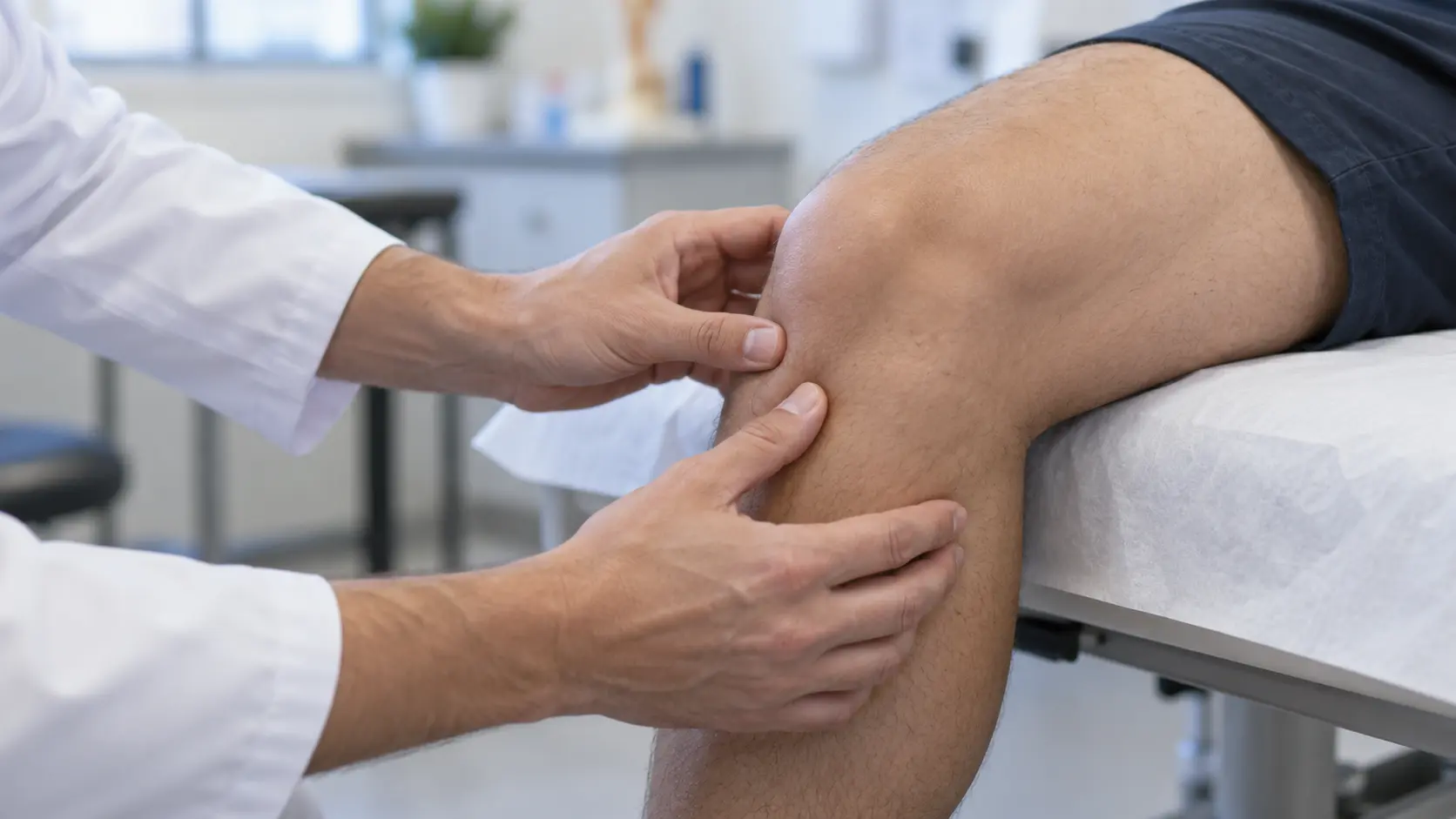
Localized fat or lipedema: how to tell them apart
No single feature makes the diagnosis, but together they draw a pattern. This is the table we use to structure the conversation in consultation.
| What is assessed | Constitutional localized fat | Lipedema | Swollen knee (joint problem) |
Pain on pressure | No | Yes, very characteristic | Pain in the joint, especially on movement |
Symmetry | Usually symmetrical | Always both knees equally | May be one knee only |
Shape | Blends into the thigh, no step | Step change in caliber, or a roll over the inner side | The swelling is in the joint, sometimes behind it |
Relation to the trunk | Proportional if it comes with weight; disproportionate but not painful in lipohypertrophy | Disproportion: slimmer trunk than legs | Unrelated |
Feet | Unchanged | Spared | Unchanged |
Onset | Gradual, with weight | Over years, often from puberty or a hormonal change | Sudden after an injury, or slow, as in osteoarthritis |
Who assesses it | GP or family doctor | A doctor experienced in lipedema | Orthopedics |
Look at the first row, but do not stop there. If you notice no symptoms at all (no pain on pressure, no spontaneous pain, no heaviness), the guideline does not consider it lipedema.
What is lipedema in the knee?
It is the same condition as in the rest of the leg, seen at one of its typical sites. The S2k guideline defines lipedema (also spelled lipoedema) as a painful, disproportionate and symmetrical disorder of fat distribution in the limbs that occurs almost exclusively in women (Recommendation 1.1, 100% consensus), and names painful deposits above or below the knees as characteristic. The guideline does not describe a lipedema confined to the knees: these deposits usually accompany involvement of the thighs or calves.
How do I know if I have lipedema in my knees?
Ask yourself three questions. Does it hurt when you press the pad on the inner side? Is it the same on both knees? Is there a step between the thickened area and the unaffected one, with your feet spared? If the answer to all three is yes, it is worth an assessment. Many patients also notice that they bruise easily; this is common, but the guideline warns that it is not a decisive criterion. The diagnosis is clinical (Recommendation 2.12): no blood test or scan confirms it, and it is made by a doctor who examines you. You will find the full list in the symptoms of lipedema.
When it is not fat: the knee that swells from the inside
A knee can get bigger without any extra fat. The most common causes lie in the joint and are managed by orthopedics: osteoarthritis and other forms of arthritis, bursitis from repeated pressure (kneeling for long periods at work, for example), meniscus or ligament injuries and a Baker’s cyst, a fluid-filled swelling behind the knee. We mention them only to rule them out: if your knee swells, hurts when you bend it or locks, you need a different kind of appointment.
How do you reduce inflammation of Hoffa’s fat pad?
Hoffa’s fat pad is the infrapatellar fat pad: it sits inside the knee capsule, behind the tendon that joins the kneecap to the shinbone. When it becomes inflamed it causes pain at the front of the knee; it is not the pad you can pinch on the inner side. It is neither localized fat nor lipedema. It is usually managed conservatively, with physical therapy, as advised by an orthopedic specialist after examining you; it makes no sense to apply to it what is used for subcutaneous fat.
The knee and walking in lipedema
This section explains why the assessment is not only about appearance. The S2k guideline notes that, when the increase in fat is very marked, changes in the alignment of the knee (knock knees, known as genu valgum) and skin damage from friction between the legs can appear.
The guideline also cites studies describing lower quadriceps strength in patients with lipedema and altered alignment of the hips and knees, which changes the way you walk and may favor orthopedic injuries, particularly in the hip and knee. The evidence is limited (one of those studies included 22 patients), and the guideline itself lists limited mobility and orthopedic complications among the aspects weighed when surgery is indicated (Recommendation 12.2). If you notice that your legs rub when you walk, that the inner side of your knees gets irritated or that you tire sooner, mention it in consultation.
What exercise does and does not do
Exercise is essential, but it does not do what half the internet promises. What it does not do: burn fat from one specific area. In a study published in 2013, a group of 11 young people trained one leg only, with around a thousand leg press repetitions per session, three times a week, for 12 weeks. They lost fat, but from the trunk and arms, not from the trained leg. Squats do not slim the knee.
What it does do, and in lipedema this matters a great deal:
It reduces pain. The S2k guideline recommends including movement with compression, or a training program, in treatment, because it is an important element in reducing pain (Recommendation 7.2, 100% consensus). Exercise in water may add benefit (Recommendation 7.5).
It strengthens the quadriceps, the muscle that supports the knee and that may be weaker in lipedema.
It helps manage weight, and that counts: if there is overweight or obesity alongside lipedema, the guideline indicates that losing weight with an appropriate diet can also reduce leg volume (Recommendation 10.2, 100% consensus).
Both things are true at once: diet and exercise do not make the disproportion of lipedema disappear, but weight and general health do respond, and they do change how your legs feel. You will find adapted routines in exercises for lipedema.
How do you lose knee fat?
It depends on what it is. If it is fat that came with weight gain, it reduces as overall body fat comes down, through diet and physical activity, not through spot exercises. If it is a pad that hurts when pressed, symmetrical and with a step, then before looking for ways to reduce it you need to know whether it is lipedema, because that changes what makes sense to do and what does not.
Cryolipolysis and cosmetic treatments versus lipedema
If you search online, you will find cryolipolysis (fat freezing), laser, radiofrequency and creams. The honest approach is to separate what each one is:
For localized fat without disease, cryolipolysis and other cosmetic treatments are an option assessed within aesthetic medicine. They are not free of adverse effects: a 2025 systematic review of more than 13,000 patients estimated, with low-certainty evidence, that paradoxical adipose hyperplasia, an increase in fat in the treated area, occurs in 1 in 455.
For lipedema, the 2024 S2k guideline does not include cryolipolysis or other non-invasive cosmetic treatments among its recommendations. Its conservative treatment includes, among other measures, compression to reduce pain (Recommendation 4.1), movement and weight management.
When surgery is needed in lipedema, the guideline recommends liposuction as the surgical method of choice to reduce the affected tissue (Recommendation 12.1), with a medical indication: pain that does not improve with conservative treatment, mobility, skin or orthopedic complications, and treating any associated obesity first (Recommendation 12.2). Liposuction of a fat distribution that does not hurt falls outside the guideline. It is not the same as cosmetic knee liposuction.
Cellulite, by the way, is something else: a change in the surface of the skin that does not hurt when pressed. We cover it in detail in the differences between lipedema and cellulite.
Why a medical assessment comes before a cosmetic one
If a clinic offers to treat the fat on your knees without asking whether it hurts, without looking at your thighs, calves and feet, and without measuring your waist, it is treating a shape, not a patient. In lipedema the order matters, for three reasons:
The diagnosis changes the plan. What makes sense for constitutional fat is not what makes sense for lipedema, and vice versa.
What mimics it has to be ruled out: obesity, lymphedema, venous problems or joint problems.
Lipedema is not a life sentence. The S2k guideline says it should not be understood as a disease that always worsens as a matter of principle, because its course depends on several factors (Recommendation 2.10). Knowing in time lets you act on those factors.
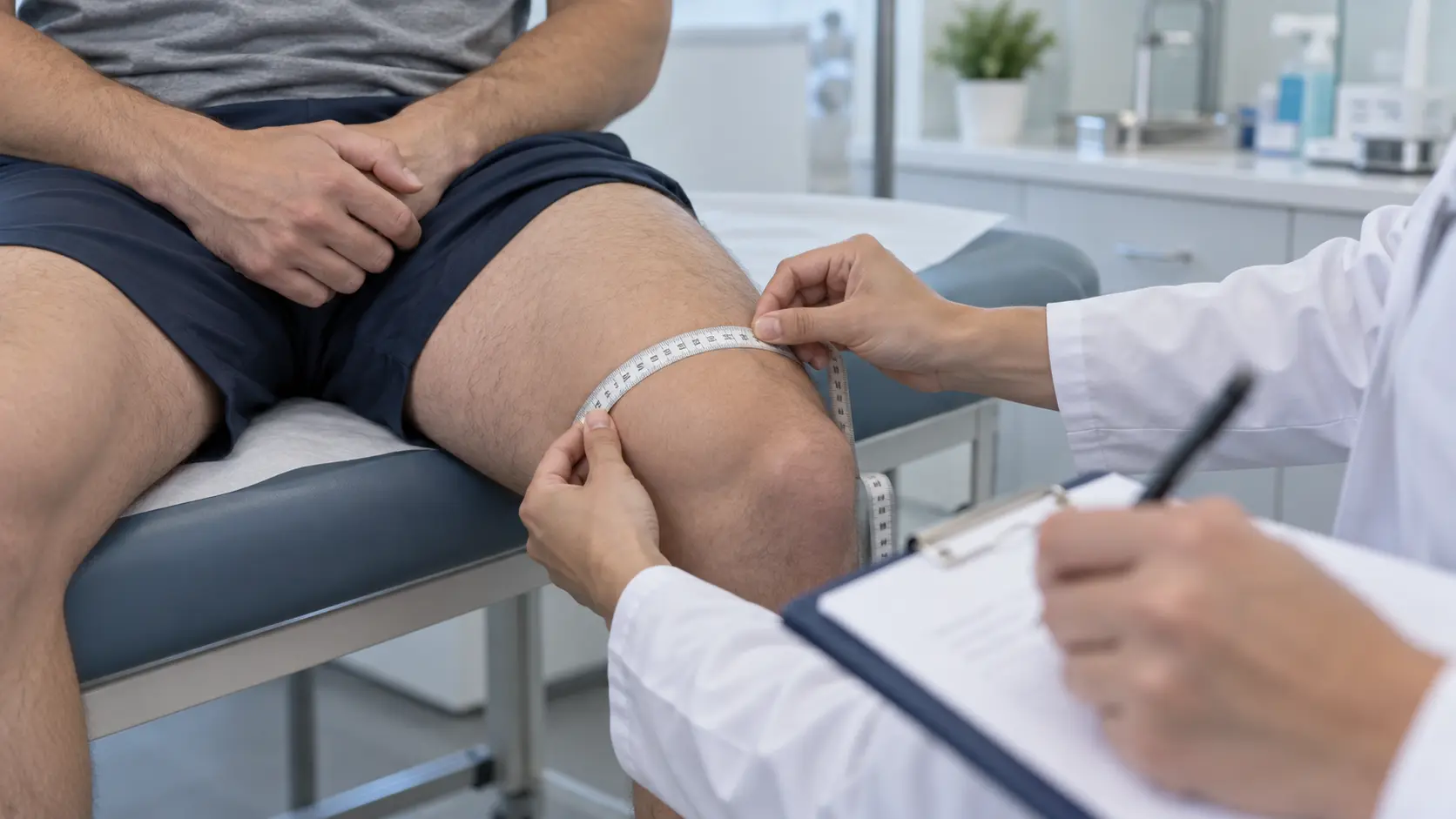
If you have spent years looking at your knees without an explanation, the first step is not a treatment: it is a diagnosis. At our lipedema clinic in Valencia, the assessment includes examining both legs, checking for pain on pressure and for the step change in caliber, measuring waist and hips and ruling out other causes. We explain step by step what the diagnosis of lipedema involves. If you are considering traveling to Spain for it, the practical side is set out for international patients. And if your question goes beyond the knees, start with what lipedema is.
Sources and references
Guideline S2k Lipoedema, AWMF 037-012, version 5.0 (2024). For the definition and pain as a constant feature (Recommendation 1.1 and its text), symptoms as a requirement and lipohypertrophy (Recommendation 2.2), the step change in caliber and the deposits around the knees, symmetry and the sparing of the feet, bruising, clinical diagnosis (Recommendation 2.12), genu valgum, gait, exercise (Recommendations 7.2 and 7.5), weight (Recommendation 10.2), compression (Recommendation 4.1), liposuction (Recommendations 12.1 and 12.2) and the course of the condition (Recommendation 2.10).
Carballeira Braña A, Poveda Castillo J. The Advanced Care Study: Current Status of Lipedema in Spain. Int J Environ Res Public Health, 2023;20(17):6647. PubMed.
Ramírez-Campillo R et al. Regional fat changes induced by localized muscle endurance resistance training. J Strength Cond Res, 2013. PubMed.
Mah AE et al. Incidence of Paradoxical Adipose Hyperplasia After Cryolipolysis: A Systematic Review and Meta-Analysis. Aesthet Surg J Open Forum, 2025. PubMed.
Hoffa Pad Impingement Syndrome. StatPearls. DuBose M, Taqi M.
Content prepared by the medical team at Lipedema Advanced Care based on the S2k lipedema guideline (AWMF 037-012, 2024 version) and the sources cited.
Published in October 2026.
This page is for information purposes and does not replace a medical consultation. The diagnosis of lipedema is clinical and must be made by a professional with experience in the condition. Seek medical attention the same day if your knee is hot, red or suddenly swollen, if you have a fever, if it swelled after a knock or a twist, if you cannot put weight on it or it locks, or if you have a single swollen, painful leg.

