
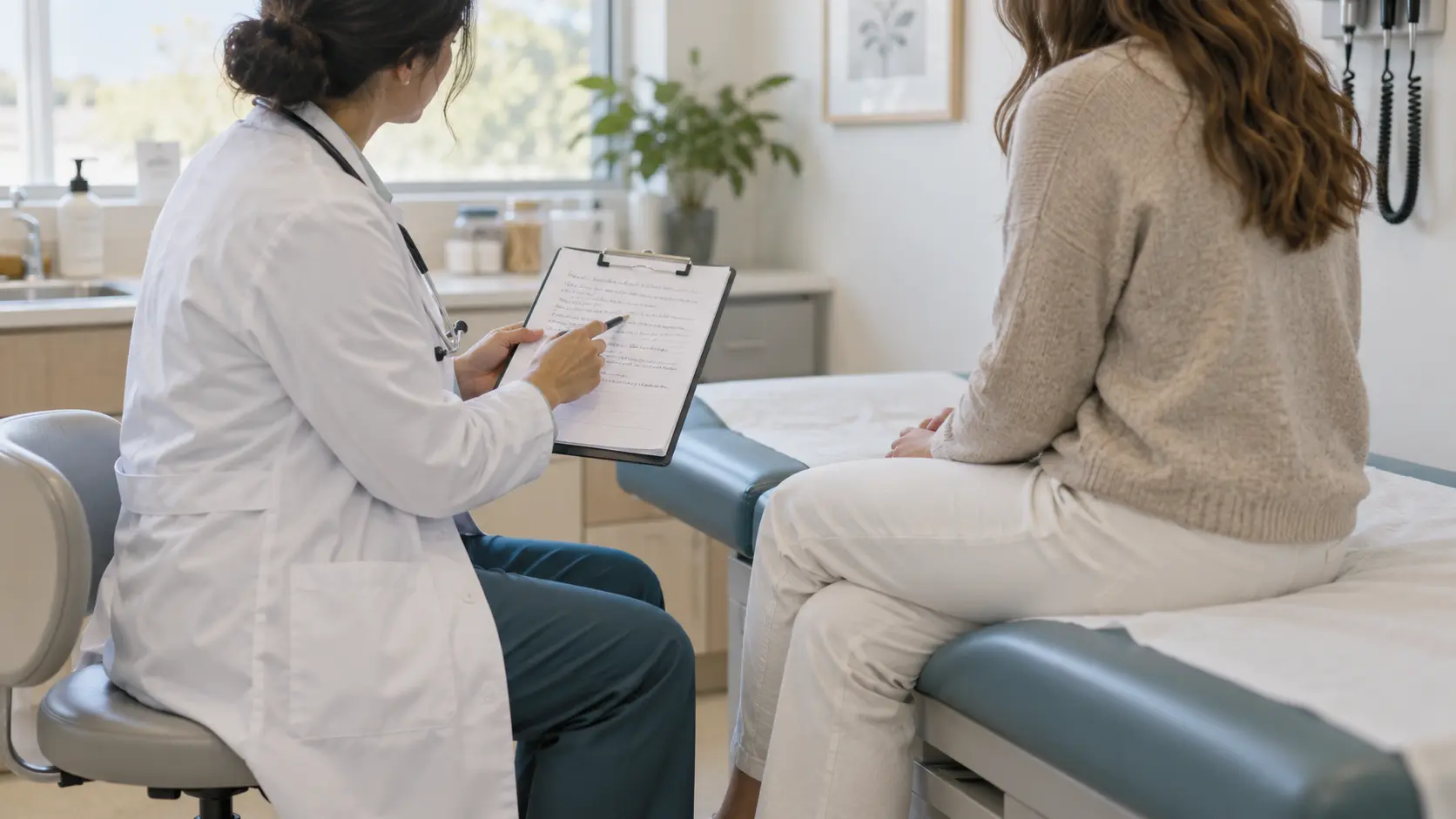
Lipedema or lymphedema? They are two different conditions that are easily confused because both make the legs larger. Lipedema is a disorder of fat that is symmetrical and painful when pressed and spares the feet and hands; lymphedema is a buildup of fluid caused by a failure of the lymphatic system, often on one side only, and it usually does reach the foot and toes.
If you have been told one thing and suspect the other, you are not alone: in our study on the situation of lipedema in Spain, in which 1,069 people answered the questionnaire and 969 were analyzed, the conclusion was that there is a real diagnostic problem. Here you will find the criteria used in consultation to tell them apart, a table to see them at a glance, and the nuance almost nobody explains: sometimes they coexist. (In British English you will also see them spelled lipoedema and lymphoedema: they are the same conditions.)
The urgent part first: when not to wait
Before comparing two long-term conditions, rule out what has to be seen the same day. If you recognize any of these, seek medical attention today:
Red, hot, painful skin with fever or chills: this may be erysipelas or cellulitis, a skin infection that is a known complication of lymphedema. It needs assessment and, if confirmed, antibiotics.
One leg that swells suddenly, especially with calf pain, warmth or redness: a deep vein thrombosis has to be ruled out. If you are also short of breath or have chest pain, it is an emergency: call your local emergency number (112 in Spain and the EU, 999 in the UK, 911 in the US).
A wound that will not heal on a swollen leg.
And although it is not urgent, see a doctor soon if, as an adult, a single limb starts to swell for no known reason: the International Society of Lymphology consensus points out that in that case the cause of the obstructed drainage has to be investigated.
What each one is, in two paragraphs
Lipedema is a disorder of fat distribution that affects only the limbs, and does so symmetrically: both hips, both thighs or both calves (and, in the arms, both sides). The trunk, head and neck are not involved, and neither are the feet and hands. It occurs almost exclusively in women, and its first appearance or worsening almost always coincides with phases of hormonal change: puberty, pregnancy or menopause. And it hurts: the reference clinical guideline states that lipedema is always painful, and that a disproportionate increase in fat that does not hurt is called lipohypertrophy, not lipedema.
Lymphedema is something else: the lymphatic system transports less than the tissue needs, and the protein-rich fluid stays behind. It can be primary, due to an abnormality of the lymphatic system present from birth, or secondary, when drainage is damaged by surgery with lymph node removal, radiotherapy, injury or repeated infections. It is not a condition exclusive to women and, particularly in its secondary form, it often affects a single limb.
What is the difference between lipedema and lymphedema?
Put simply: in lipedema what increases is fat, and in lymphedema what builds up is lymph. That is why lipedema is symmetrical, spares the feet and hurts when pressed, whereas lymphedema can be one-sided, spreads to the top of the foot and the toes, and is not painful to pressure the way lipedema is. Imaging studies have not shown edema in pure lipedema: the tissue is enlarged, but not waterlogged.
Lipedema vs lymphedema: the differential diagnosis table
This is the comparison we make in consultation, criterion by criterion. Read it as a whole: no single row makes a diagnosis.
| Criterion | Lipedema | Lymphedema |
What increases | Subcutaneous fat, out of proportion to the trunk | Protein-rich fluid; over the years, fibrosis and fat as well |
Who it affects | Almost exclusively women | Women and men |
When it starts | Almost always at times of hormonal change: puberty, pregnancy, menopause | Primary: from childhood or later. Secondary: after surgery, radiotherapy, injury or infections |
Symmetry | Always symmetrical | Often one-sided or asymmetrical |
Feet and hands | Spared: the volume stops at the ankle or wrist | Involved: swollen top of the foot and toes |
Kaposi-Stemmer sign | Negative: the skin of the toe can be pinched | Positive: the thickened skin cannot be pinched |
Pitting when pressed | Little or none | Present in the early stages; may disappear as the tissue becomes fibrotic |
Pain when pressed | Yes, a core criterion | Not a typical feature |
Bruising | Frequently reported, but not useful as a deciding criterion | Not an associated feature |
When the leg is raised | The volume does not go down noticeably: it is not fluid | Goes down in stage I; in stage II elevation is rarely enough |
Skin infections | In its original description, recurrent erysipelas is not part of the picture | Risk of repeated cellulitis and lymphangitis |
Ultrasound | Cannot be reliably told apart from healthy tissue or from obesity; no signs of edema | Thicker, less echogenic skin |
Lymphoscintigraphy | Does not confirm lipedema; requested if a lymphatic component is suspected | A useful test to show the lymphatic abnormality |
Basis of treatment | Compression for pain, weight management if there is obesity and, in selected cases, surgery | Complete decongestive therapy, skin care and compression |
A note on the elevation row: with lipedema there may be some swelling at the end of the day, especially in hot weather or after many hours on your feet, but that stasis is independent of the lipedema fat, which does not go away when you lie down.
The examinations that help most to tell them apart
Lipedema is diagnosed clinically, and the S2k guideline recommends exactly that with 100% consensus; lymphedema, in most cases, is also diagnosed from the medical history and physical examination. These are the checks that carry the most weight.
Symmetry and feet. Both legs are compared and the examiner looks at where the volume ends. In lipedema there is a step change in caliber (the cuff sign) toward the unaffected area, at ankle level, and the foot is spared. In lymphedema the foot and toes are part of the swelling.
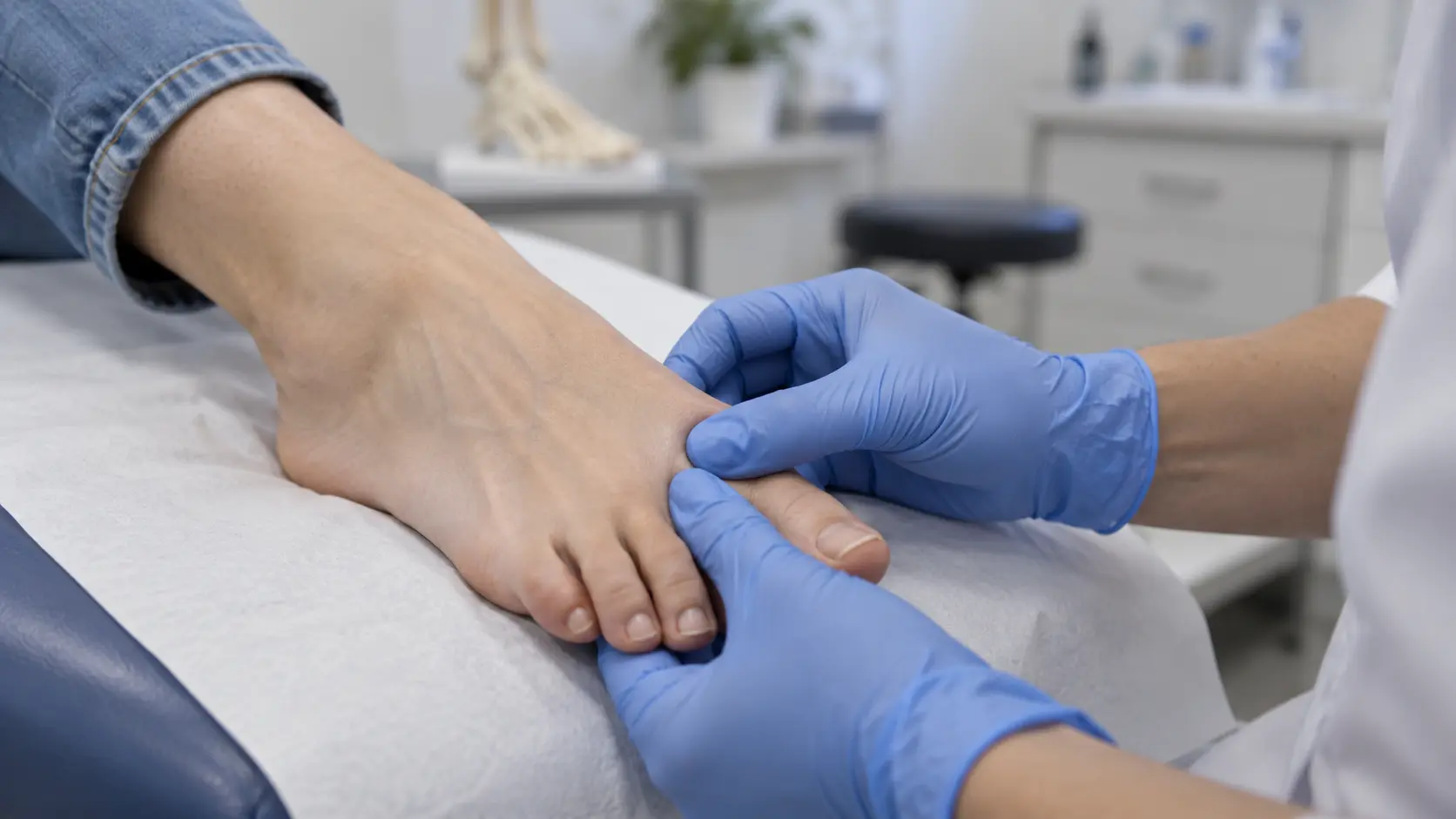
Kaposi-Stemmer sign. The examiner tries to pinch the skin at the base of a toe. In pure lipedema it is negative; it can turn positive when lymphedema is added to lipedema. How it is done and what it means in a leg that has hardened is covered in hard swollen leg.
Pitting. Pressure is held for a few seconds over the bone. If a dent remains, there is free fluid, something pure lipedema does not explain. The comparison with fluid swelling is in our piece on swollen ankles.
Pain when pressed. In lipedema, pressure and friction hurt, and there is also spontaneous pain and a feeling of heaviness. In lymphedema heaviness is common, but pain on pressure is not a typical feature.
How do I know if I have lipedema or lymphedema?
Through an in-person medical assessment. What you can observe at home comes down to three questions: are both legs affected equally?, do your feet and toes swell? and does it hurt when you press? Both legs alike, feet spared and pain on pressure point toward lipedema; one leg more than the other, a swollen foot and little pain point toward lymphedema. If your answers are mixed, that is exactly the case that needs examining.
Imaging tests: when they help and when they do not
No blood test or imaging test proves that you have lipedema. Tests are used to rule out other causes and to detect whether there is a fluid component that needs treating separately. We go into this in lipedema diagnosis; here is what matters for telling the two conditions apart:
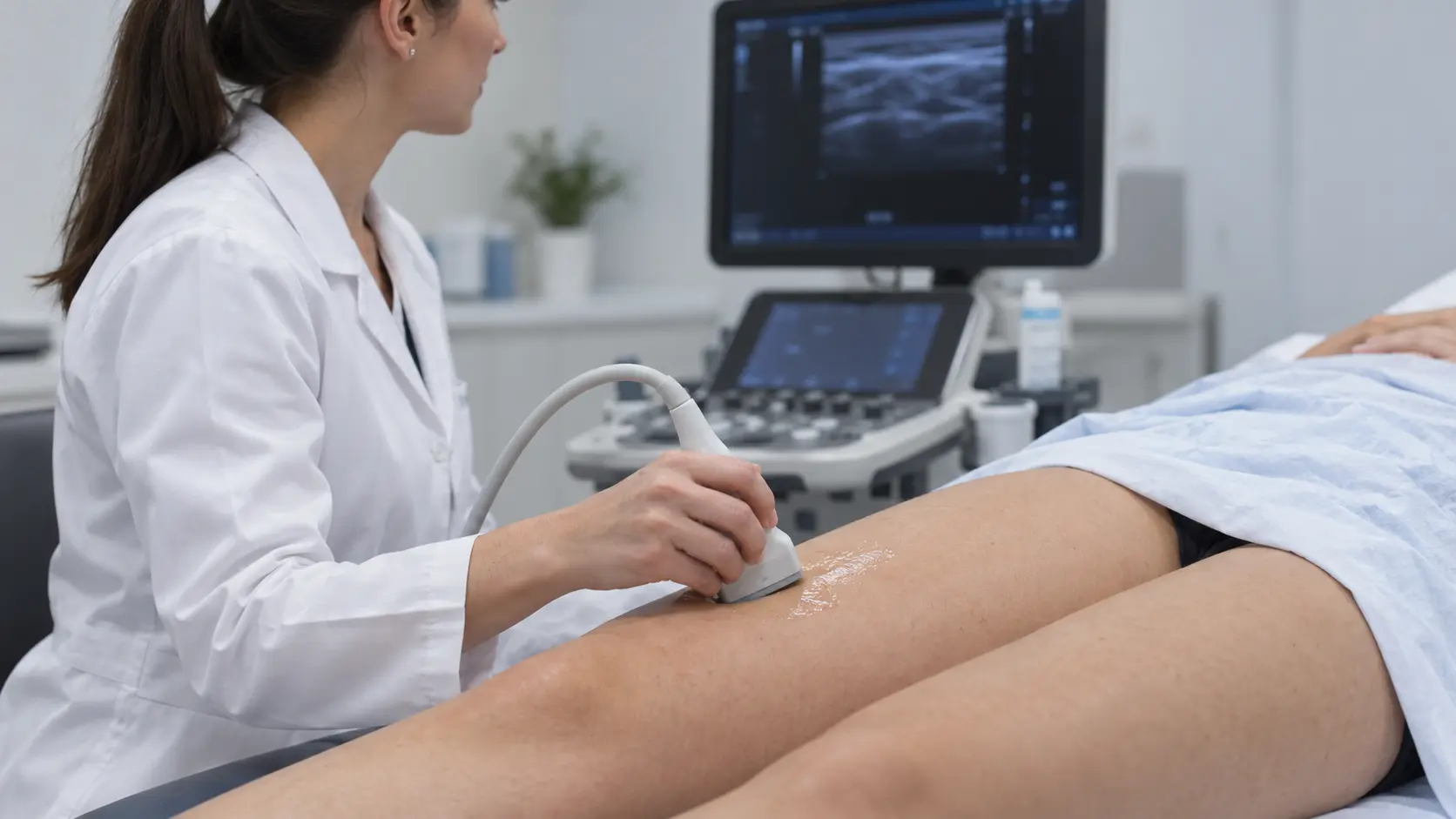
Doppler ultrasound: in the assessment of lipedema its role is to identify alternative vascular diagnoses, such as varicose veins or post-thrombotic syndrome. It does not confirm lipedema: it rules out what mimics it.
Soft tissue ultrasound: in lymphedema the skin appears thicker and less echogenic; in lipedema, ultrasound cannot reliably distinguish the tissue from healthy tissue, and no edema component has been identified.
Lymphoscintigraphy: this is the test that most clearly shows impaired lymphatic drainage. In lipedema there are no systematic studies validating it for the differential diagnosis, and lymphatic function also declines with age in healthy people, so an abnormal result has to be interpreted. The Spanish Lipedema Consensus Group proposes it to rule out associated lymphatic disease before liposuction.
MRI and indocyanine green lymphography: they are not part of the routine diagnosis and do not confirm lipedema. Published studies show neither edema in pure lipedema nor a failure of lymphatic drainage.
When they coexist: lipedema with a lymphatic component
The question is not always “one or the other”. A lymphatic component can be added to lipedema, and then features appear that lipedema alone does not have: pitting, involvement of the foot or a Stemmer sign that turns positive. The International Society of Lymphology consensus sums it up this way: lipedema is not a lymphatic disease, at least at the outset, but in later phases and with significant obesity, lymphedema can be added as a complication.
Can you have lipedema and lymphedema at the same time?
Yes, they can coexist. What needs qualifying is the name you will read on many websites, “lipolymphedema”. The S2k guideline writes it in quotation marks and warns that the entity is not well defined: in the published studies it is impossible to tell whether it was lipedema with lymphedema added or obesity-associated lymphedema, which can develop with obesity whether or not there is lipedema.
This has two practical consequences. First: lipedema does not turn into lymphedema as a rule; the guideline recommends not regarding it as a disease that inevitably advances, because how it evolves depends on factors such as weight. Second: weight matters. Diet does not make the disproportion typical of lipedema disappear, but if you are overweight or living with obesity, losing weight through an appropriate diet can also reduce the volume of the legs, and treating obesity is a priority.
What changes in treatment
Telling them apart is not an academic detail: the core treatment is different.
In lymphedema the standard is complete decongestive therapy, in two phases: an intensive phase, with skin care, manual lymphatic drainage, exercises and multilayer bandaging, and a maintenance phase with a compression garment. Skin infections with fever are treated with antibiotics.
In lipedema compression is used to reduce pain, with 100% consensus, and the guideline asks that patients be told it does not reduce fat. If there is associated edema of another origin, compression also helps to control it. Manual lymphatic drainage is considered in combination with other techniques when compression alone does not relieve the pain, and its aim in lipedema is not to reduce volume. Suitable garments are covered in our guide to compression garments.
Lipedema surgery, that is, liposuction, is assessed against specific criteria: documented pain that does not improve with conservative treatment, complications such as limited mobility, prior treatment of any coexisting obesity and decongestion before surgery if there is edema of another origin. If there is no edema, that prior decongestion is not needed.
How can I reduce swelling in my legs with lipedema?
It depends on what is swollen. If it is pure lipedema, what has increased is fat and there is no fluid to “drain away”: what is treated is the pain, with compression and conservative measures. If there is an edema component, from fluid retention, from the veins or from associated lymphedema, compression and drainage recommended by a professional do act on that fluid. That is why it is worth knowing first what you have. And a warning: the S2k guideline states that diuretics should not be used to treat lipedema, unless your doctor prescribes them for another reason.
What we do in an assessment
If you have spent a long time hearing “it is fluid retention”, “it is lymphedema” or “it is just your weight” and nothing fits, what you need is a diagnosis. At our clinic in Valencia we examine both legs using these criteria, assess whether there is a lymphatic or venous component with whatever tests are needed, and explain the result to you along with a plan setting out your options. If it is not lipedema, we will tell you: ruling it out is part of the job too. If you are considering traveling to Spain for the assessment, the practical side is explained on our page for international patients. And if you are also unsure about orange-peel skin, see the difference between lipedema and cellulite.
Sources and references
Guideline S2k Lipoedema, AWMF 037-012, version 5.0 (2024). Definition, symmetry and sparing of feet and hands, pain, hormonal influence, bruising, differential diagnosis table, Kaposi-Stemmer sign, ultrasound, lymphoscintigraphy, “lipolymphedema” and Recommendations 2.10, 2.12, 2.14, 4.1, 4.3, 4.4, 6.1, 7.1, 10.2 and 12.2.
The Diagnosis and Treatment of Peripheral Lymphedema: 2020 Consensus Document, International Society of Lymphology. Definition and causes of lymphedema, stages, elevation, lymphoscintigraphy, complete decongestive therapy, infections and the relationship with lipedema.
Lymphedema. StatPearls. Lymphedema in both sexes and one-sided involvement.
Gracia Graells M, Alcolea López JM. Lipedema y linfedema. Hacia un diagnóstico diferencial correcto. Journal of the Spanish Society of Aesthetic Medicine (SEME), in Spanish.
Carballeira Braña A, Poveda Castillo J. The Advanced Care Study: Current Status of Lipedema in Spain. Int J Environ Res Public Health, 2023;20(17):6647. PubMed.
Content prepared by the medical team at Lipedema Advanced Care based on the S2k lipedema guideline (AWMF 037-012, 2024 version) and the sources cited.
Published in October 2026.
This page is for information purposes and does not replace a medical consultation. The diagnosis of lipedema and lymphedema is clinical and must be made by an experienced professional. Seek medical attention the same day if the skin of your leg is red, hot and painful with fever or chills; if one leg swells suddenly, with pain, warmth or redness; or if you have a wound that will not heal on a swollen leg. If you are also short of breath or have chest pain, call your local emergency number now (112 in Spain and the EU, 999 in the UK, 911 in the US).

