

The exercises for lipedema that suit you most are the ones you can keep doing over time without your pain flaring up: exercise in water, walking, cycling and adapted strength training, ideally with your compression garment on. Exercise reduces pain, improves mobility and fitness, may lift your mood, and helps you manage your weight and associated conditions. What it does not do is make lipedema fat disappear, and it is worth knowing that before you start, so that every session does not end in disappointment.
If you have spent years hearing “just exercise more” as if that explained your legs, here we separate what the reference clinical guideline (the German S2k guideline on lipedema, spelled lipoedema in British English, 2024 version) says from what circulates without a source.
First things first: when to stop and get help
Exercise is part of treatment, but some symptoms are not caused by lipedema and cannot wait until your next appointment.
Call your local emergency number (112 in Spain and the EU, 999 in the UK, 911 in the US) or go to the emergency department now if you have breathlessness that starts suddenly, chest pain or heaviness that gets worse when you breathe in deeply, dizziness or fainting, at rest or during exercise, and also if you have a swollen, painful leg and any of those symptoms appear: they can be signs of a pulmonary embolism.
Stop and seek medical attention today if you notice:
Sudden pain in one calf with swelling, warmth or redness in one leg only: this can be a deep vein thrombosis, which almost always affects one side of the body.
A chafe or wound that becomes red, hot, tight and keeps spreading, with fever or chills: this can be infectious cellulitis, an infection of the skin that has nothing to do with “orange peel” skin.
And book an appointment within the next few days if the swelling does not go down with rest and elevation, or if it starts to affect your feet or toes: lipedema spares the feet, so that change needs a separate explanation.
What exercise achieves in lipedema, and what it does not
The S2k guideline is clear about the role it gives exercise. Its Recommendation 7.2, a strong recommendation with 100% consensus, states that movement in compression, or a training program, is an important element in reducing pain and should therefore be included in the overall treatment plan. Notice which chapter it sits in: pain management, not fat reduction.
| What you expect | What the evidence says |
Less pain | Yes. It is the main reason the guideline recommends exercise, backed by a 12-week leg training study that shows it. |
More strength and mobility | Yes. The guideline notes that quadriceps strength is reduced in patients with lipedema, and strength can be trained. |
Better mood | Likely. The guideline cites studies, not specific to lipedema, in which physical activity reduces symptoms of depression and anxiety. |
Control of weight and associated obesity | Yes, combined with nutrition and, if needed, behavioral support (Recommendation 10.5). |
Less volume in the legs | Mixed results: in one leg training study, volume increased (without reaching statistical significance); in another it fell, but less than with combined treatments. |
Slowing the course of lipedema | Not demonstrated. And the guideline points out that lipedema should not be understood as a condition that advances as a matter of course. |
Does exercise help lipedema?
It helps the symptoms and your overall health, which is a lot. Pain on pressure can ease with regular exercise, strength and fitness can be trained, and your ability to move and your mood can improve. The disproportion, on the other hand, does not change reliably. Put another way: you train for less pain, more strength and better health, not to change the shape of your legs.
Can exercise get rid of lipedema?
No. Compression does not reduce fatty tissue (Recommendation 4.4) and there are no studies showing that exercise does: exercise studies do not show a consistent reduction in volume. This is where the differential diagnosis matters: fat from obesity does respond to exercise and diet; the disproportion of lipedema does not respond in the same way. So exercising without seeing changes in your legs does not mean you are not trying hard enough. With one important caveat: if you are also overweight, losing weight can also reduce the volume of your legs (Recommendation 10.2).
The most repeated myths, checked against the guideline
Much of what you will read about exercise and lipedema has a reasonable basis with an exaggeration on top. These are the claims repeated most often in top search results, and what the source says:
| What gets repeated | What the S2k guideline says |
“Exercise stops lipedema from advancing” | No study demonstrates it. Recommendation 2.10 (94.4% consensus) says lipedema should not be understood as a condition that advances as a matter of course, because its course depends on several factors. One of the factors that is linked to leg volume is weight (Recommendation 10.4). |
“Moving drains the lymph and gets rid of fluid retention” | Lipedema is not, first and foremost, a disease of edema or of lymphatic dysfunction. Pain is the dominant feature, and that is where exercise helps. |
“If you do not move, you will end up with lipolymphedema” | The guideline writes “lipolymphedema” in quotation marks and warns that this entity is not well defined in the studies. |
“With lipedema, no strength training and no squats” | The guideline includes moderate strength training among the options, and the programs studied combine warm-up, stretching, aerobic exercise and strengthening. |
“Walking 30 minutes a day is the dose” | The guideline sets no dose for lipedema. As a general reference for adults, the WHO recommends at least 150 minutes of moderate activity a week, and points out that any amount is better than none. |
Which types of exercise fit, and why
There is no compulsory exercise. The guideline mainly describes water-based activity, aerobic exercise, stretching and moderate strength training, and in its self-care content it asks you to increase the load gradually and to plan active breaks. The rest depends on your pain, your joints, your weight and what you enjoy, because the exercise that works is the one you actually do.
Which lipedema exercises for the legs are most suitable?
Those that work the legs with little load on the joints and without repeated impact. This table summarizes options compatible with the aerobic exercise described in the guideline, and what to watch for with each one:
| Activity | Why it fits | What to watch |
Water: water aerobics, swimming, aquacycling | The guideline includes it as a complement, in the section on lipedema with additional edema (Recommendation 7.5), and its self-care content highlights it as especially effective. | The evidence is small: studies of 3 and of 10 patients. |
Walking | Aerobic, accessible and easy to dose. | Chafing on the inner thighs and knees. |
Stationary bike | Aerobic, with your body weight supported by the saddle. | Saddle height and knee discomfort. |
Elliptical trainer | Aerobic, standing and without impact: your feet never leave the pedals. | Knee or hip discomfort, and balance when getting on and off. |
Adapted strength training | The guideline notes that quadriceps strength is often reduced in lipedema. | Loads that increase gradually and careful technique, especially if you have joint hypermobility. |
Mobility, stretching and breathing | The guideline mentions mobilization exercises and breathing exercises as part of self-care. | They complement the rest; they do not replace it. |
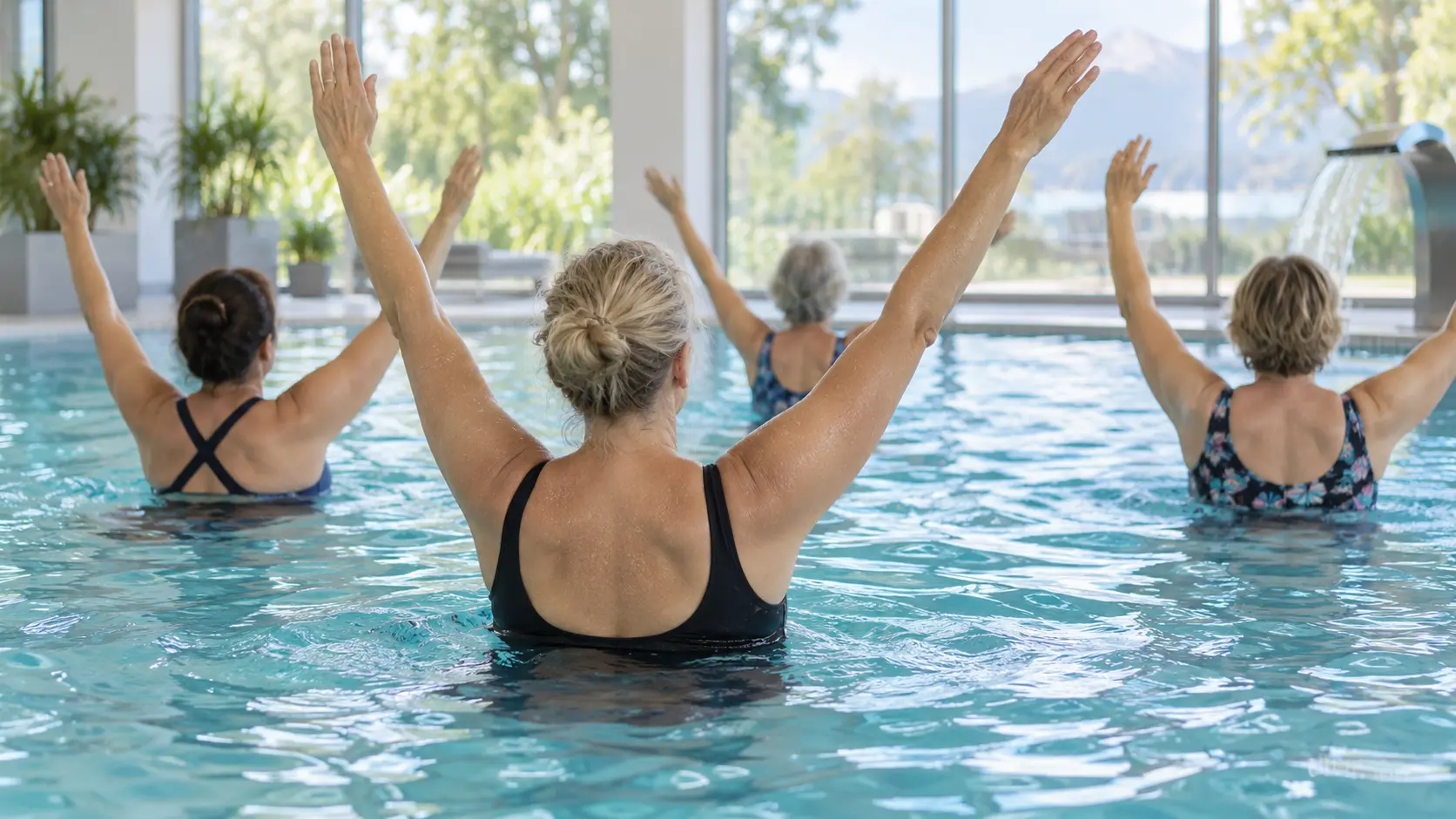
Exercise in water, in proportion
Recommendation 7.5 states that water-based exercise, for example aquacycling, can have a positive effect as a complement, in the section on lipedema with additional edema (open recommendation, 100% consensus). It is a cautious recommendation because the studies are very small: three patients in one, ten in another. Even so, the guideline describes it as especially effective in its self-care content, so it deserves a place if you find it comfortable. If going to the pool is hard because of how people look at you, that is not a trivial concern: small-group classes or a full-length swimsuit are practical options.
Can I go to the gym if I have lipedema?
Yes. Strength training is not contraindicated: the guideline includes moderate strength training, and the programs studied combine it with aerobic exercise. The sensible approach is to start with light loads, increase them gradually and put technique before weight, because joint hypermobility is common in lipedema (up to 66.7% in stage 3 in one study). Some illustrative examples for the legs: standing up from a chair and sitting back down, glute bridges, heel raises and gentle pedaling.
Important: these are examples, not a program. The number of repetitions, the load and the progression should be set by a professional who knows your case, especially if you have knee or hip pain, associated obesity or have had surgery.
Compression while training: what it adds and what it does not
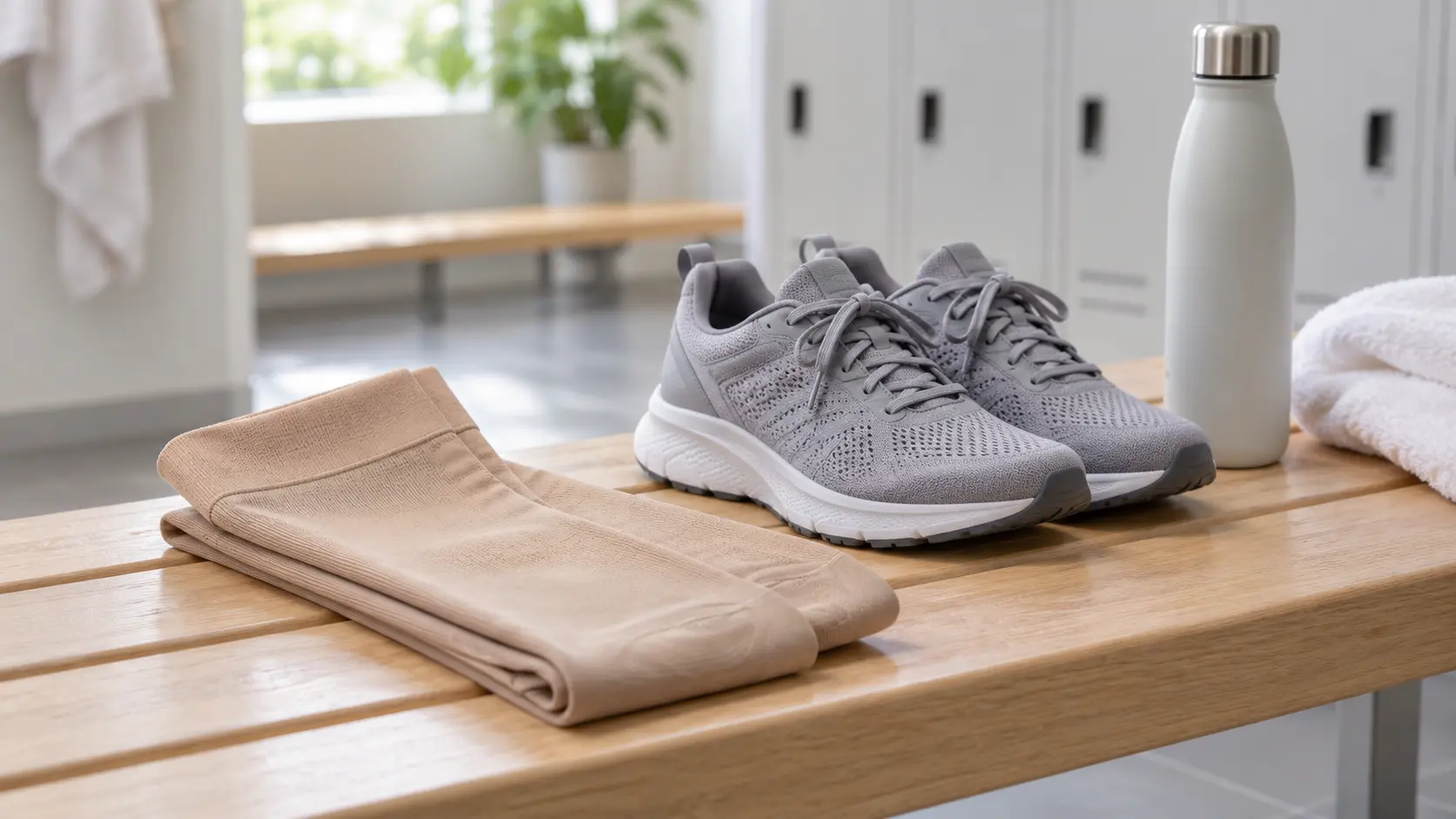
The guideline talks about movement in compression, and that is not a minor detail. Among the self-care measures it recommends is physical activity, ideally sport, preferably with compression, to reduce pain.
The evidence behind this is a 2023 pilot study that the guideline summarizes: six patients followed the same exercise program for six weeks, some wearing a flat-knit class 2 garment and some without. With compression there was less pain on palpation and less tendency to bruise, and leg circumferences tended to stay the same or fall, while without compression they tended to rise. It is a very small study, and the guideline itself phrases it conditionally: training in compression could improve quality of life and reduce discomfort.
What it is for: compression is used to reduce pain (Recommendation 4.1, 100% consensus).
What it is not for: it does not reduce fatty tissue (Recommendation 4.4), and the guideline notes that there is no evidence that it prevents progression.
If it hurts, do not put up with it: the guideline says explicitly that pain from the garment should not be tolerated and that compression that does not fit properly should be corrected.
How to choose the class and fabric for training is explained in our guide to compression garments for lipedema.
Knees, hips and impact: why it pays to start gently
The guideline does not forbid any sport. What it does describe are four reasons to look after your knees and hips:
Hypermobility: in the study the guideline cites, the proportion of women with hypermobile joints is higher than in patients with Dercum’s disease and rises with stage (from 26.9% in stage 1 to 66.7% in stage 3).
Knock knees (genu valgum): when the increase in fat is very marked, it can shift the axis of the knee inward.
Less strength in the quadriceps, the large muscle at the front of the thigh.
Changes in the way you walk, with a risk of hip and knee damage in the long term.
With that context, a prudent approach is to start with low-impact exercise and leave jumping and running until your strength and technique allow it and a professional has assessed you. The guideline also describes skin irritation from the thighs rubbing together: leggings or the compression garment itself prevent a lot of chafing when you walk. And a note so you do not feel alarmed: the stage describes the state of the tissue, it is not a life sentence; the studies included in the guideline feature exercise programs with patients in stages 3 and 4.
Pain and bruising after training
Pain when you start does not mean exercise is harming you. In its psychosocial chapter, the guideline describes a well-known cycle in chronic pain: avoiding movement for fear of pain is one of the factors that increases it, and losing that fear by moving is one of the factors that eases it. That is why progression matters more than intensity: short sessions, active breaks and a gradual increase in load.
Something similar happens with bruising. Many patients report that they bruise easily, although the guideline notes that this tendency could not be objectively confirmed in a comparative study. In the 2023 pilot study, training with compression reduced it. If it worries you, there is more detail in our article on bruising and lipedema, and about pain in why your legs hurt.
What is not normal: pain that increases day by day instead of easing, a large bruise after a minimal knock, or any of the signs in the first section. In those cases, see a doctor.
Exercise and associated obesity
Here exercise has a clear role: it is part of the treatment of associated obesity (Recommendation 10.5). Many patients with lipedema are also overweight or have obesity, and the guideline is direct: weight gain always increases limb volume, and associated obesity can reduce mobility and add joint, lymphatic and cardiovascular problems. That is why its treatment should be included in the lipedema treatment plan (Recommendation 10.4) and should combine nutrition, exercise and, if needed, behavioral support (Recommendation 10.5), both to lose weight and to maintain the loss.
The guideline adds a nuance that takes a lot of pressure off: the goal is not to reach an ideal weight, but less discomfort, physical well-being and fitness. If you want to see where you are starting from, our BMI calculator for lipedema explains why BMI is interpreted differently in lipedema, and nutrition in lipedema completes the other half of the equation.
Exercise after surgery
After lipedema liposuction, physical activity is resumed gradually, and the surgical team decides when, after reviewing you, depending on how the swelling, the wounds and the compression evolve. The guideline sets no timeframe for returning to training: what it does recommend is starting decongestive therapy immediately after the operation, with an intensity and duration adjusted to the findings in each patient (Recommendation 12.5).
Two ideas from the guideline for the long term: surgery can improve mobility by correcting the misalignment of the leg axis, and after surgery the principles of conservative treatment, exercise included, should continue. The phases of returning to activity are covered in our guide to recovery after lipedema surgery.
Where exercise fits in your treatment
Exercise is one piece, not the whole treatment. It is combined with compression, weight management, psychological support when needed and, in some cases, surgery, as we explain in our overall approach to lipedema. And before all of that there is an earlier question: whether what you have is lipedema, obesity, lymphedema or a mix, because the role of exercise changes in each case.
That is the purpose of our medical assessment in Valencia: to confirm or rule out the diagnosis, explain which part of what you notice can improve with exercise and which cannot, and advise you on which professional should support you with your program. If it is not lipedema, we will tell you. The team sees international patients in English, and if you are traveling from abroad, the practical details are set out for international patients.
Sources and references
Guideline S2k Lipoedema, AWMF 037-012, version 5.0 (2024). Recommendations 2.10, 4.1, 4.4, 7.2, 7.5, 10.2, 10.4, 10.5 and 12.5; chapters on exercise therapy, self-care, psychosocial factors in pain, nutrition and weight management, and liposuction.
Czerwińska M, Teodorczyk J, Spychała D, Hansdorfer-Korzon R. The Usefulness of the Application of Compression Therapy among Lipedema Patients: Pilot Study. Int J Environ Res Public Health, 2023;20:914 (included in the S2k guideline).
Physical activity. World Health Organization (fact sheet, 2024).
Content prepared by the medical team at Lipedema Advanced Care based on the S2k lipedema guideline (AWMF 037-012, 2024 version) and the sources cited.
Published in October 2026.
This page is for information purposes and does not replace a medical consultation. Any exercise program should be individual and adapted to your diagnosis, your joints and your situation after surgery. Call your local emergency number (112 in Spain and the EU, 999 in the UK, 911 in the US) or go to the emergency department now if you have sudden breathlessness, chest pain or heaviness, dizziness or fainting, including when they come on top of a swollen, painful leg. Stop training and seek medical attention the same day if you notice sudden pain in one calf with swelling, warmth or redness in one leg only, or a chafe or wound that is red, hot and keeps spreading, with fever. See a doctor within a few days if the swelling does not go down or starts to affect your feet.

