Lipedema surgery:how it works, step by step
Surgery is currently the only treatment that removes lipedema tissue. It does not cure the condition, which is chronic, but it can produce a lasting reduction in pain and volume when conservative management is not enough. Here we explain when it is indicated, which techniques are used, how the procedure works and what determines the quote.
A medical procedure, not a cosmetic liposuction
Lipedema surgery, also called lipedema reduction surgery, consists of removing the diseased fatty tissue through a specific liposuction that spares the lymphatic vessels. It shares the name of the technique with cosmetic liposuction, but it shares neither the aim nor the execution.
The practical difference lies in three things: the aim is functional, to reduce pain and restore mobility, not to reshape the silhouette; the technique orients the cannulas to preserve the lymphatic system, whose integrity conditions the long-term outcome; and the volume and the areas are planned on a prior clinical diagnosis, not on a cosmetic request.
And one clarification, because it is the question that comes up most in consultation: surgery does not cure lipedema. Lipedema is a chronic condition and there is no cure. What surgery does is remove the affected tissue in the treated areas, and with it reduce pain and volume. Conservative management (compression, exercise, weight control) remains part of the treatment both before and after surgery.
When surgery is indicated
Not every patient with lipedema needs surgery, and the indication is not decided by looking at a photograph. These are the criteria that are assessed:
- A confirmed clinical diagnosis. Before considering surgery we must be certain it is lipedema and not something else. This is how lipedema is diagnosed.
- Symptoms that limit your daily life. The decisive criterion is pain and functional impact, not volume or appearance.
- Conservative management already under way. Compression, drainage and weight control are the basis of treatment; surgery is considered when they are not enough to control the symptoms.
- Vascular status assessed. A prior venous study makes it possible to rule out concomitant venous disease and adjust the planning.
- Documented pain that does not respond to conservative treatment. Pain alone is not enough: the guideline asks that it be established that it does not improve despite properly delivered conservative care.
- Weight and obesity assessed beforehand. If obesity coexists, it is treated first: with a BMI above 40 or a waist-to-height ratio above 0.55 the surgical indication is considered with particular caution.
- Realistic expectations. Understanding that the tissue of the operated areas is treated and that the condition remains chronic.
A point that is often misread: the surgical indication does not depend on the stage. The stages of lipedema describe the appearance of the tissue, they do not measure the severity of the symptoms. Pain can be intense at stage 1 and manageable at stage 3, and what decides is the pain and the limitation, not the number.
When surgery is not performed, or not yet: if there is associated oedema of another cause, decongestive therapy is carried out before surgery; if obesity coexists, it is treated first; in patients under 18 the indication is strict; and active venous disease, recent thrombosis, a clotting disorder or pre-existing anaemia are corrected or ruled out before scheduling theatre. Liposuction of painless lipohypertrophy, with no pain or limitation, falls outside the indication in the guideline.
The techniques, and what each is for
There is no single technique. They are combined according to the areas, the consistency of the tissue and the quality of the skin:
| Technique | What it involves | Why it is chosen |
|---|---|---|
| WAL Water-jet Assisted | A pressurised jet of saline separates the fatty tissue before it is aspirated. | It makes it easier to remove the fat while sparing neighbouring structures, among them the lymphatic vessels. |
| PAL Power Assisted | The cannula vibrates mechanically to pass through the tissue with less force. | In our experience, useful in fibrous, hardened tissue, where simple aspiration is more traumatic. The guideline places PAL and WAL at the same level. |
| Renuvion® | Applies energy to the subcutaneous tissue to encourage its contraction and, with it, the retraction of the skin. It does not appear in the reference clinical guideline. | When residual laxity is anticipated because the skin will not retract on its own. |
| FLACS The clinic's own denomination | It is not a separate technique nor a term from the guidelines: it is the name we give to our planning for treating the legs in full as one whole, using the techniques above. | Cases with extensive involvement, so the outcome is not fragmented across isolated procedures. |
The choice is not a clinic preference: it is decided on your tissue and your areas. It is usual to combine more than one in the same procedure. WAL and PAL are the systems recommended by the reference clinical guideline; Renuvion® is a complementary resource for skin quality, not a method for removing tissue.
What the procedure is like
The concrete facts about the day of surgery, in our protocol.
Why it is divided into several procedures
This is the point that surprises patients most, and there is a safety reason for it: there is a limit to how much tissue can be safely removed in a single procedure. Exceeding it increases the surgical risk without improving the outcome. That is why, when the involvement is extensive, it is planned by areas and across several sessions spaced out over time, rather than forcing everything into one.
It is not a commercial strategy nor a way of stretching out the process: it is what makes it possible to operate with a margin of safety. The reference clinical guideline sets a maximum aspirate per session in relation to body weight and limits the number of sessions per limb. At the assessment you are told how many are anticipated in your case and how far apart.
The five phases of the process
Assessment, diagnosis and vascular study
Before theatre is discussed, the diagnosis is confirmed and the venous system is assessed with duplex ultrasound, carried out by Dr Marta Zaplana, angiologist and vascular surgeon. Varicose veins, venous insufficiency or the after-effects of thrombosis are ruled out, as they change the planning.
A 3D body scanner is also incorporated, documenting the starting contour and making it possible to measure change afterwards objectively, rather than comparing by eye.
Surgical planning by areas
With the diagnosis and the vascular study on the table, we define which areas are treated, in what order, with which techniques and across how many sessions. This is where it is decided whether Renuvion® is needed because of the quality of the skin, or whether fibrous tissue calls for PAL in a particular area.
The procedure
The lipedema tissue is removed from the planned areas using the chosen technique, orienting the cannulas to preserve the lymphatic vessels. That preservation depends on how the surgery is performed: it is a matter of surgical technique, not of the equipment used.
The first hours and discharge
After surgery the compression is fitted and the first hours are monitored before discharge. You are given the instructions on mobility, compression and care of the area, which are part of the outcome and not a formality.
Recovery and follow-up
Recovery is gradual and with scheduled reviews: compression, manual lymphatic drainage and the progressive reintroduction of activity. The full detail, with timings and what to expect week by week, is in lipedema surgery recovery.
Areas that are treated
The distribution of your lipedema determines the areas, and that distribution is what defines the type (from I to V, described alongside the stages):
| Area | What is addressed |
|---|---|
| Full legs | Hips, thighs, knees and calves in one joint plan, the FLACS approach. |
| Thighs and saddlebags | The most frequent area and the one that most limits chafing and the choice of clothing. |
| Calves and ankles | A delicate area because of drainage; planned with particular care for the lymphatic system. |
| Arms | Inner and upper aspect, characteristic of type IV lipedema in the arms, which can occur alongside involvement of the legs. |
| Buttocks and abdomen | When the involvement extends to the lower trunk. |
The foot and the hand are spared: in lipedema the build-up stops at the ankle or the wrist, and that is one of the signs that set it apart. See the symptoms of lipedema.
What determines the cost of surgery
We do not publish a fixed price on the website, and it is not evasion: giving a figure without having assessed the case would mean making it up. Two patients with the same diagnosis may need a single procedure or three, and that changes the quote completely. These are the factors that determine it:
| Factor | Why it matters |
|---|---|
| Number of areas | Each area adds theatre time and its own planning. |
| Number of sessions | Because of the limit on how much tissue can be safely removed in one procedure. |
| Extent of involvement | It determines the volume to be treated and the complexity of the approach. |
| Techniques required | Whether Renuvion® is needed for the quality of the skin, or PAL for fibrous tissue. |
| Anaesthesia and stay | They vary with the duration and the extent of the procedure. |
| Follow-up included | Reviews, compression garments and the drainage sessions of the recovery period. |
What the assessment includes: medical consultation, vascular study with duplex ultrasound carried out by our angiologist, 3D body scan and a concrete surgical plan with the areas, the techniques and the number of sessions anticipated. The quote comes from that, in writing and with no surprises. Financing options are available; the terms are reviewed at the assessment.
What you should ask at any clinic
Having lipedema surgery is an important decision and it deserves a proper comparison. These are the questions we would ask, and which have an answer here:
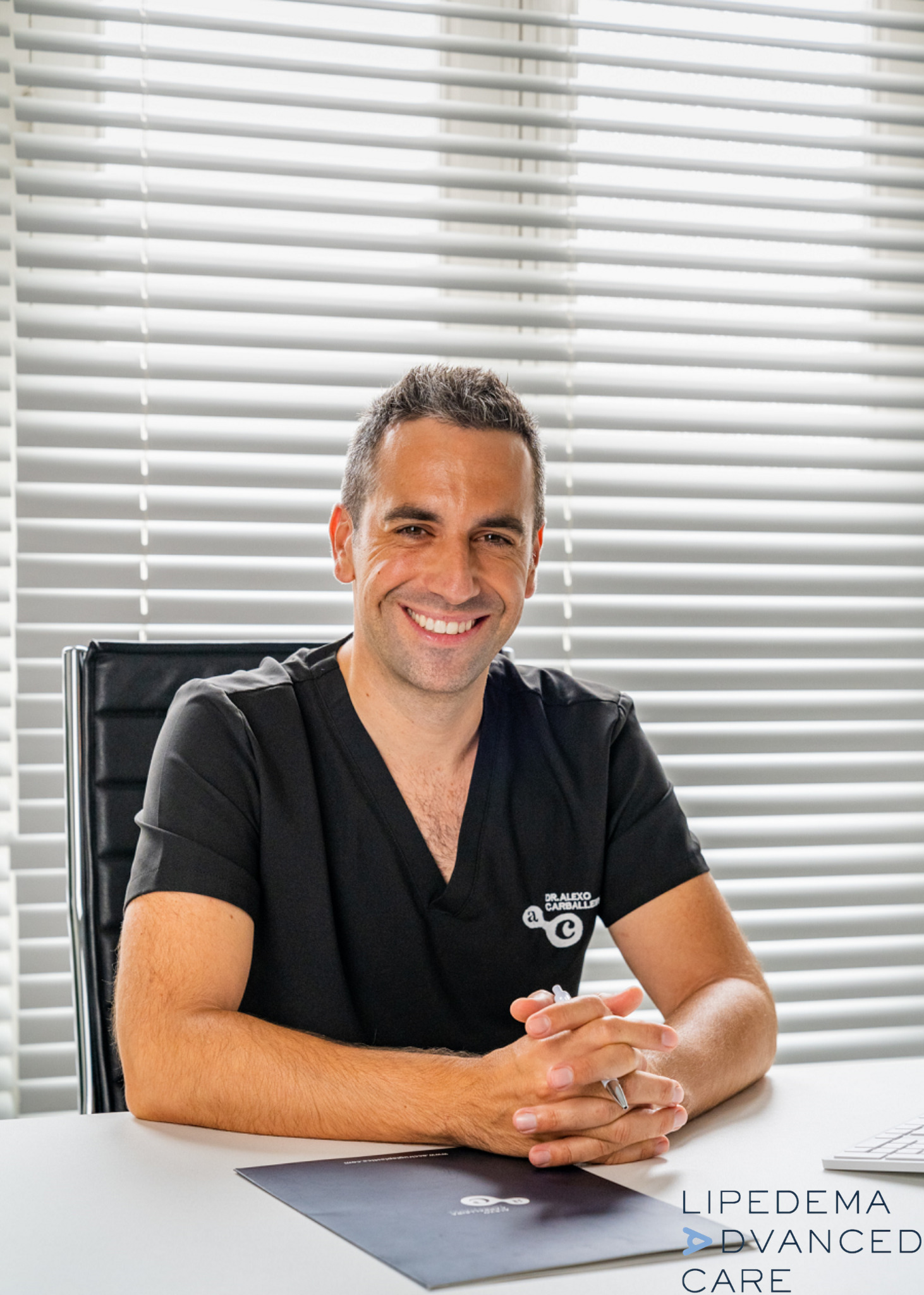
- Who will operate on me, and with what credentials? Here the surgeon is Dr Alexo Carballeira, plastic surgeon recertified by the SECPRE, specialising in lipedema.
- Is my vascular system studied beforehand? Yes, with duplex ultrasound performed by Dr Marta Zaplana, angiologist and vascular surgeon integrated into our team, at the same clinic.
- How is my progress measured? With a 3D body scanner, which gives an objective measurement rather than an impression.
- Does the technique preserve the lymphatic system? This is the point that conditions the long-term outcome and should always be asked.
- Is there published research behind it? In 2023 our team published a study of 969 participants with lipedema in Spain.
- What follow-up is included? Scheduled reviews and compression and drainage instructions, within the Advanced Care Method.
What you can expect and what you cannot
This is probably the most important part of the page, because a badly set expectation ruins a good surgical outcome. Here is what it does and what it does not.
What surgery does do
- It removes the lipedema tissue from the treated areas. It is the only thing that achieves this: that tissue is not eliminated by diet or exercise, although losing weight does reduce leg volume when there is associated overweight.
- It can reduce pain and heaviness in a lasting way in the operated areas, which is the functional aim of the procedure. This is what the German clinical guideline and the published series describe, with improvements sustained over years, although the magnitude varies from one patient to another.
- It improves mobility and chafing between the legs when volume was limiting them.
- It partly corrects the disproportion relative to the trunk, with the consequent effect on clothing and body image.
What surgery does not do
- It does not cure the condition. Lipedema is chronic. The tissue of the operated areas is treated, not the underlying predisposition.
- It does not replace conservative management. Compression, low-impact exercise and weight control remain part of the treatment after surgery.
- It is not a weight-loss treatment. The target is the diseased tissue and the symptoms, not the scales.
- It does not guarantee a particular outcome. It depends on your tissue, on the quality of the skin and on individual progress, and like all surgery it carries risks that are explained in consultation.
About weight: if there is associated overweight or obesity, losing weight does also reduce leg volume, even though the characteristic disproportion and pain remain. That is why nutrition and exercise are not a discarded alternative, they are the foundation on which everything else rests, before and after surgery.
Our own research, not just experience
Most of the information about lipedema in circulation in Spanish comes from elsewhere, and almost no clinic in Spain has published data of its own. Our team has: in 2023 we published The Advanced Care Study in the International Journal of Environmental Research and Public Health, a descriptive cross-sectional study of 969 participants with lipedema in Spain.
From it comes a figure that explains a great deal about why so many patients come to consider surgery late: 51.2% needed to consult three or more different specialists before receiving a diagnosis, and one in three more than five. By the time they finally reach a specialist clinic, they carry years of accumulated delay.
The existence of research behind us does not guarantee a surgical outcome, and we do not present it as such. What it does indicate is the level of rigour with which the diagnosis and the indication are approached, which is exactly what determines whether an operation is well planned. You can read the full study.
Questions about the surgery
What does lipedema surgery involve?
Removing the diseased fatty tissue through a specific liposuction that spares the lymphatic vessels. It is planned by areas on a prior clinical diagnosis and a vascular study, and the aim is functional: to reduce pain and volume, not to reshape the silhouette.
Does surgery cure lipedema?
No. Lipedema is a chronic condition and there is no cure. Surgery removes the affected tissue in the treated areas and with it reduces pain and volume, but conservative management remains part of the treatment both before and after.
How does it differ from a cosmetic liposuction?
In the aim, in the technique and in the indication. Here the purpose is functional, the execution preserves the lymphatic system and the procedure is planned on a medical diagnosis. A conventional cosmetic liposuction is not designed for this tissue.
How much does lipedema surgery cost?
It depends on the number of areas, the sessions required, the extent and the techniques that need to be combined, so we do not publish a fixed figure: without assessing the case it would be made up. A written quote is provided at the assessment, and financing options are available.
How many sessions are needed?
It depends on the extent. There is a limit to how much tissue can be safely removed in a single procedure, so when the involvement is extensive it is planned across several sessions spaced out over time. At the assessment you are told how many are anticipated in your case.
How long does the surgery take and is a hospital stay required?
The procedure can be carried out as a day case or with an overnight stay. In our protocol it usually takes between 2 and 5 hours depending on the number of areas, with one night in hospital to monitor the first hours. The type of anaesthesia, sedation with tumescent local anaesthesia or general anaesthesia, is decided with the anaesthetist according to the case and the extent.
What is the difference between WAL, PAL and Renuvion®?
WAL separates the tissue with a jet of saline before aspirating it; PAL uses a cannula that vibrates and works better in fibrous tissue; Renuvion® does not remove fat, it applies energy to encourage the skin to contract. They are combined according to the case.
Do I need a diagnosis before having surgery?
Yes, always. It must be confirmed that it is lipedema and not another cause of increased volume, and the venous system must be assessed. This is how lipedema is diagnosed.
Does it depend on the stage of lipedema I have?
No. The stages describe the appearance of the tissue, they do not measure the severity of the symptoms. The indication is decided by pain and functional limitation, not by the stage number.
Who performs the surgery and where?
Dr Alexo Carballeira Braña, plastic surgeon recertified by the SECPRE, with the vascular study carried out by Dr Marta Zaplana, angiologist and vascular surgeon on the team. The clinic is in Valencia. Meet the medical team.
Sources and references
- Carballeira Braña A, Poveda Castillo J. The Advanced Care Study: Current Status of Lipedema in Spain, A Descriptive Cross-Sectional Study. Int J Environ Res Public Health, 2023;20(17):6647. View on PubMed (study by our team)
- S2k guideline Lipoedema, AWMF 037-012, v5.0 (2024). View guideline
- Herbst KL et al. Standard of care for lipedema in the United States. Phlebology, 2021. View on PubMed
- Lipedema - StatPearls (NCBI)