Lipedema in Spain: what 1,069 patients told us
We ran a questionnaire among patients across Spain to measure three things: how long it really takes to reach a diagnosis, which symptoms women with lipedema share, and which treatments work. 1,069 answered. These are the results, and they are not comfortable reading.
The figures that sum up the study
The finding that weighs most is not clinical, it is about access: in Spain lipedema is diagnosed late not for lack of criteria, but because the patient has to work through several consultations until someone recognises it.
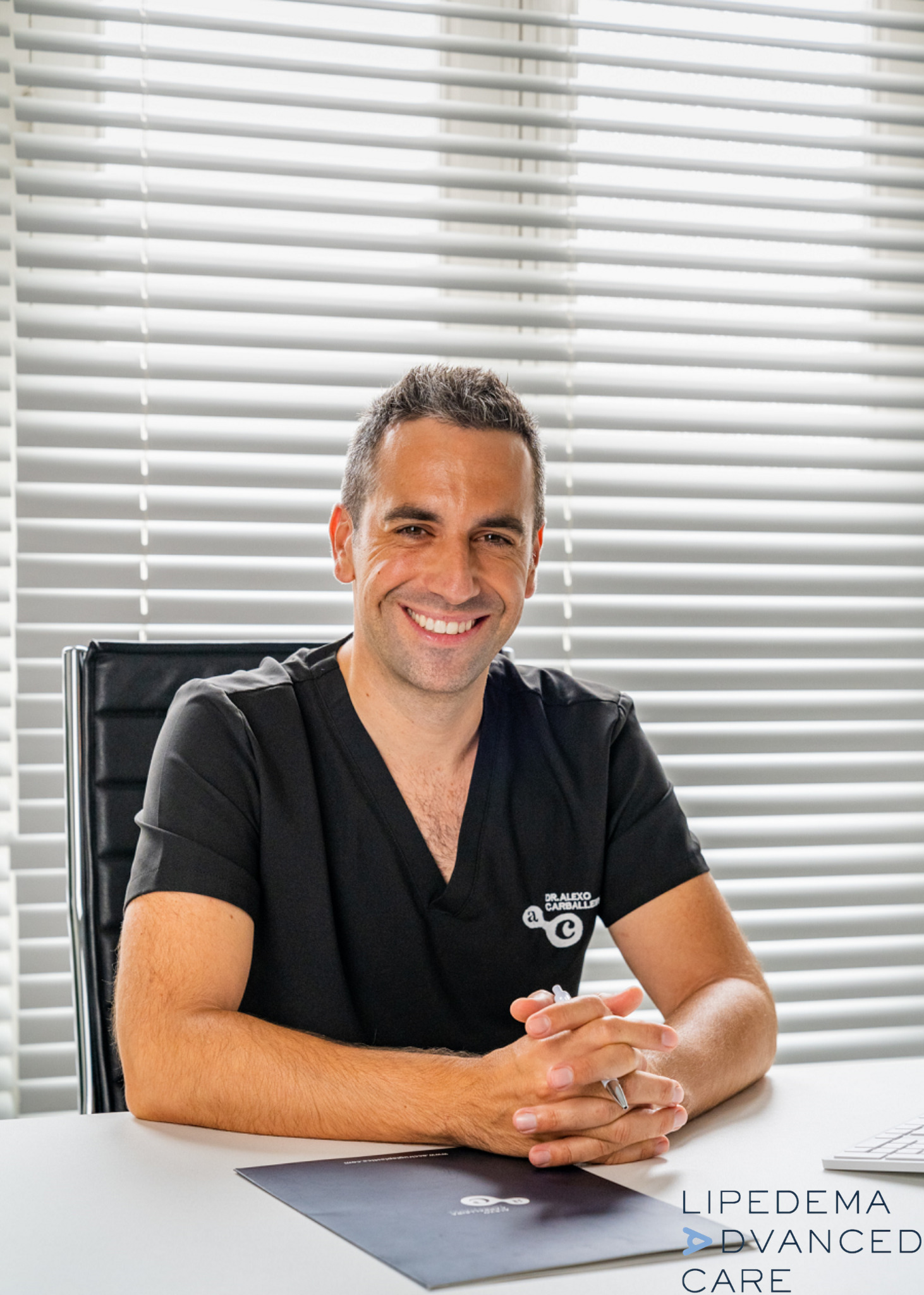
The study, explained by Dr. Carballeira
The video is the original presentation of the study, from November 2022. The criteria on diet, exercise and bruising have been updated in the text of this page in line with the S2k AWMF 037-012 v5.0 (2024) guideline. Where the video and this text disagree, the text is the current position.
The video is in Spanish. Turn on subtitles and use YouTube auto-translate if you need them in English. The full findings are written out below.
How we did it
We distributed a questionnaire through patient associations and our own digital channels, with three aims: to measure where lipedema diagnosis stands in Spain, to compare how effective the different treatments are, and to see what the pandemic had left behind. This is an in-house study by Lipedema Advanced Care, led by Dr. Carballeira.
1,069 patients responded. Of those, 717 had a confirmed diagnosis and 352 did not. For the analysis we applied a conservative criterion, meeting at least six diagnostic criteria, which left an effective sample of 969 participants.
This is an observational study based on self-reported answers: it describes what patients report, it does not establish cause and effect.
The problem is not the disease. It is reaching the diagnosis
67.1% of participants had been diagnosed and 32.9% had not. Among those diagnosed, roughly half were diagnosed by a vascular surgeon, 10% by a rehabilitation physician and the rest by other specialties. We explain how lipedema is diagnosed and which tests rule out other causes.
- Half had to see three or more specialists.
- 33.7% had to see more than five doctors.
- The 352 undiagnosed reported 6.5 symptoms on average, against 7.3 among the diagnosed.
Comparing both groups with a non-parametric test (Mann-Whitney U), the distribution of the number of symptoms was very similar. In other words: a large share of that 32.9% without a diagnosis very probably has lipedema too. They simply have not yet reached the specialist who will confirm it.
The symptoms, by frequency
In both groups, diagnosed and undiagnosed, the symptoms clustered the same way and in the same order. These are the lipedema symptoms by frequency:
- Heaviness or swollen-feeling legs
- Leg volume does not come down with dieting
- Tendency to bruise
- Leg volume does not come down with exercise
- Pain on palpation
- Disproportion between legs or arms and the rest of the body
- Hands and feet spared
- Firm tissue consistency, nodularity and spontaneous pain
Two clarifications, because these are the points that get oversimplified most. Diet and exercise do not on their own remove the disproportionate component of lipedema, and pain does not track the amount of volume accumulated; but they do reduce volume and improve symptoms, and where there is associated excess weight or obesity, losing weight also brings leg volume down. This is why nutrition and exercise are baseline therapy in lipedema, not an optional extra. And the tendency to bruise often accompanies lipedema, but it is not currently a validated diagnostic criterion: it is weighed alongside the rest, never on its own.
Who the patients are
| Data point | Result |
|---|---|
| Sex | 99.8% women |
| Main age bracket | 35 to 45, almost half the sample |
| Average weight, height and BMI | 75.8 kg · 164 cm · BMI 28 |
| Weight distribution | One third healthy weight, one third overweight, one third obesity |
| Family history | Half have it confirmed; 30% believe they have it |
| Most common age of onset | Puberty, in 73% of cases |
| Healthcare cover | 41% public · 22% private only · 37% both |
| Most frequent presentation | Type 3 (thighs, hips and calves), followed by type 4, which adds the arms. Beltran and Herbst classification by affected area: it describes distribution, not severity |
And one everyday consequence that rarely makes it into the literature: 81% report difficulty finding clothes that fit.
Associated conditions
These are the conditions participants reported. They are questionnaire answers, not verified diagnoses:
| Condition | Reported in the sample |
|---|---|
| Obesity | 28.1% |
| Lymphoedema | 8.6% |
| Diabetes | 0.8% |
We do not set these figures against the general Spanish population, tempting though it is. The sample is concentrated between 35 and 45, while national statistics cover everyone from 15 upwards, and conditions such as diabetes become far more common with age. Without adjusting for age, any comparison would mostly measure how young the sample is, not anything specific to lipedema.
What the pandemic left behind
These are self-reported answers about the same period: they describe a worsening that coincides with weight gain and with treatment being interrupted, not a cause-and-effect relationship between them. Even so, it is the clearest argument for keeping management going over time.
What treatments they use, and which ones work
By frequency of use, the lipedema treatment options they reported: anti-inflammatory nutrition, low-impact exercise, compression garments, decongestive physiotherapy, surgery and mesotherapy. In compression, 52% use flat-knit garments and 35% circular-knit.
We asked them to rate the improvement from each treatment from 1 to 10:
| Treatment | Average score |
|---|---|
| Surgery | 7.8 |
| Physiotherapy, compression, diet and exercise | around 5.5 |
| Radiofrequency | 3.7 |
| Mesotherapy | 3.5 |
Taken separately, each treatment produced a marked reduction in symptoms in around 25-28% of patients. The group with the best outcome was the one combining several at once, not the one choosing a single option.
Among those who had surgery, 62.8% had their calves treated, 57.8% their thighs and 16% their arms. The most used technique was water-assisted liposuction (WAL), in 65.4% of cases. 90.6% reported reduced symptoms in the treated area, markedly so in 63.9%. These are self-reported perceptions, not clinical measurements. Half were operated on only once, and only 5.6% had the same area treated again. The survey does not record follow-up time, so that figure describes what had happened by the time they answered and supports no conclusion about how durable the result is.
One finding that says a lot about the state of the field: 44% of the women who had surgery do not know what kind of surgeon operated on them. The next most frequent answer was plastic surgeon, then general surgeon.
Our conclusions
- Spain has a diagnostic problem. Too many appointments, too many years. The diagnosis has to be sought actively, not waited for.
- Management has to be multidisciplinary. That is what delivers the best overall results, ahead of any single treatment.
- Lipedema surgery is one of the pillars of treatment where the case calls for it, but it does not replace the chronic management of the condition.
We want to thank the lipedema patient associations for their collaboration. Without them we would not have reached so many women, nor had a sample this representative. This is an in-house study by Lipedema Advanced Care, led by Dr. Carballeira. If you are reading this from abroad, we set out what travelling to Spain for treatment actually involves.
If you recognise yourself in the symptoms in this study, the lipedema test gives you a first indication in two minutes.